In Response to 'Discord Between Ministries' Criticism, President Lee Says "Ministers Must Argue So the People Don't Have To"
"It is only natural for ministries to have differing positions"
"Debate leads to unified positions… Only announcing conclusions is closed-door decision-making"
On policy revisions: "Valid counterarguments must be accepted"
To Koo Yoonchul: "You will inevitably face criticism, so be as humble as possible"
On August 11, President Lee Jae-myung addressed criticisms regarding so-called "discord" or "conflict" between government ministries, stating that "it is only natural for ministries to have differing positions." Citing policies such as the 52-hour workweek, where industrial and labor sectors have conflicting interests, President Lee remarked, "When ministers engage in debate, it prevents the public from fighting amongst themselves." He emphasized that the very process of ministries bringing their respective perspectives and expertise into open conflict and undergoing coordination is, itself, the core of governmental policymaking.

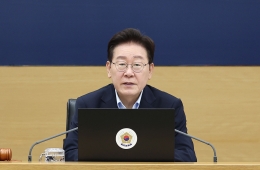
President Lee Jae-myung is speaking at the cabinet meeting held at the Government Complex Sejong on August 11, 2026. Photo by Yonhap News
View original imagePresident Lee directly addressed the controversy over "discord between ministries" that has recently arisen around government operations during the cabinet meeting held at the Government Complex Sejong that day.
He further stressed that such differences of opinion being made public should be seen as part of "transparent administration" and "open administration." President Lee said, "If government ministries present only the finalized, coordinated opinions to the outside after ironing out all internal differences, and then persistently push them through, that is the closed-door decision-making criticized in the past."
He continued, "If we pursue open and transparent administration, we can express opinions freely from the early stages of discussion, and the public can also join in voicing their opinions and debating. Through this process of adjustment, a certain conclusion is eventually reached, and that process is the most democratic." He further explained, "The transparent and open decision-making process itself is what should be shown to the public."
President Lee also suggested that differences of opinion between ministries are, in fact, a fundamental reason for dividing government organizations in the first place. It is a normal part of the policymaking process for each ministry to voice its opinions based on its own expertise and interests, for these opinions to be gradually coordinated by the Office for Government Policy Coordination, the Prime Minister, or the President, and, finally, for the government to establish its unified position.
President Lee stated, "It is not easy to create a single, unified stance on every issue in a country with over 50 million people," adding, "The process consists of people being able to express their views freely, modifying and incorporating those views through reasonable debate and discussion, and then bringing all positions together into one."
He also emphasized that the same reasoning lies behind the public disclosure of cabinet meetings. President Lee asserted, "If all we intended to do was present a predetermined conclusion to the public, we could simply have the spokesperson make the announcement. If the intent is only to announce decisions, doing so in writing would be cleaner, but we spend hours in debate in order to spot possible disagreements or issues as they arise during the process and to incorporate different opinions and make revisions."
He went on to argue that intense debate within government on issues where the interests of labor and business are in conflict can actually reduce social conflict. President Lee pointed out that it is natural for the Ministry of Employment and Labor and the Ministry of Trade, Industry and Energy to have different policy orientations, saying, "Of course there will be debate. I am instructing them to debate." He continued, "If ministers debate among themselves, the public does not have to fight. If ministers do not argue, then divided business owners and workers will end up clashing on the ground."

Deputy Prime Minister and Minister of Economy and Finance Koo Yoonchul is reporting on the emergency national operations and response status regarding the Middle East war at the Cabinet meeting presided over by President Lee Jae-myung, held at the Government Complex Sejong on August 11, 2026. Photo by Yonhap News
View original imagePresident Lee also rebutted the view that modifying policy proposals through public feedback undermines "policy consistency." As an example, he cited the recent controversy over tax reform proposals, stressing the need to distinguish between the government's initial proposals and its final policies. President Lee explained, "When a proposal is presented, it is to gather opinions. The government presents the outcome of its internal debate so that the public can voice their views, and if any counterarguments prove valid, it is proper to accept them."
He further stated, "It is right to incorporate valid suggestions when other opinions are raised. A policy, by definition, is subject to interpretation and different views. If there is no room for disagreement, it is not a policy but a truth. Policy and truth are different."
At that, Deputy Prime Minister and Minister of Economy and Finance Koo Yoonchul also clarified that the tax reform proposal is not yet the government’s final plan. He stated, "During the legislative notice period, we listen carefully to public opinion, revise and supplement the proposal, submit it to the National Assembly, and even within the National Assembly discussions and revisions take place to enhance its completeness."
Hot Picks Today
 "There’s Good Reason for Samsung’s 600,000 Won Target Price... Stock Surges on Expectations of At Least Tenfold Increase in Shareholder Returns"
- "When Should We Buy?" Prices Surge from 1.94 Million to 2.9 Million Won... Chinese Parents Sigh Before New School Year
- President Lee: "Financial Institutions Should Actively Resolve Unpayable Debts"... Basic Pension to Be More Targeted Toward the Most Needy
- "Isn't Coffee After Lunch a Must-Have Ritual?"... Korea's Coffee Craze Fuels Rapid Market Growth
- "I Am Like a Japanese"... Actor Ha Young's Great-Grandfather's Pro-Japanese Activities Unearthed
President Lee then asked Minister Koo to be even more humble in gathering public feedback during the tax reform process. President Lee said, "Changing taxes inevitably invites criticism. Those who benefit from changes usually stay silent, while those who bear greater burdens feel extremely antagonistic," adding, "You should be humble to the utmost degree." Minister Koo responded, "Understood."
© The Asia Business Daily. All rights reserved. Unauthorized AI training and use prohibited.