President Lee: "Financial Institutions Should Actively Resolve Unpayable Debts"... Basic Pension to Be More Targeted Toward the Most Needy
President Lee Presides Over Cabinet Meeting
"Unconditional Sale of Overdue Debts Should Not Cause Hardship"
Urges Financial Institutions to Actively Restructure Debts
Orders Basic Pension Reform to Prioritize Those Most in Need
Calls for Strengthened Early Identification of Isolated and Caregiving Households
President Lee Jae-myung identified economic hardship and excessive debt as one of the main causes of suicide on August 11, stating, "Unpayable debt should be settled by the system so that people can make a fresh start." He urged improvements to the system so that financial institutions and other lenders actively restructure and resolve overdue debts that are difficult to collect, rather than unconditionally selling and pursuing them over extended periods.

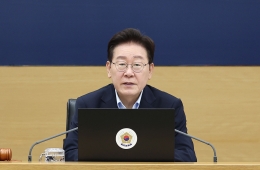
President Lee Jae-myung is speaking at the Cabinet meeting held at the Government Complex Sejong on August 11, 2026. Photo by Yonhap News
View original imageAt the Cabinet meeting presided over at the Government Complex Sejong that day, President Lee received a report on comprehensive government suicide prevention measures from Minister of Health and Welfare Jeong Eun-gyeong. He remarked, "While there can be a wide range of causes for suicide, many cases in the final stages involve depression or other mental illnesses," but added, "Ultimately, the reason is that life becomes painful, lonely, and difficult."
President Lee placed particular emphasis on the issue of economic crises and debt. He said, "In cases of family suicides, for example, people often cite struggles with debt and problems with making a living," continuing, "We must remain constantly vigilant about unresolvable debt." He further stressed, "Just as developed countries do, settling unpayable debts systematically so that people can make a new start should be persistently implemented in the field," and pointed out, "There are still many who suffer under a burden of debt that cannot be repaid."
He also emphasized that financial institutions, which lend money without adequately considering borrowers' abilities to repay, bear part of the responsibility. President Lee remarked, "While it is fundamentally the debtor's fault if they are unable to repay a loan, it is widely acknowledged nowadays that creditors who lend excessively without considering this also share responsibility," noting, "Professional lenders in particular should account for the potential of loan defaults in their upfront costs."
President Lee also called for the Credit Counseling and Recovery Service and financial institutions to proactively settle debts. He mentioned that even applying for credit recovery, bankruptcy, or discharge can incur significant costs, and said, "Ultimately, the Credit Counseling and Recovery Service, financial institutions, or lending agencies themselves should handle the restructuring and liquidation." He continued, "I hope efforts will be made to avoid causing unnecessary hardship by unconditionally selling and collecting bad debts."
At the meeting, Minister Jeong reported that psychological autopsies indicate that approximately 54% of suicide victims had debt at the time of death, and 78% belonged to low-income households with monthly family incomes below 2 million won. The Minister also noted a declining trend in suicide deaths this year. Based on provisional statistics through May, the number of suicide deaths decreased by 733 (12.3%) compared to the same period last year, with about 5,200 deaths through May. Last year, there were approximately 13,900 suicide deaths.
Despite the declining trend, President Lee stated, "The level is still too high," and confirmed that Korea's suicide rate is nearly three times the OECD average. He remarked, "This has happened because we have not paid enough attention, so please monitor this issue more closely."
He also directed that the basic pension system be revised from the standpoint of suicide prevention and anti-poverty measures. Currently, the basic pension is paid to the lowest 70% income group among the elderly, meaning that those with relatively higher incomes also receive significant sums, while there is still room to expand support for seniors with higher levels of poverty.
Hot Picks Today
 "There’s Good Reason for Samsung’s 600,000 Won Target Price... Stock Surges on Expectations of At Least Tenfold Increase in Shareholder Returns"
- "Regardless of Income, 500,000 Won Per Person, 2 Million for a Family of Four"... This Place Begins Livelihood Support Payments
- "Working in Heatwaves Is Already Tough"...More Heat Exposure Leads to Faster Aging
- "Even a One-Time Payment of 77 Million Won Isn’t Enough"—Russia's Forced Conscription Now Targets Workplaces and Streets
- "Cooler Than Air Conditioning?"...Sudden Midnight Stench and Burst: The Story Behind China's 'Natural Cooling Item'
President Lee noted, "The real value of the same payment of about 500,000 won varies greatly," and suggested, "Let’s adjust future increases and current payments to be more targeted towards those with lower incomes." He also pointed out, "There are cases where qualified people are excluded due to unreasonable criteria, while in other cases, people are paid even though there may be no real need," requesting, "Please establish detailed and clear criteria, even if it is complicated."
© The Asia Business Daily. All rights reserved. Unauthorized AI training and use prohibited.