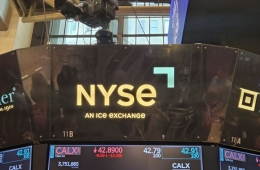
[New York Stock Exchange] All Major Indexes End Lower as U.S.-Iran Talks Stall
Intel Falls on Large-Scale Share Issuance Plan
Caution Prevails Ahead of CPI Announcement
On August 10 (local time), all three major indices on the New York Stock Exchange closed lower as the United States and Iran failed to find common ground on conditions for the reopening of the Strait of Hormuz, triggering a rise in international oil prices. Investor sentiment was also weighed down by caution ahead of the U.S. Consumer Price Index (CPI) announcement scheduled for this week.
At the New York Stock Exchange (NYSE), the Dow Jones Industrial Average ended at 53,975.98, down 60.95 points (0.11%) from the previous trading day. The S&P 500 index, which is focused on blue-chip stocks, fell 4.53 points (0.06%) to 7,753.11, and the Nasdaq index, focused on technology stocks, dropped 85.25 points (0.32%) to close at 26,605.35.

Investor sentiment weakened as talks between the U.S. and Iran on reopening the Strait of Hormuz reached an impasse. On August 8, Iran presented the U.S. with additional demands beyond the contents of the ceasefire memorandum of understanding (MOU) signed in June as preconditions for reopening the Strait of Hormuz.
Iran's demands included the lifting of the U.S. maritime blockade against Iran, a permanent cessation of military attacks, and withdrawal of U.S. troops. Iran also called for compensation for war damages, lifting of sanctions against Iran, and unconditional release of Iran's frozen assets.
In response, U.S. President Donald Trump demanded that Iran pay compensation for its past acts of terrorism and for the killing of protesters within the country.
International oil prices also ended higher. On the New York Mercantile Exchange, West Texas Intermediate (WTI) crude for September delivery rose 5.1% from the previous session to $82.13 per barrel. On the ICE Futures Exchange, Brent crude for October delivery jumped 5.0% to $87.72 per barrel.
Zachary Hill, Head of Portfolio Management at Horizon Investments, analyzed, "Everyone is exhausted by the constant back-and-forth," adding, "Tensions in the Middle East are having a somewhat muted impact compared to the past, but they are still influencing today's market activity."
Intel closed at $97.52, down 4.06% from the previous session. The decline was attributed to selling pressure on concerns over share dilution after Intel announced a new share issuance worth $15 billion to fund its investments in artificial intelligence (AI). Microsoft (MS) gained 1.21% on reports that it plans a significant ramp-up in production of its next-generation proprietary AI chip 'Maia 300'. SK hynix ADR closed the day at 135.29, down 1.90% from the previous session.
Market attention is now focused on the CPI to be released this week. Chris Larkin of E*Trade at Morgan Stanley projected, "While the recent employment report may have somewhat eased concerns about a potential Federal Reserve rate hike next month, if this week's inflation number comes in higher than expected, these worries could reach a peak."
As doubts about the Fed's resolve to tackle inflation have emerged following the July Federal Open Market Committee (FOMC) meeting, comments from Fed officials continue to flow in. Beth Hammack, President of the Federal Reserve Bank of Cleveland, said in an interview with Yahoo Finance that while several rate hikes may be needed to bring inflation down to the target level, she does not wish to predict when the final interest rate hike will occur.
Hot Picks Today
 "Regardless of Income, 500,000 Won Per Person, 2 Million for a Family of Four"... This Place Begins Livelihood Support Payments
- Samsung and SK Move Ahead, but Even with a Decade of Data, SMEs Lack Talent to Use It [AI for Everyone, Divergent AX] ①
- "Mistaking Rescuers for Spirits... Elderly in China Endure 35 Hours Stranded in the Mountains"
- "Teams Must Consist of 40, Hourly Wage Set at 8,200 Won"...Why North Korean Women Are Heading to Russia
- "Cooler Than Air Conditioning?"...Sudden Midnight Stench and Burst: The Story Behind China's 'Natural Cooling Item'
Meanwhile, according to Investing.com, the yield on the 10-year U.S. Treasury note was 4.705%, up 4.7 basis points (1bp=0.01 percentage point) from the previous session. The yield on the two-year Treasury note rose 3.7 basis points to 4.241%.
© The Asia Business Daily. All rights reserved. Unauthorized AI training and use prohibited.