Blue House: Mega Project Investments of 246 Trillion Won in Chungcheong, 107 Trillion Won in Yeongnam to Start This Year
2nd Joint Public-Private Mega Project Inspection Meeting
62% of Chungcheong Investments and 34% of Yeongnam's to Be Deployed This Year
Gwangju Military Airport Relocation and Dispersal to Be Completed by 2028
On August 10, the Blue House announced that, as part of the nation's three major mega projects, investments worth 246 trillion won in the Chungcheong region and 107 trillion won in the Yeongnam region will begin this year.
Kang Hoon-sik, Chief Secretary to the President, stated this during a briefing at the Blue House Press Hall following the "2nd Joint Public-Private Inspection Meeting on the Mega Project," explaining, "We reviewed the large-scale investment plans for the Chungcheong and Yeongnam regions and discussed government support measures to ensure timely implementation." In the case of Chungcheong, about 62% of the total investment of 392 trillion won announced at last month's public briefing will be executed within this year. For Yeongnam, about 34% of the planned 312 trillion won investment will be executed within the year. Additionally, research and development (R&D) projects worth 57 trillion won are set to begin in 2026.

Kang Hoon-sik, Chief Secretary, is briefing the results of the 2nd Joint Public-Private Inspection Meeting on the Mega Project held on the 10th at the Blue House Press Hall. August 10, 2026 Yonhap News Agency
Photo by Yonhap News Agency
For the Honam region, since the Gwangju Military Airport site has been selected as the location for a semiconductor cluster, the relocation of military facilities and their temporary dispersal will be completed by the second half of 2028. Kang explained, "Since the first meeting, the government has designated 2.5 million pyeong of the Gwangju Military Airport site as a candidate location for a national industrial complex," adding, "For the slated ammunition depot site, land preparation has begun early, so that companies can break ground as soon as possible if they wish." He further emphasized, "Once corporate demand is confirmed, we will promptly push forward with designating additional candidate sites in the vicinity."
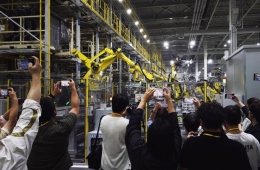
At the meeting, President Lee was briefed on strategies for fostering the early market for physical artificial intelligence (AI) and called for bolder policies. Minister of Trade, Industry, and Energy Kim Jeonggwan reported plans to purchase 700 humanoid robots for research and data factory use, and 1,000 quadruped robots by 2030. In response, President Lee pointed out that this is insufficient for creating a physical AI market and instructed that "based on a demand survey, significantly expand the scale of government purchases," according to Kang.
Kang also stressed, "We will actively pursue mutually beneficial cooperation measures that address K-shaped polarization and ensure the benefits of mega project investments spread throughout the entire industrial ecosystem." In the semiconductor sector, a "Grow Together Project" will be promoted in which large, medium, and small enterprises will collaborate on technology development, demonstration, and mass production, with an investment of 1 trillion won over the next ten years. Additionally, 5 trillion won in mutually supportive trade financing will be made available to ease funding difficulties for export-oriented material, parts, and equipment companies. A new semiconductor fund worth 5 trillion won will also be created to concentrate investments in promising materials, parts, and equipment companies and fabless firms within the semiconductor field.
Regarding infrastructure such as electricity and water supply, Kang stated that "supply will be provided in a timely manner." He added, "For the Honam region, the first-phase power supply line will be swiftly established to supply electricity beginning at the end of 2028, and additional generation capacity will be developed based on local renewable energy, energy storage systems, cogeneration, and liquefied natural gas (LNG) power to ensure a stable supply." For water, up to 650,000 tons per day required by 2030 will be secured by utilizing reclaimed wastewater, Dongbok Dam, Juam Dam, and Naju Dam.
Hot Picks Today
!["Don't Use Chinese-Made Products": One U.S. Warning Triggers a 5 Trillion Won Jackpot for Korean Batteries [Weekend Money]](https://cwcontent.asiae.co.kr/asiaresize/93/2025121709393659037_1765931975.jpg) "Don't Use Chinese-Made Products": One U.S. Warning Triggers a 5 Trillion Won Jackpot for Korean Batteries [Weekend Money]
"Don't Use Chinese-Made Products": One U.S. Warning Triggers a 5 Trillion Won Jackpot for Korean Batteries [Weekend Money]
- "Dividend Payouts of 40 Million Won Before Their First Birthday"...'Baby Shareholders' Put Ordinary Workers at a Disadvantage
- The Identity of a Metal Chunk Kept at Home for 10 Years... AI Says "It's a Bomb"
- "Even With Airfare and Hotel Costs, It's Cheaper": South Koreans Traveling to Japan for Mounjaro
- 'How Bad Was the Mistreatment'... Boss Tearfully Asks for Understanding and Generosity
Furthermore, the Yongin Semiconductor Cluster plans to supply a final power demand of 14.7GW by 2041 by utilizing cogeneration LNG, along with generation capacity from the central region, the east coast, and the Honam region, within the industrial complex.
© The Asia Business Daily. All rights reserved. Unauthorized AI training and use prohibited.