"Dozens of Public Hearings... Data Centers Must Be Good Neighbors" Interview with MS Finland Director of Governmental Affairs [AIDC Era Coexistence] ⑤
Ⅱ. Finland's Eco-Friendly Data Centers Become Urban Partners
Forest Conservation Campaign Launched to Address Environmental Concerns
Construction Alone to Generate 2.1 Trillion Won in Economic Activity and Create 12,650 Jobs

Heidi Neustadt, MS Finland Director of Governmental Affairs, is being interviewed by The Asia Business Daily. Photo by Hee-Jong Kang
View original image"The keywords for data centers should be being a good neighbor as a member of the local community. Data centers must also contribute to society."
On July 9 (local time), at Microsoft's office in Espoo, Finland, Heidi Nystedt, Director of Governmental Affairs, answered this way when asked what is emphasized in order for data centers to coexist with the local community.
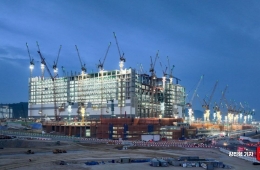
Currently, Microsoft is constructing data centers in three Finnish locations: Espoo, Kirkkonummi, and Vihti. All three data centers are scheduled for completion by 2027. Once construction is finished, Microsoft will operate the largest data center in Finland. In May, the company also secured 190 hectares of land in Vaasa and Mustasaari for additional data center construction.
Regarding the reasoning behind establishing large-scale data centers in Finland, Nystedt cited strong demand in the Nordic region, the advantage of Finland's cool climate for heat dissipation, and outstanding geographic stability.
Another factor Microsoft highlighted was cooperation with the energy industry. The company was able to easily secure environmentally-friendly energy supplies and actively promote projects to utilize waste heat.
To supply the data centers with green electricity, Microsoft signed power purchase agreements (PPAs) for 200 MW of wind energy. The company is also collaborating with local energy company Fortum to utilize waste heat from the data centers for district heating projects.
The city of Espoo actively supported Microsoft's data center development. Nystedt explained, "There were no major procedural difficulties, such as with site permitting." However, even in Finland there was some opposition and concern from residents, particularly with regard to environmental impact. Local opposition was especially strong about the potential harm to the natural environment.
Nystedt stated, "We have held dozens of open public hearings to communicate with residents and also provided financial support for addressing environmental damage." For the Kirkkonummi data center construction, Microsoft had to clear approximately 90 hectares of forest. To compensate, Microsoft is running a campaign with the Finnish Natural Heritage Foundation to protect 300 hectares of forest.
In addition, local residents have received cybersecurity training, and Microsoft established an educational program called the “Data Center Academia” to foster AI-related talent. Including environmental restoration and forest protection initiatives, Microsoft has invested 1.12 million euros in the local community.
Above all, Microsoft has high expectations for its project to use data center waste heat for district heating. Utilizing the waste heat from Microsoft’s data centers would provide heating for 250,000 people across Espoo and Kirkkonummi. The company expects this will reduce carbon dioxide emissions by 400,000 tons per year.
!["Dozens of Public Hearings... Data Centers Must Be Good Neighbors" Interview with MS Finland Director of Governmental Affairs [AIDC Era Coexistence] ⑤](http://www.asiae.co.kr/news/img_view.htm?img=2026081914340885207_1787117649.jpg)
Nystedt said, "The waste heat utilization project at the data center has helped improve perceptions among not only the local community but also politicians. While it is currently used exclusively for district heating, we plan to broaden its use to include greenhouses and other applications in the future."
According to Microsoft's "Economic Impact of Data Centers in Finland" report published in July, the company expects to generate 143 million euros (approximately 233.4 billion won) in economic activity and create 725 direct and indirect jobs from data center operations in 2028 alone. Additionally, data center construction is projected to deliver an economic impact of 1.29 billion euros (about 2.1 trillion won) and create 12,650 construction-related jobs between 2026 and 2028.
Income earned by those involved in data center operations and construction is expected to reach 41 million euros (around 6.7 billion won) and 685 million euros (approximately 1.1179 trillion won), respectively.
The report stated, "For every new operational data center job created, an additional 4.3 jobs will be created locally by 2028 as a ripple effect. Moreover, as data center operations expand, the scale of job creation is expected to grow even further."
Hot Picks Today
 "I Went for the Cheap Coffee, but Now I Feel Uneasy"... Major Coffee Franchises Cited for Violations One After Another
- In Korea, Studying Medicine Is in High Demand, but in China, It's Shunned: "Why Become a Doctor When You Can’t Make Money?"
- "How Did It Get Here?"... Ramen Noodle Packet Discovered 2,000 Meters Deep in the Abyss
- "50 Million Won for Weekly Encounters"... Man in His 60s Sentenced for Deceiving Woman in Her 20s with Forged 1.4 Billion Won Account
- "Surprisingly Real, Perfect Like AI" -- Global Media Praise Korean Fencer's Beauty
This series is supported by the Media Promotion Fund, created through government advertising fees.
© The Asia Business Daily. All rights reserved. Unauthorized AI training and use prohibited.