How to Reduce Stock Market Volatility: Advice from Foreign Experts
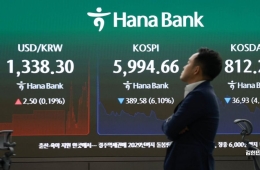
Recently, with increased volatility in the domestic stock market, experts have advised that an institutional framework is needed to support market stability. They analyze that modernizing the infrastructure can attract more investment.

On the morning of the 0th, participants are taking a commemorative photo at the seminar on 'Advancement of the Capital Market of Korea and Enhancement of Global Competitiveness' held at the National Assembly in Yeouido, Seoul. Photo by Seungwook Park
View original imageOn the morning of the 10th, Assemblyman Kim Namseok of the Democratic Party of Korea spoke at the seminar titled 'Advancement of South Korea's Capital Market and Enhancement of Global Competitiveness' held at the National Assembly in Yeouido, Seoul. He stated, "Seventy percent of household assets in Korea are concentrated in real estate, so the proportion of financial assets is evaluated to be lower compared to major developed countries." He added, "As the Korean stock market has grown to rank sixth in the world by market capitalization, measures to stabilize volatility are needed so that investors can invest with confidence."
Lynn Martin, President of the New York Stock Exchange (NYSE), emphasized the need for investor protection mechanisms. She explained, "A key characteristic of markets that maintain investor trust is the quality of the institutional framework and protection mechanisms that support the marketplace." She continued, "Despite increased volatility amid geopolitical uncertainty, the NYSE has maintained stability."
President Martin noted, "The ability to handle high volatility transactions and high trading volumes is extremely important, and technology alone is not sufficient for this." She described the U.S. Designated Market Maker (DMM) system: "At the NYSE, listed securities are matched with DMMs, and as a result of combining technological infrastructure with human discretion, the volatility of NYSE-listed companies has decreased." She added, "At the core of everything an exchange does is the protection of, and trust between, investors and issuers."
She also stressed the importance of information sharing and regulatory cooperation between South Korea and the United States. President Martin said, "The information-sharing system that exists in the existing American Depositary Receipt (ADR) process helps maintain the stability of distribution markets in both countries." She added, "Cooperation through information sharing is crucial, especially when we consider what we are seeing in the market and what types of products we allow."
Hot Picks Today
 "Expensive, Smelly and Scary"... What's Happened to the "Honeymooners' Paradise" Tourists Have Abandoned?
- Women Who Say "A Husband's Annual Salary of 100 Million Won Is a Given"... Matchmaking CEO: "They Talk About It Like It's Nothing"
- "I Want to Eat Like Koreans..." Foreigners Who Once Opened Ramen Packs Now Keep Gochujang in Their Pantries
- "'Unprecedented pain finally sent her home from work': Working mom finds seaweed soup made by her fourth-grade son"
- "They Said Today Was the Cheapest..." "Let's Get Wedding Jewelry!" Why Did the Luxury Brand Crowds Flocked To Cut Prices by 1.08 Million Won?
President Martin also pointed out that innovation in technology infrastructure is important. "From a capital raising perspective, South Korea has achieved digital innovation such as converting the won-dollar foreign exchange market to a 24-hour trading system on July 6," she noted. "This is similar to the NYSE's plan to implement 23-hour, five-day-a-week trading starting this December, as both represent a step toward modernizing infrastructure."
© The Asia Business Daily. All rights reserved. Unauthorized AI training and use prohibited.