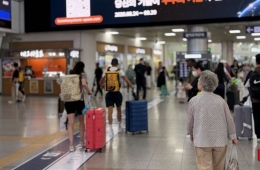
Jeju Air Expands Korea-China Routes... Most Passengers in Their 20s and 30s
Passenger Numbers Up 37.4% Year-on-Year
Driven by Increased Demand for Travel to China
As Jeju Air increased its capacity on routes between Korea and China, the number of passengers also rose accordingly.

On August 10, Jeju Air announced that it supplied a total of approximately 494,300 seats on Korea–China routes from January to July this year, up 26.8% compared to approximately 389,900 seats during the same period last year.
During the same period, the number of passengers reached about 427,300, which is a 37.4% increase compared to 311,000 last year. The seat occupancy rate also rose 6.6 percentage points from last year’s 79.8% to 86.4%.
Notably, the growth rate in passenger numbers (37.4%) exceeded the increase in seat capacity (26.8%) by 10.6 percentage points. This is attributed to a rise in travel demand due to both countries’ visa-free policies, as well as an increase in travelers favoring short-haul trips.
The largest passenger demographic was the 20s–30s age group, accounting for around 158,500 people (37.1%). Routes with high usage among Millennials & Gen Z included Busan–Shanghai (Pudong), Jeju–Beijing (Daxing), and Incheon–Qingdao. These routes all recorded high seat occupancy rates from January to July 2026: Busan–Shanghai (Pudong) at 89.0%, Jeju–Beijing (Daxing) at 89.7%, and Incheon–Qingdao at 93.5%. Compared to the previous year, these figures increased by 2.1 percentage points, 13.7 percentage points, and 10.8 percentage points, respectively.
The travel pattern, which was previously centered on group tourism, has recently shifted towards individual and small group travel. As a result, there is an increase in independent travelers seeking to enjoy local cuisine, sightseeing, and night views in each city. In addition to routes departing from Incheon, the airline has also successfully captured travel demand among routes departing from regional locations such as Busan and Jeju, substantially strengthening competitiveness on China-bound routes.
As of August 2026, Jeju Air operates 11 routes to China: Incheon–Qingdao/Weihai/Yanji/Harbin/Jiamusi/Shijiazhuang; Busan–Shanghai (Pudong)/Shijiazhuang/Zhangjiajie; and Jeju–Beijing (Capital)/Beijing (Daxing). The company is considering expanding and operating additional routes, including Busan–Guilin/Shanghai, Daegu–Shanghai, and Jeju–Chengdu/Chongqing, which were allocated by the Ministry of Land, Infrastructure and Transport in April.
Hot Picks Today
 "Surviving on One Meal a Day to Invest 3.5 Million Won Monthly... 'FIRE' Craze Sparks 'NISA Poverty' in Japan"
- "Used for the Wedding" 300,000-Won Ring and Dress...Changing Wedding Trends
- "As Soon as Yong Hyein Was Nominated... After a 195% Surge, This Stock Suddenly Plunged"
- "Correction Over for Samsung and SK hynix" "670,000 for Samsung, 4.7 Million for SK hynix": Why Global IBs Remain Optimistic
- Causing Trouble Without a Simple "Sorry"... The Reason Behind the 'Gen Z Stare' Revealed
A Jeju Air representative stated, "We will further strengthen our competitiveness on China routes by operating flexibly to reflect travel demand not only from Incheon but also from regional departures."
© The Asia Business Daily. All rights reserved. Unauthorized AI training and use prohibited.