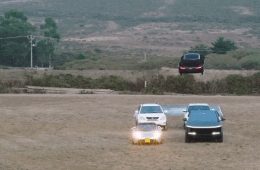
Hyundai Motor Group to Resolve Residential 'Parking Crisis' with Robots
Hyundai Motor, Hyundai Wia, and Hyundai Engineering & Construction Form Consortium
Pilot Project for Residential Parking Robots Begins with Support from the Ministry of Land, Infrastructure and Transport
Hyundai Wia Parking Robots to Be Deployed
Hyundai Motor Group is taking steps to solve parking lot congestion caused by insufficient space through the use of parking robots.

On August 10, Hyundai Motor Group announced that a consortium consisting of Hyundai Motor Company, HYUNDAI WIA, and Hyundai Engineering & Construction will carry out a pilot project for parking robots in multi-family residential complexes at ‘Hillstate The Wave City’ located in Siheung, Gyeonggi Province.
This pilot project has been approved by the Ministry of Land, Infrastructure and Transport as a smart demonstration project through the Smart City Regulatory Sandbox, and is supported by national funds. Through this demonstration, Hyundai Motor Group aims to verify solutions that address the shortage of parking spaces, congestion, and safety issues in multi-family residences using robot-based smart parking technology.
Recently, due to the increase in vehicle ownership and the concentration of parking demand at certain times, underground parking lots are experiencing a lack of space and congestion.
In particular, the process of drivers manually searching for available parking spaces leads to wasted time and unnecessary idling of vehicles, while the mixed movement of vehicles and pedestrians creates a risk of safety accidents.
This demonstration project was prepared to resolve these issues using robotics technology and to validate a smart parking operation model suitable for multi-family residential complexes and similar settings.
Hyundai Motor Group will conduct the demonstration using two sets of HYUNDAI WIA parking robots in a designated area with a total of 53 parking spaces on the first basement level of Hillstate The Wave City’s parking lot.
The HYUNDAI WIA parking robot operates by having a pair of thin (110mm thick), broad robots move under a vehicle, lift its wheels, and transport the vehicle to a designated spot.
The parking robot uses an equipped LiDAR sensor to accurately recognize the size and position of the car’s wheels, allowing it to lift the vehicle. It is designed to automatically park SUVs weighing up to 3.4 tons at a maximum speed of 1.2 meters per second.
Notably, the robot can move freely in all horizontal directions, enabling it to transport vehicles even in narrow spaces where parking is difficult. This increases efficient use of space, allowing more vehicles to be parked in the same area.
After drivers disembark at the designated pick-up/drop-off zone within Hillstate, they can request their vehicle using a kiosk or the multi-family complex wallpad system. The parking robot will then enter beneath the vehicle, detect and lift the tires, and automatically transport the vehicle to an available parking space.
Hyundai Motor Group expects that this approach will significantly reduce the time spent searching for available parking and increase parking capacity by at least 20 percent and up to 50 percent within the same area.
Furthermore, separating the movement paths of vehicles and pedestrians will reduce the risk of accidents in the parking lot, while minimizing unnecessary vehicle movement will help achieve environmental benefits such as reduced carbon emissions and fine dust.
During the demonstration, Hyundai Motor Group will measure factors such as the time required for each vehicle to enter and exit, actual user waiting times, parking success rate, robot operation rate, the number of operations completed monthly, and improvements in parking space efficiency.
Based on the demonstration data, Hyundai Motor Group plans to develop detailed proposals for the improvement of laws and systems related to parking robots, and build virtual environment models to apply various types of parking space layouts for residential, commercial, office, transportation hub, public, and cultural buildings.
Through this approach, the company will calculate the optimal number of parking spaces and robots by building type and parking space category, taking into account average waiting times, throughput, and operation rates. Hyundai Motor Group also intends to identify effects on traffic flow and spatial utilization, improvements in user experience and safety, and economic benefits from a smart city perspective.
Hot Picks Today
 "The Transfer Failed, but 'Ding Dong' Money Came In"... 32.5 Billion Won Financial Incident at Toss Bank
- "They Wouldn't Give It a Second Look When Offered to Ancestors"... MZ Goes Wild for 80-Year-Old Ceremonial Liquor as a Household Must-Have
- [Good Morning Stock Market] U.S. Stocks End Mixed as "AI Concerns Persist"; South Korean Stocks Likely to Pare Losses After Opening Lower
- Kim Taewon, Blue House Senior Secretary for Youth and Future Affairs, Reports 16.1 Billion Won in Assets, Including Google Shares
- "Baek Jongwon Had Been Quiet, Then Hit It Big"... Waits in the 100s in U.S. Despite KRW 46,000 Pork Belly
An official from Hyundai Motor Group stated, “This multi-family residential parking robot demonstration is an important step, not just for technological verification, but for establishing a new parking paradigm in the smart city era. We plan to comprehensively verify the operational stability, efficiency, and user convenience of parking robots in real-life residential environments, and derive a standard model that can be expanded to various urban spaces both in Korea and overseas.”
© The Asia Business Daily. All rights reserved. Unauthorized AI training and use prohibited.