Jokook Jo Criticizes Minister for Praising China's 996 Work System: "Is He Proposing to Introduce a Harmful Practice?"
"Anti-human rights and anachronistic," strong criticism
"'996 work system is now illegal even in China'"
Minister of Trade, Industry and Energy Kim Jeonggwan faced backlash from political circles after citing China’s “996 working system” as an example to argue for exceptions to the 52-hour workweek in certain industries. Guk Cho, Director of the Innovation Policy Research Institute at the Guk Innovation Party, fiercely criticized the minister, calling it a “dehumanizing and anachronistic idea.”
On August 9, in a post on his Facebook page, Director Cho stated, “Minister Kim claims that working hours in the semiconductor, research and development (R&D), and startup sectors need to be increased, using the 996 system employed by Chinese IT companies as a model.” The term “996 working system” refers to the convention of working from 9 a.m. to 9 p.m., six days a week—a term commonly used to describe excessive overtime prevalent in Chinese tech startups.

Guk Cho, Director of the Innovation Policy Research Institute at the Guk Innovation Party. Yonhap News Agency
View original imageDirector Cho pointed out, “The 996 working system that Minister Kim praised is illegal even in China. In 2021, China’s Supreme People’s Court and Ministry of Human Resources and Social Security defined the 996 system as illegal labor practice. Is Minister Kim unaware of the 2021 decision by China’s judiciary and administrative authorities? Or is he knowingly advocating for an abusive practice that was confirmed to be an illegal violation of labor rights even in China?”
He further argued, “The real driving force behind China’s scientific and technological advancement is the massive support funneled into science and engineering and the overwhelming compensation for researchers. Believing that long working hours directly lead to technological innovation and productivity improvements is an outdated notion reminiscent of the development dictatorship era under Park Chung-hee.”
The criticism was extended to the ruling party. Director Cho said, “In the past, when the Yoon Suk-yeol administration attempted to introduce exceptions to the 52-hour workweek for R&D workers, it was the then-opposition Democratic Party that strongly opposed and blocked it. Now Minister Kim is advocating for the adoption of the 996 system. What is the Democratic Party’s stance now? As the responsible governing party, it must clearly answer whether Minister Kim’s argument is aligned with the Democratic Party’s centrist and pragmatic path.”
Hot Picks Today
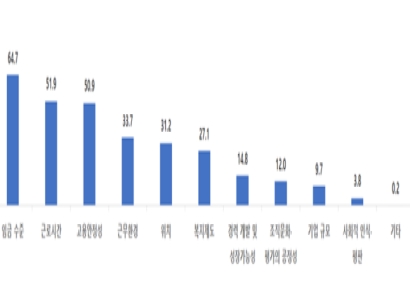 "Please Pay Me at Least 3 Million Won a Month": More Than Half of Young People Today Prioritize "Working Conditions" Over Company Size
- Selling Like Crazy Every Year... 30-Year-Old Hetbahn Takes on a New Challenge: Tastes Better Than "Mom's Home Cooking" [On-Site Report]
- "Americans Would Be Amazed If They Came": Wide-Eyed at a Sight They've Never Seen Before... Foreigners Also Fall for K-Baseball [K-Holic]
- "Hey, Lady, Teach Your Kids to Behave!" ... 300,000 Won in Cash and a Bodily Injury Claim Demanded Over Child's Door Ding
- Beachgoer Finds 'Plastic' That Turns Out to Be Perfume Ingredient Worth More Than Twice as Much as Gold
Meanwhile, on August 6 at the Korea Press Center in Jung-gu, Seoul, Minister Kim attended the Kwanhun Forum and said, “We need to revisit labor regulations for the entire spectrum of advanced industries—including R&D and startups. In order to secure international competitiveness, it is necessary to introduce exceptions to the 52-hour workweek.” He also mentioned, “I was surprised to hear that when an IT company in Chongqing, China attempted to implement the 996 work system, employees pushed back, saying ‘How can we compete working like that?’ and the company changed to a system where employees worked until midnight instead.”
© The Asia Business Daily. All rights reserved. Unauthorized AI training and use prohibited.