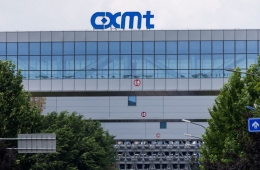
Apple Tests Chinese CXMT Chips, Considers Adoption Amid U.S. Regulatory Pressure
Chinese Chips Under Consideration Amid AI-Driven Memory Shortage
U.S. Regulations and Political Backlash Remain Key Variables
Apple has reportedly begun trialing memory chips from Changxin Memory Technologies (CXMT), China's largest DRAM manufacturer, in its iPhones, MacBooks, and other devices as a response to the global memory semiconductor supply shortage fueled by the artificial intelligence (AI) boom. With the U.S. government ramping up regulations on Chinese semiconductor companies, Apple’s push to introduce Chinese-made memory into its products is expected to become a new flashpoint in the ongoing U.S.-China technology conflict.

On August 9 (local time), the Wall Street Journal (WSJ) reported, citing people familiar with the matter, that Apple is testing CXMT’s memory chips across several product lines, including iPhones and MacBooks. Apple has also held preliminary talks to source CXMT chips for select products sold in China.
In its dealings with CXMT, Apple reportedly wants to secure the White House’s approval to avoid political backlash. Previously, Apple requested permission from the Trump Administration to use memory chips from Chinese firms such as CXMT and Yangtze Memory Technologies (YMTC) in products sold outside the U.S.
However, U.S. export control regulations are restricting Apple’s ability to utilize CXMT. U.S. companies are not permitted to transfer technology or disclose product specifications to CXMT. As Apple typically uses customized memory chips to optimize product performance, it is difficult for the company to request custom designs from CXMT.
Kevin Wolf, a partner at Akin Gump and an expert on export controls, explained that under current regulations, Apple may purchase and negotiate prices for CXMT’s off-the-shelf memory products. However, according to the WSJ, applying such generic chips could require Apple to modify certain aspects of its existing product designs.
The main driver behind Apple’s consideration of Chinese-made memory is the worsening global supply shortage triggered by a surge in AI investments. Major suppliers such as Samsung Electronics, SK hynix, and Micron are ramping up production of high-value memory for AI data centers, resulting in shortages of general-purpose memory chips used in smartphones and PCs.
U.S. Political Circles Oppose Apple’s Request, Seek to Rein In Chinese Semiconductor Industry
U.S. political circles remain opposed to Apple’s adoption of Chinese memory chips. The U.S. Department of Defense has designated CXMT as a company linked to the Chinese military and added it to the Chinese Military-Industrial Complex Companies list under Section 1260H of the National Defense Authorization Act. The Department of Defense also states that CXMT is directly connected to China’s Ministry of Industry and Information Technology (MIIT).
Being included on the 1260H list does not result in an immediate ban on civilian transactions between U.S. companies and CXMT. However, it can restrict contracts or research funding from the Department of Defense, and is viewed as a warning that future investment and trade restrictions could be strengthened.
Some U.S. policymakers are concerned that if major global tech players like Apple place large orders with CXMT, Chinese companies could use American technology know-how and funds to enhance their competitiveness. In particular, with U.S. memory manufacturer Micron currently building new plants in Idaho and New York, there are worries that the growth of Chinese companies could exert further pressure on the American semiconductor industry.
By contrast, global PC companies have already expanded the use of CXMT chips. HP and Acer have started incorporating CXMT memory in some products sold outside the U.S., and are reportedly seeking to secure additional supply for next year.
Hot Picks Today
 "The Transfer Failed, but 'Ding Dong' Money Came In"... 32.5 Billion Won Financial Incident at Toss Bank
- "They Wouldn't Give It a Second Look When Offered to Ancestors"... MZ Goes Wild for 80-Year-Old Ceremonial Liquor as a Household Must-Have
- [Breaking] Shinsegae Chairman Chung Yongjin Returns as E-Mart CEO
- "Even If He's Handsome, That's a Bit Much"... The "Behavior" That Turns Off 7 in 10 Women
- 'Hangover Legend' Returns After 11 Years... Lee Sunmin Hyung's 'Captain Q' Sells Out
Nonetheless, CXMT is unlikely to resolve Apple’s memory shortage in the near future. The company is currently operating at virtually full production capacity this year, leaving limited supply for new international clients. Additionally, industry assessments indicate that CXMT’s technology lags behind leading companies like Samsung Electronics, SK hynix, and Micron. CXMT plans to more than double its production capacity by 2028.
© The Asia Business Daily. All rights reserved. Unauthorized AI training and use prohibited.