"Is the KOSPI's Nightmare Rollercoaster Over? Has the Market Finally Bottomed Out?...Foreign Media Highlights the 'Turning Signal'"
VKOSPI Drops to Mid-70s After Peaking
Investors Remain Cautious Amid Lingering Extreme Volatility
Foreign media reports have suggested that the period of extreme market volatility that shook the Korean stock market may be nearing its end.

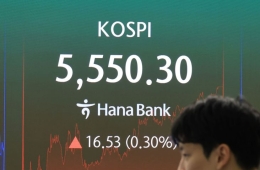
The KOSPI started higher on the 7th, and the KOSPI was displayed on the status board in the dealing room of Hana Bank in Jung-gu, Seoul. Photo by Yonhap News Agency
View original imageOn August 9, Bloomberg reported that with the liquidation of leveraged positions and strengthened regulatory measures by financial authorities, market instability is now entering a phase of moderation.
According to Bloomberg, on June 29, the KOSPI 200 Volatility Index (VKOSPI) surged to 97.99 during intraday trading, marking its highest level since the global financial crisis of 2008.
The outlet explained that this unprecedented surge in volatility was due to a sharp decrease in margin loan balances caused by forced selling, as well as tighter regulations on leveraged exchange-traded funds (ETFs) enforced by the authorities. As a result, trading volume and asset size of products linked to semiconductor giants Samsung Electronics and SK hynix decreased significantly, which in turn helped reduce volatility.
While the VKOSPI had remained above the 90 level until the end of last month, it plummeted to the mid-70s in August. Bloomberg analyzed that this indicates a partial resolution of the leverage-driven overheating that had fueled extreme stock price volatility.
Bloomberg also noted that the KOSPI's 12-month forward price-to-earnings ratio (PER) has dropped to 5.1 times, approaching a record low, and pointed out, "After the recent sell-off, some indicators suggest that Korean equities are undervalued." However, the agency added, "Market volatility remains high, so global asset managers are not rushing back into the Korean market." Furthermore, "Even after the decline in volatility, elevated levels persist, leading investors to weigh historically low valuations and robust earnings outlooks against the risk of further dramatic swings."
In this context, Yiping Liao, a fund manager at Templeton Global Investments, pointed out, "It's clear that Samsung Electronics and SK hynix are currently attractively priced with solid earnings prospects, but the intense volatility observed so far is making investors cautious in the short term."
The single-stock leverage trading value declined from 12.4485 trillion won on the day before the regulations, to 3.1518 trillion won on July 31, the day the regulations took effect. By August 7, it had dropped further to 845.2 billion won.
After the launch of 16 single-stock leveraged products (including 2 inverse types) on May 27, trading volumes on the KOSDAQ, which had plummeted, rebounded to 5.4357 trillion won on July 31 as regulations intensified, and further increased to 6.3927 trillion won by August 5. The securities industry interprets this as evidence that, with the stricter regulations on single-stock leveraged products, some funds have shifted back into KOSDAQ leverage products.
Hot Picks Today
 "The Transfer Failed, but 'Ding-Dong,' Money Came In"... KRW 32.5 Billion Financial Incident at Toss Bank
- Shark 'Bukkangi' Missing... Oil Spill off Busan North Port Raises Concerns
- "Made 12 Billion Won Cleaning Up Other People's Dog Poop With Just a Rake"... 'Poop Scoop Millionaire' Is All the Rage in the U.S.
- "We Don't Trust the Police": French Shopkeepers Prepare to Defend Themselves Ahead of Weekend Protests
- Woman Who Bought Economy Ticket Causes Uproar, Demands "Put Me in Business Class," Delays Flight
Woo-Yeol Park, a research analyst at Shinhan Investment & Securities, commented, "As the 16 types of single-stock leveraged products absorbed liquidity from the KOSDAQ, trading volume fell and underperformance deepened. Now, with a decline in single-stock leverage trading, we can expect the KOSDAQ to potentially reverse its oversold position."
© The Asia Business Daily. All rights reserved. Unauthorized AI training and use prohibited.