"Surprised by the First Action in 44 Years" Was Visiting Hungary a Mistake?... Tourists Sigh as They Give Up 'Night View Photos'
Nuclear Power Plant Shuts Down for the First Time in 44 Years, Nightscapes Disappear
Danube River Drought Shakes Europe
Nighttime Lighting Turned Off at Parliament and Buda Castle
Danube Water Level Falls... Reactor Halted Amid Coolan
Major tourist attractions that once illuminated the nights of Budapest, Hungary have started turning off their lights en masse. An unprecedented heat wave and drought have caused the water level of the Danube River to drop sharply, resulting in concerns over electricity supply. In response, the Hungarian government has launched a massive energy-saving campaign.
On August 7 (local time), international media reported that the Hungarian government has turned off nighttime lighting at key landmarks in the capital, Budapest—such as the Parliament Building, Buda Castle, and the Széchenyi Bridge. As a result, buildings and bridges that normally shone along the Danube River at night are now darkened.
Authorities have stated that they will continue to keep exterior lights off at major facilities as long as the power grid remains under strain. Tourists visiting Budapest have reportedly expressed disappointment at the changed nighttime scenery.

The background to these power-saving measures is the heat wave and drought that have swept across Europe. In particular, the significant drop in the water level of the Danube River has directly impacted the operation of Hungary's Paks Nuclear Power Plant, which is responsible for supplying a substantial portion of the country's electricity.
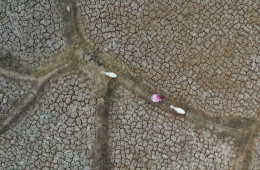
The Paks Nuclear Power Plant is operated by drawing cooling water from the Danube to cool its reactors. However, with the river’s water level recently dropping to as low as 23 centimeters, securing enough cooling water has become difficult. This is even lower than the previous record low of 33 centimeters in 2018.
As a result, the Paks Nuclear Power Plant first reduced output and then entered a complete shutdown. This is the facility’s first full suspension in 44 years, since its first reactor began commercial operation in 1982. As the Paks plant is a core power facility accounting for a significant share of Hungary’s electricity production, the shutdown has further strained the country’s electricity supply.
Trains Halted, Lights Off... Hungary's All-Out Energy-Saving Efforts

On the 3rd (local time), the water level of the Danube River in the Rasova region of Romania dropped, revealing sandy beaches. Photo by Yonhap News Agency
View original imageThe Hungarian government has begun importing electricity to address the shortage and has asked both businesses and households to reduce their power consumption. It halted the operation of freight trains during commute hours, lowered the speed of certain passenger trains, and reduced decorative lighting in public buildings. There have also been requests to refrain from using air conditioning and charging electric vehicles during the evening.
These measures have shown some effect. The Hungarian government announced that daily electricity demand decreased by approximately 700 megawatts. This amount is equivalent to the output of more than one unit at the Paks plant. Additionally, the expansion of solar power in recent years has helped to supplement the electricity supply.
Neighboring Romania is also facing difficulties at its nuclear power plants due to a drop in the Danube’s water levels. The Cernavodă Nuclear Power Plant has encountered problems securing cooling water, raising the possibility of a reactor shutdown. Authorities responded with emergency measures, including blasting the riverbed rocks near the plant to create a channel for water to flow in.
Hot Picks Today
 "Once Worth 4 Million Won a Day, Now Going for Chicken Money"... Chinese Robots' Humiliating Fall to 'Bargain-Bin' Prices in Just One Year
- "Who Says It's a Meal for Ordinary People? It Deserves 'Special Dish' Status Now"... The Era of 12,000-Won Bibimbap
- "I will open fire at a childcare center"... Australian man in his 20s arrested over AI chatbot conversation
- Daughter in Her 30s Ate Tteokbokki Alone... 34-kg Father Dies of Malnutrition
- "I Won't Take It Even If You Leave It to Me"... 9 Million Parents' Homes Sit Empty as 320,000 Japanese Renounce Inheritances
The decline in the Danube’s water volume is not only causing power supply issues. It has also led to logistical disruptions, as seen on Western Europe’s Rhine River, where a drop in water levels has forced many cargo ships to drastically reduce their cargo loads.
© The Asia Business Daily. All rights reserved. Unauthorized AI training and use prohibited.