"All-In" Housing Supply Stalls... Less Than 30% of This Year's Housing Starts Achieved
Redevelopment of Aging Public Rental Housing and Government Offices
Only 1,370 Units Started in the Seoul Metropolitan Area in the First Half
Just 28% of the 4,893-Unit Annual Target Achieved
The government's redevelopment of aging public rental housing, mixed-use office complex development, and small-scale housing renewal projects, which had been promoted as one pillar of housing supply in the Seoul metropolitan area, have all shown sluggish progress. The policy package announced last September 7, which highlighted the redevelopment of old public buildings and urban housing supply, has resulted in this year's actual housing starts falling short of even 30% of the initial targets, including these highlighted initiatives.
These projects, implemented across various urban districts where the scale is limited and existing infrastructure can be utilized, are known as so-called "total mobilization" housing supply initiatives. On August 7, the government, under the chairmanship of President Lee Jae-myung, will hold a policy review meeting to discuss housing supply strategies. However, experts point out there is an urgent need to prioritize and expedite execution for already-approved projects.

Only 28% of Housing Starts Target Achieved in the First Half
According to data submitted by the Ministry of Land, Infrastructure and Transport to Assemblyman Lee Jongwook of the People Power Party, just 1,370 housing units broke ground in the first half of this year through the rebuilding of aging public rental housing and offices, as well as small-scale renewal projects in the greater Seoul area. The ministry originally set a goal of starting construction on 4,893 housing units in the capital region in 2026, meaning only about 28% of this target was met in the first half of the year.
By region, Seoul planned to start construction on 3,022 units, including non-apartment dwellings, but only 568 units were actually started. Some projects, such as Seongdong Hanshin (January, 105 units) and Gwanak Culture Plaza (June, 276 units), broke ground in the first half, but the majority are concentrated toward the end of the year. Among publicly owned rental apartments, the Hwagye 5 Complex in Nowon-gu, which is being piloted as the first high-density reconstruction project, is scheduled to break ground in October. Other locations, including Jungnang Start-up Support Center, Geumcheon Siheung, and Seoul Mokdong 2, are set for December.
In Gyeonggi Province, construction has commenced on some small-scale projects, such as Uiwang Useong 4-cha and Gwangmyeong Jangmi Complex; however, more than half of the supply volume will not break ground until the end of 2026. In Incheon, there is only one project scheduled this year, which started construction in March. Examining the scheduled months for housing starts, 38% of the planned supply is targeted for December. Given that delays due to unforeseen variables are common during the process, there is a significant possibility that the annual target may not be reached.
Last year, the government announced in its September 7 housing supply expansion measures that it would use ground-breaking as the key metric for housing supply performance. Previously, licensing or permit numbers were also used, but because many projects with granted permits did not actually start construction, these indicators were deemed inadequate. While licenses were frequently pushed out near the year-end to meet annual targets, this pattern seems to persist even after shifting to ground-breaking as the primary metric.

Villa neighborhood in downtown Seoul as seen from Namsan, Seoul. 2025.06.27 Photo by Dongju Yoon
View original imageSlow Progress Due to Construction Downturn and Stakeholder Coordination
Supplying new housing through small-scale redevelopment projects has long been regarded as a fast-track model because administrative procedures can be reduced and stakeholder coordination is relatively easier compared to large-scale reconstruction and redevelopment. Nevertheless, progress has been slower than expected. This is attributed both to the continuing slump in the housing construction market and the difficulty of coordinating interests with existing residents, landlords, and occupants.
For alleyway housing renewal projects, public implementation agencies such as Korea Land and Housing Corporation (LH) or Seoul Housing and Communities Corporation (SH) participate, partially utilizing budget or public funds. However, project financing (PF) conditions have not improved due to the contraction in the PF market, making it difficult to secure funds to proceed with actual construction. Soaring construction costs due to higher raw material prices further burden construction sites. Because public agencies tend to conservatively estimate project costs, this diminishes incentives for private construction firms to participate.
Moreover, since new supply is effectively limited to apartments, additional time is needed for planning to address building codes and strengthen nearby infrastructure. In the case of the Hwagye 5 Complex, which is the first public rental reconstruction project, it is reported that coordinating opinions regarding relocation methods for current residents and conditions for re-entry has not been easy.
The Special Act on Comprehensive Redevelopment of Aging Public Offices, which would integrate permitting procedures and grant strong project authority to the Minister of Land, Infrastructure and Transport, has not yet passed its final reading in the National Assembly. The special bill envisions providing housing for youth and newlyweds in the additional facilities built during the replacement of aging public office buildings on state- or publicly-owned land. However, nearly a year has passed since the outline was announced in October last year and final approval has yet to be secured.

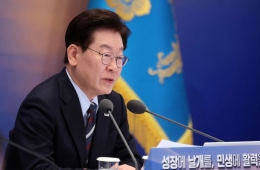
President Lee Jae-myung is speaking at the National Real Estate Policy Forum held on the 23rd of last month at the KBS annex in Yeouido, Seoul. Photo by Yonhap News
View original imageA representative from a private construction industry association, speaking on condition of anonymity, said, "While the government stresses the importance of housing supply on the surface, it is clamping down on financing for both builders and prospective homeowners, making it difficult for these supply measures to be effective." He continued, "Rather than always searching for new measures or sites, it is necessary to resolve existing bottlenecks and improve execution capabilities in parallel."
The sluggish progress on housing supply is not limited to small-scale public sector renewal projects. The Ministry of Land, Infrastructure and Transport planned 269,000 new units in the greater Seoul area this year, including 68,000 in Seoul, as part of the September 7, 2025 package. In addition to increasing and expediting public land supply, including the Phase 3 New Towns, the ministry committed to redeveloping old and underutilized sites, and improving conditions in the private housing market, in order to overcome the housing supply crunch of the past 3-4 years. As of mid-year, just 13,121 units in Seoul and 65,204 units in the broader metropolitan area have started construction, amounting to only 19% and 24% of the respective annual targets.
Hot Picks Today
 "Please Pay Me at Least 3 Million Won a Month": More Than Half of Young People Today Prioritize "Working Conditions" Over Company Size
- Selling Like Crazy Every Year... 30-Year-Old Hetbahn Takes on a New Challenge: Tastes Better Than "Mom's Home Cooking" [On-Site Report]
- "Americans Would Be Amazed If They Came": Wide-Eyed at a Sight They've Never Seen Before... Foreigners Also Fall for K-Baseball [K-Holic]
- "Hey, Lady, Teach Your Kids to Behave!" ... 300,000 Won in Cash and a Bodily Injury Claim Demanded Over Child's Door Ding
- Beachgoer Finds 'Plastic' That Turns Out to Be Perfume Ingredient Worth More Than Twice as Much as Gold
President Lee Jae-myung is directly chairing the real estate policy meeting today to observe and address the bottlenecks in the housing supply project pipeline. With the first anniversary of the September 7 policy package approaching and housing supply conditions still unimproved, the president is expected to identify problem areas and, if necessary, facilitate more active mediation among the Ministry of Land, Infrastructure and Transport, other ministries, municipal governments, and even the National Assembly.
© The Asia Business Daily. All rights reserved. Unauthorized AI training and use prohibited.