WSJ: "Dollar Supply for Yen Defense Runs Counter to Fed Tightening"
Use of the Fed’s Emergency Liquidity Facility
There have been concerns that the administration of U.S. President Donald Trump could increase domestic liquidity and weaken the effects of monetary tightening by using the Federal Reserve’s dollar lending facility for foreign central banks to help defend the value of the Japanese yen.

The Wall Street Journal (WSJ) reported on August 6 (local time) regarding the joint intervention by U.S. and Japanese authorities to buy yen, stating, "The joint intervention itself is unusual, but the method of funding is unprecedented," and evaluated, "It is resulting in the injection of additional liquidity into an already overheated U.S. economy and financial markets."
From July 31, the United States and Japan jointly intervened in the foreign exchange market by selling dollars and buying yen. To secure the dollars needed for the intervention, Japan utilized the Federal Reserve’s "Foreign and International Monetary Authorities (FIMA) Repo Facility."
The FIMA repo allows foreign central banks to pledge their holdings of U.S. Treasuries to the Federal Reserve as collateral in exchange for dollars. This means Japan can obtain the necessary dollar funds for yen purchases without directly selling its U.S. Treasuries on the market.
Dollar Supply via FIMA Repo...Concerns Over Eased U.S. Monetary Conditions
WSJ explained that this method is not entirely the same as quantitative easing (QE) since it differs from the Federal Reserve’s direct purchase of U.S. Treasuries. However, it is similar in that it expands the Fed’s balance sheet and supplies liquidity amounting to billions of dollars to the financial markets.
U.S. Treasury Secretary Scott Bessent expressed the view that the current FIMA repo cap of $60 billion should be abolished or expanded. He also said, "We will take whatever steps are necessary" to support Japan’s defense of the yen.
Secretary Bessent’s support for the use of the FIMA repo appears to stem from concerns that if Japan were to sell its holdings of U.S. Treasuries in the traditional manner, prices of U.S. Treasuries would fall, and yields would rise.
Nathan Sheets, Citi’s Global Chief Economist, commented, "U.S. authorities seem to be concerned about the potential impact on the U.S. Treasury market if Japan intervenes using the traditional approach," analyzing that "Secretary Bessent is seeking to manage potential tail risks in the U.S. Treasury market."
However, WSJ pointed out that the method of lending dollars to Japan eases U.S. monetary conditions, which is problematic. In a situation where the Fed is signaling the possibility of additional rate hikes, expanding its balance sheet runs counter to the direction of monetary tightening.
WSJ criticized, "At a time when it is believed that the Fed is moving to raise rates, this is exactly the opposite of what the Fed should be doing," and added, "Expanding the balance sheet also contradicts the reduction policy repeatedly stated by Federal Reserve Chair Kevin Warsh."
Chair Warsh has repeatedly emphasized in confirmation hearings and other settings that the Fed’s balance sheet grew excessively during past crisis responses and that a resumption of quantitative tightening (QT) is needed.
Need for Yen Intervention Acknowledged...Concerns Over the Method

However, some have acknowledged a certain necessity for the yen defense intervention itself. The real value of the yen fell to its lowest level against trading partner currencies since 1970 as of June.
In particular, although the Bank of Japan has raised its benchmark interest rate five times over the past two years and the Fed has cut rates six times, the yen has continued to weaken, and speculative short positions on the yen have increased sharply.
WSJ pointed out that if speculative positions were to be unwound en masse, the global financial market could experience a sudden shock. In 2024, the combination of the Bank of Japan’s hawkish policy stance and weak U.S. jobs data led to the rapid closure of yen carry trades, and the Japanese stock market plunged 12% in a single day.
Economist Sheets assessed that intervention to prevent a "nonlinear adjustment" leading to a rapid yen appreciation and market turmoil was reasonable.
Hot Picks Today
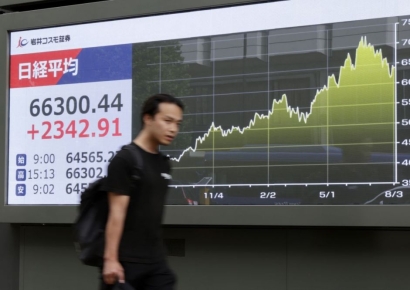 "Ruined Because of Korea" Even with a Sharp Rally, No One Buys... Japanese Market Sways with KOSPI
- '1,670,000 Won to 1,170,000 Won': SK hynix Hits Lower Limit Shock, Pre-market Opening Price Controversy
- Seoul’s 39-Degree ‘Extreme Heat’ Is Just the Beginning... Experts Warn: “It Will Persist Until 2050”
- "Don't Be Sad, Mom Was Very Happy"... Son Battling Illness for Life Saves Four Before Passing Away
- "Don't Worry, That's Just How It Is"... Thai Tourists in Korea Touched by Elderly Man Who Paid for Their Meal
WSJ noted, "There is some justification for intervening now," but added, "The method raises questions as to whether the U.S. Treasury is concerned about hidden risks in the Treasury market and whether the Federal Reserve is being drawn toward easing at a time when it should be tightening."
© The Asia Business Daily. All rights reserved. Unauthorized AI training and use prohibited.