'1,670,000 Won to 1,170,000 Won': SK hynix Hits Lower Limit Shock, Pre-market Opening Price Controversy
SK hynix Hits Lower Limit Again at Pre-Market Open on August 6
Only 11 Shares Trigger Opening Price Turmoil; Controversy Over Price Determination Method

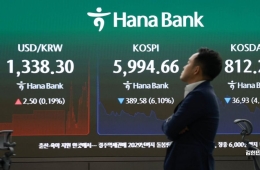
On the 6th, when the KOSPI started off lower, the KOSPI and KOSDAQ indices were displayed in the dealing room of Hana Bank in Jung-gu, Seoul. Photo by Yonhap News
View original imageOn the NextTrade (NXT) pre-market, an alternative trading system (ATS), unusual fluctuations in opening prices due to extremely low trading volumes have repeatedly occurred, signaling cracks in market confidence. Notably, on August 6, SK hynix once again plunged to its lower limit with just 11 shares traded. This has highlighted the structural weaknesses of pre-market trading ahead of regular sessions. As such price distortions have previously escalated beyond simple volatility—triggering forced liquidations in overseas derivatives markets—concerns are mounting over the potential for market disruption.
Opening Price Set at -29.98% with Only 11 Shares Traded
At 8:00 a.m. on August 6, immediately after the NextTrade pre-market (open from 8:00–8:50 a.m.) began, just 11 shares of SK hynix were traded at 1,168,000 won—a sharp 29.97% drop from the previous trading day’s closing price of 1,668,000 won. The opening price was thus set at the lower limit, with merely 11 shares sharply pulling down the stock price in an instant.
Immediately after, the dynamic volatility interruption (VI) system was triggered, switching trading to a single-price auction for two minutes. When trading resumed, the price promptly rebounded, narrowing the decline to the high 3–4% range.

On the 6th, immediately after the opening of NextTrade (NXT) pre-market of the Alternative Exchange, SK hynix dropped to the lower limit price with only 11 shares traded. NH Investment & Securities
View original imageThe root cause of such price distortion incidents is the difference in price-setting mechanisms between the regular market and the pre-market. In the Korea Exchange (KRX) regular session, all orders are collected until 9:00 a.m. The opening price is then determined by a single-price auction, where the price at which the most buy and sell orders match is selected.
In contrast, the NextTrade pre-market uses a “continuous trading” method, where transactions occur as soon as bid and ask prices match. At the start of the session, with thin order books, it is structurally possible for a single share order to send the price to either the upper or lower limit. In fact, the day prior, on the 5th, both Samsung Electro-Mechanics and Alteogen hit their upper price limits at the open with only one share traded, revealing persistent systemic uncertainty.
Last Month: Forced Liquidations of 80 Billion Won
The problem is that in pre-markets with very shallow liquidity, errors (fat finger trades) or abnormal prices can trigger a “butterfly effect,” impacting not only the domestic spot market but also global derivatives markets. On July 28, SK hynix experienced a similar situation: right after the pre-market opened, a single share was traded at the lower limit of 1,272,000 won.
This sharp 29.99% plunge from the previous day was immediately reflected in the SK hynix perpetual futures (TradFi) oracle (the underlying price feed) of the digital asset derivatives exchange Trade.xyz. As a result, the futures price collapsed by 17.9%, leading to the forced liquidation of long positions worth USD 57.4 million (about 81.5 billion won) in an instant.

Although Trade.xyz announced that it would fully compensate the losses at that time, it made it clear that this was a one-time measure. As a result, voices across the domestic securities and derivatives industry have raised suspicions that certain entities may be deliberately manipulating the fragile opening prices of the pre-market, aiming for liquidation profits in overseas derivatives markets. In regular sessions, with much thicker order books, fat finger errors have only limited impact on market prices. In contrast, distortion targeting thin pre-market quotes before the regular session poses a serious risk to the entire capital market.
NXT Moves to Improve System, to Introduce 'Static VI'
As such abnormal trades continued to unsettle the market, NextTrade, the alternative trading system, has moved to resolve the situation by introducing new rules. Starting September 14, NextTrade will implement a 'static volatility interruption (VI)' mechanism in the pre-market.
The newly introduced static VI will automatically switch trading to a two-minute single-price auction if an order deviates 10% or more from the previous day’s closing or reference price, instead of executing the order immediately. During these two minutes, buy and sell orders are collected to calculate a new equilibrium price, after which trading resumes. This aims to physically prevent illusory moves to the upper or lower limit price caused by the trade of just a few shares at the open.
Hot Picks Today
 "Expensive, Smelly and Scary"... What's Happened to the "Honeymooners' Paradise" Tourists Have Abandoned?
- Women Who Say "A Husband's Annual Salary of 100 Million Won Is a Given"... Matchmaking CEO: "They Talk About It Like It's Nothing"
- "I Want to Eat Like Koreans..." Foreigners Who Once Opened Ramen Packs Now Keep Gochujang in Their Pantries
- 9-Month-Old Who Swallowed Lithium Battery During Holiday... Emergency 230-km Transfer from "North Jeolla to Busan"
- "They Said Today Was the Cheapest..." "Let's Get Wedding Jewelry!" Why Did the Luxury Brand Crowds Flocked To Cut Prices by 1.08 Million Won?
However, many in the market argue that this measure alone is insufficient. More fundamental solutions are needed, such as improving the methodology for determining derivatives oracles and strengthening liquidity. Experts point out, “Activating alternative exchanges is important, but a continuous trading system without sufficient liquidity is vulnerable to market disruption. Until these improvements are complete, repeated pre-market price distortions remain a possibility, making heightened investor vigilance essential.”
© The Asia Business Daily. All rights reserved. Unauthorized AI training and use prohibited.