‘Surcharge on Major Shareholders’ Rises from 20 Billion to Hundreds of Billions… Why Joo Byung-Ki’s FTC Changed Its Approach [Why&Next]
Basis for Surcharge: Greater of Omitted Affiliates’ Assets or Revenue
Introduction of Surcharge Imposed Directly on Major Shareholder
Reflects Determination for Strict Action Against Conglomerate Wrongdoing
One of the most notable aspects of the Fair Trade Commission’s presidential work report for the second half of the year is the introduction of a so-called “surcharge on major shareholders.” Under this plan, if a conglomerate omits affiliate companies when submitting required information for designation, the individual major shareholder would face a surcharge of up to 10% of either the total assets or the average annual revenue of the omitted affiliates, whichever amount is greater. The Fair Trade Commission plans to push for amendments to the relevant laws in the second half of the year to introduce this system.
Introduction of a 10% Proportional Surcharge... Reflecting a Strong Commitment to Strict Penalties

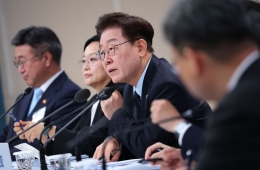
Joo Byungki, Chairman of the Fair Trade Commission, is reporting on major plans for the second half of the year, including the establishment of a new fine system for business owners, at the presidential briefing held at the Blue House State Guesthouse on the 4th. Yonhap News.
View original imageAccording to the Fair Trade Commission on August 10, this presidential work report marks the first official announcement of the plan to introduce a “proportional surcharge” on individual major shareholders. Previously, Chairman Joo Byung-Ki of the Fair Trade Commission stated at a press conference in May that the agency was considering a “fixed amount surcharge” of up to 20 billion won for the false submission of materials for designation. After three months of internal review, the agency developed a system using proportional surcharges and set more detailed criteria for imposing them. An FTC official explained, “If the false submission involves acts where estimating the scale is difficult, a fixed amount surcharge will be imposed. However, for the omission of affiliate companies, a proportional surcharge corresponding to the degree of violation will be imposed directly on the major shareholder. This reflects a more detailed version of the previous plan.”
The designation materials are key information—for instance, corporate affiliates, relatives, executives, and shareholder status—submitted annually by major shareholders and serve as the foundation for the government’s conglomerate policies. However, existing regulations only allow for a prison sentence of up to two years or a fine of up to 15 million won for false submissions or omissions, which has long been criticized as insufficient to ensure effectiveness.
Both inside and outside the Fair Trade Commission, there is consensus that the new measure reflects Chairman Joo’s commitment to taking a tough stance against rule-breaking by conglomerates. A legal industry source noted, “Chairman Joo has repeatedly emphasized the need for tougher penalties on false submissions in academic forums and seminars. The introduction of the proportional surcharge system can be seen as the institutionalization of this awareness.”
In fact, during the three years of the Yoon Suk-yeol administration, only one major shareholder was referred to the prosecution over the false submission of designation materials. However, since Chairman Joo took office, the heads of three corporate groups—HDC Group, DB Group, and Youngone Group—have each been reported to the prosecution. Recently, the rules have been strengthened to require referral to the prosecution in principle if a person has received a warning for submitting false materials within the past three years.
'Greater of Assets or Revenue' as the Basis for Surcharge... Blocking Loopholes for Conglomerates
![‘Surcharge on Major Shareholders’ Rises from 20 Billion to Hundreds of Billions… Why Joo Byung-Ki’s FTC Changed Its Approach [Why&Next]](http://www.asiae.co.kr/news/img_view.htm?img=2026080516374570937_1785915465.png)
It is also noteworthy that the surcharge will be calculated based on whichever is greater—total assets or total revenue. Unlike the existing system, which primarily uses revenue as the standard, this method is meant to prevent conglomerates from deliberately omitting affiliates that have little revenue but hold significant assets such as real estate or shares, in order to evade regulation as a conglomerate. An FTC official explained, “Even if revenue is minimal, omitting a company with billions of won in assets could allow a firm to evade designation as a publicly announced conglomerate group (assets of five trillion won or more) or a mutual investment restricted conglomerate group (assets of ten trillion won or more). Considering the seriousness and potential profit of the violation, it is reasonable to use the greater of total assets or total revenue.”
If applied to cases the FTC has referred this year, the surcharges could reach into the hundreds of billions of won. For example, in the case involving Youngone Group chairman Sung Kihak, who was reported for omitting 82 affiliates to avoid designation as a conglomerate group, the combined assets of those omitted affiliates reached 3.24 trillion won. Applying the 10% rate would result in a surcharge of 324 billion won. Likewise, HDC Group chairman Chung Mong-Kyu failed to report 20 family-owned companies from 2021 to 2024, with their annual combined assets amounting to between 1 trillion and 1.2 trillion won. Under the new criteria, this could lead to a surcharge of up to 120 billion won. However, as both cases involve past incidents, the planned new surcharge system would not be applied retroactively.
Hot Picks Today
 "I Thought Weak Hands Were Just a Sign of Aging"... This Was Found in 85% of Seniors
The business community is closely watching the implications. An executive at a major conglomerate commented, “Imposing direct financial liability on the owner is the most sensitive measure for businesses. It's essentially the highest level of sanction intended to send a strong warning message. Moving forward, companies will have to be far more careful in verifying affiliate lists and submitting designation materials.”
© The Asia Business Daily. All rights reserved. Unauthorized AI training and use prohibited.