"I Thought Stocks Would Rise... But I'm Quitting": Retail Investors Exit as Samsung Electronics and SK hynix Falter
KOSPI Plunges 4% on Semiconductor Peak Concerns
Daily Volatility Doubles Year-on-Year Amid Samsung Electronics, SK hynix, and Leveraged ETF Turmoil
Investor Deposits Drop Sharply as Market Volatility Surges

As concerns over the peak of the semiconductor market persist, the KOSPI has plummeted sharply once again. With market volatility intensifying, more investors are leaving the stock market. The severe fluctuations in the share prices of Samsung Electronics and SK hynix, along with an increase in supply-demand clashes among investors following the launch of single-stock leveraged exchange-traded funds (ETFs), have been cited as reasons for the increased volatility.
Renewed Concerns Over Semiconductor Peak, KOSPI Plunges 4%
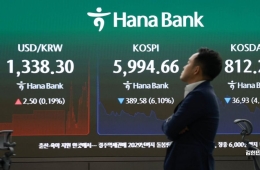
On August 6, the KOSPI opened at 6,478.75, down 1.81% from the previous trading day, and by 10 a.m., the decline had widened, with the index trading at 6,320.11, down 4.22%. At the same time, the KOSDAQ was also trading at 789.25, down 1.29% from the previous session.

Overnight, weakness in U.S. semiconductor stocks negatively impacted the Korean market. The Dow Jones 30 Industrial Average rose 0.49%, but the S&P 500 fell 0.17% and the Nasdaq dropped 0.83%. Major artificial intelligence (AI) related stocks such as AMD (-7.0%) and Alphabet (-4.03%) saw profit-taking sell orders. After the market closed, memory semiconductor company SanDisk plunged more than 7% after its earnings guidance fell short of expectations in after-hours trading.
The Korean stock market is also showing a clear downward trend, especially among large-cap semiconductor stocks. As of 10:02 a.m., Samsung Electronics was trading at 234,000 won, down 4.88% from the previous session, and SK hynix was down 8.99% to 1,520,000 won. SK Square (-10.46%) and Samsung Electro-Mechanics (-10.18%) were also sharply lower. Foreign investors have net sold about 1 trillion won worth of shares on the KOSPI, while individual and institutional investors have net bought 900 billion won and 100 billion won, respectively.

Recently, as the stock market nosedived and volatility grew, more investors have been leaving the market. According to the Korea Financial Investment Association, investors' deposit balances stood at 103 trillion won as of August 3, marking the lowest level since February 13. The investor deposit refers to funds deposited into brokerage accounts by investors to purchase stocks, which have not yet been used for stock purchases—essentially, it is idle capital. The deposits rebounded to 110 trillion won on August 4, but the figure is still 30 trillion won down from the year-to-date high of 140 trillion won recorded on June 4.
Securities industry experts point to the expanded market volatility as a primary cause for the decline in deposits. In July alone, not only did the KOSPI plunge by more than 22%, but volatility among semiconductor-related stocks intensified, prompting many individual investors—who faced difficulties in investing—to pull their money out.
The Capital Market Institute noted that the severe concentration on semiconductors was a major reason for rising volatility in the equity market. According to its recently released report, "Review of the Background of the Rise in Stock Market Volatility," the daily return volatility of the KOSPI in the first half of this year averaged 3.6%, more than double last year's 1.4%. In particular, volatility reached 4.8% in March and 4.7% in June, both surpassing the 4.2% level seen in March 2020, when the COVID-19 pandemic led to a dramatic stock market crash.

Volatility Fueled by Plunge in Top Semiconductor Stocks and Supply-Demand Conflicts from Leveraged ETFs
The report noted that the sharp increase in the market capitalization weight of Samsung Electronics and SK hynix has made the KOSPI even more sensitive to risks unique to the semiconductor industry.
Kim Junseok, Senior Research Fellow at the Capital Market Institute, explained, "The steep rise in the stock index since early 2026 has been driven by the share price gains of these two large-cap stocks. The combined share of the KOSPI market cap for Samsung Electronics and SK hynix (SamjeonNix) rose from 23% in early 2025 to 24% in early 2026, and reached 55% by the end of June." He added, "The problem is that the volatility of these two stocks has increased significantly this year, and as they both belong to the semiconductor sector, their price movements are highly correlated." He went on to state, "The correlation coefficient of their returns is as high as 0.82."
Supply-demand conflicts among investors have also grown following the introduction of single-stock leveraged ETFs. While foreign and institutional investors focused on profit-taking and reducing their portfolio allocations, individual investors have continued to buy, especially through direct stock purchases and equity ETFs, widening the gap in order flows.
The capital that has left the stock market has moved into safer places such as bank deposits. According to financial sector data, as of the end of the previous month, the combined balance of time deposits at the five major banks—KB Kookmin Bank, Shinhan Bank, Hana Bank, Woori Bank, and NH Nonghyup Bank—stood at 984.9399 trillion won, up 35.5401 trillion won from the end of the previous month. This followed increases of 7.5327 trillion won in May and 4.6837 trillion won in June, marking the third straight monthly rise and the largest monthly increase so far this year.
Hot Picks Today
 "Expensive, Smelly and Scary"... What's Happened to the "Honeymooners' Paradise" Tourists Have Abandoned?
- Women Who Say "A Husband's Annual Salary of 100 Million Won Is a Given"... Matchmaking CEO: "They Talk About It Like It's Nothing"
- "I Want to Eat Like Koreans..." Foreigners Who Once Opened Ramen Packs Now Keep Gochujang in Their Pantries
- 9-Month-Old Who Swallowed Lithium Battery During Holiday... Emergency 230-km Transfer from "North Jeolla to Busan"
- "They Said Today Was the Cheapest..." "Let's Get Wedding Jewelry!" Why Did the Luxury Brand Crowds Flocked To Cut Prices by 1.08 Million Won?
An industry insider at a brokerage said, "Until early June, many customers came to local branches to entrust their money, but since the stock market peaked and started to decline, the atmosphere has changed." He added, "Many individuals jumped into the market late and suffered losses, so a large portion of idle capital has withdrawn from the market."
© The Asia Business Daily. All rights reserved. Unauthorized AI training and use prohibited.