“AI Integration Across All Industries Beyond Semiconductors”... Driving Innovation in Steel, Shipbuilding, and Automotive Manufacturing
Emergency Economic Headquarters Meeting Held on the 5th
Announcement of Economic Structural Reform Directions
"Structural Reform Aimed at Rebounding Potential Growth Rate"

The government will introduce artificial intelligence (AI) across South Korea’s key industries, including steel, petrochemicals, shipbuilding, and automobiles, as part of its economic structural reform efforts. Starting in the fourth quarter, sector-specific AI-driven manufacturing process innovation plans will be formulated, while the robot industry will be intensively fostered to lay the groundwork for integrating physical AI into all industries. The aim is to broaden the recent semiconductor-driven growth into "growth for all," thereby boosting the nation’s potential growth rate.
On August 5, the Ministry of Economy and Finance announced these measures during a joint meeting of the Emergency Economic Headquarters and the Economic and Structural Innovation Ministers at the Government Complex Seoul, outlining the "Direction for Advancing Economic Structural Innovation."

The South Korean economy is showing a clear recovery in key indicators such as growth rate, exports, and current account balance, backed by the semiconductor boom. Globally surging memory demand continues to drive price increases for general-purpose DRAM and NAND flash, including high-bandwidth memory (HBM). With the rapid expansion of real services such as AI search services and on-device AI, the demand for general-purpose memory used in SSDs is also soaring, and the semiconductor industry is expected to continue its upward trend. The photo shows the construction site of the first phase fab of the SK hynix semiconductor cluster in Cheoin-gu, Yongin, Gyeonggi Province. Photo by Jinhyung Kang
View original imagePolarization Hidden Behind the Semiconductor Boom... "Urgent Need for Structural Innovation Across All Industries"
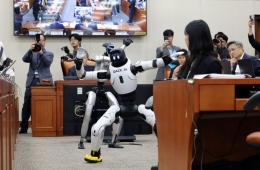
The government has assessed that, while the recent semiconductor industry boom is fueling continued economic growth, disparities in assets, income, labor, generation, and region are widening. Therefore, it believes that, to spread the benefits of semiconductor-led growth throughout the broader economy, structural innovation is urgently needed across core industries beyond semiconductors. To address this, the government will sequentially develop and announce AI-driven manufacturing process innovation and advancement plans for major industries, including steel, petrochemicals, home appliances, shipbuilding, automobiles, and bio, starting in the fourth quarter. By integrating AI technology to upgrade manufacturing infrastructure and accelerating the shift to high value-added and eco-friendly production, the plan aims to fundamentally strengthen industrial competitiveness. Examples include introducing humanoid robots specialized for replacing hazardous welding work in shipbuilding, and developing hydrogen reduction steelmaking technology domestically to drastically reduce carbon emissions.
With the current AI paradigm shifting from traditional computation and inference to physical AI such as robotics, the government will significantly strengthen the foundation for related implementation. There are plans to drive the development of humanoid robots tailored for ten core industries and to create a supply plan to deploy about 1,000 AI robots annually, linked with AI factories and smart factories.
Establishing Social Safety Nets and Supporting Structural Innovation Infrastructure for ‘Growth for All’
The government will also expand social safety nets to spread the effects of economic growth. Initiatives include strengthening safeguards to alleviate the livelihood and financial instability of vulnerable groups, supporting asset-building across the life cycle, and easing management burdens for small business owners. In response to the AI transition, it will revamp the education and vocational training systems and protect vulnerable workers, while ensuring a safe working environment.
Hot Picks Today
 "Expensive, Smelly and Scary"... What's Happened to the "Honeymooners' Paradise" Tourists Have Abandoned?
- Women Who Say "A Husband's Annual Salary of 100 Million Won Is a Given"... Matchmaking CEO: "They Talk About It Like It's Nothing"
- "I Want to Eat Like Koreans..." Foreigners Who Once Opened Ramen Packs Now Keep Gochujang in Their Pantries
- Hong Rahee Gifts Samsung Electronics Shares Worth KRW 2.6 Trillion to Chairman Lee Jaeyong... Stake to Rise 0.17 Percentage Points
- "They Said Today Was the Cheapest..." "Let's Get Wedding Jewelry!" Why Did the Luxury Brand Crowds Flocked To Cut Prices by 1.08 Million Won?
Various support mechanisms will be activated to enhance policy implementation. The government will provide comprehensive policy support encompassing fiscal, tax, and financial measures, and bolster fiscal resilience through bold expenditure restructuring. Additionally, it will actively engage in social dialogue with organizations such as the Economic, Social and Labor Council and the National Assembly’s special committees to mediate conflicts during the structural innovation process.
Monthly Meetings of Structural Innovation Ministers... Rapid Deliberation of Urgent Issues
The government will institutionalize monthly ministers’ meetings on structural innovation to continuously generate solutions for structural issues. The implementation system will be dualized based on the nature of the tasks. Current issues will be announced following inter-ministerial coordination (top-level consultative body) and then discussed with the National Assembly in ongoing consultations. Mid- to long-term tasks will be guided by joint research with relevant institutions, such as the Korea Institute for Industrial Economics & Trade (KIET), and expert discussions, with directional decisions made at the ministers’ meeting. In particular, urgent structural innovation agendas, such as the "Youth Employment Restoration Plan" to improve youth job opportunities and the "Retirement Pension Activation Plan" to ensure multi-layered old-age income protection, will be brought to the meetings promptly to accelerate deliberations.
© The Asia Business Daily. All rights reserved. Unauthorized AI training and use prohibited.