Minimum Wage Returns to Court... What’s Different from Nine Years Ago?
Next Year's Minimum Wage Set at 10,700 Won
Federation Files Lawsuit Seeking to Cancel the Notice
Dismissed Nine Years Ago... Will the Outcome Change This Time?
"Escalating Management Difficulties" at the Center of the Dispute
With small business owners filing an administrative lawsuit demanding the cancellation of next year’s minimum wage announcement, there is growing attention on whether this case could yield a different result than nine years ago. The industry cites the sharp deterioration in small business management conditions, which have worsened to a degree that is incomparable to the past, due to prolonged sluggish domestic demand and persistent high inflation, as the core grounds of the current lawsuit.
According to industry sources on August 6, the Korea Federation of Micro Enterprise submitted a petition to the Seoul Administrative Court in Seocho-gu, Seoul, the previous day, demanding the cancellation of the announcement for the minimum wage to be applied in 2027. The plaintiff group has also requested a constitutional review, thereby launching a full-scale legal challenge to the structure of minimum wage determination. After submitting the complaint, Song Chi-young, president of the federation, told reporters, “It is time to change the minimum wage determination system that no longer reflects the reality facing small business owners.”
This is not the first time that small business organizations have filed a lawsuit to cancel a minimum wage announcement. In 2017, when the minimum wage for 2018 was raised by a record 16.4%, the federation filed its first-ever cancellation lawsuit since the introduction of the system in 1988, but the court dismissed the case the following year.
Industry representatives argue that, in light of the prolonged economic slump and shrinking consumption, the business environment for small business owners has deteriorated far more than nine years ago, and thus the court’s ruling should reflect this change. According to the Bank of Korea, as of the end of last year, the outstanding loans held by self-employed people totaled 1,092.9 trillion won—the highest figure since related statistics began. The delinquency rate among vulnerable borrowers has also tripled in four years, reaching 12.14%.
Hwang Seong-hyun, the attorney representing the Korea Federation of Micro Enterprise, stated, “Various statistics and indicators clearly show that small business management conditions have changed completely over the past nine years,” adding, “Even so, the minimum wage decision structure has remained unchanged. The core issue raised by small business owners in this lawsuit is that the law must reflect both common sense and current realities.”

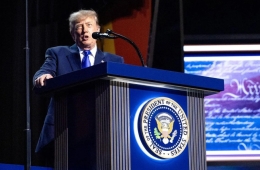
On the 5th, Song Chi-young, Chairman of the Korea Federation of Micro Enterprise, is reading a statement in front of the Seoul Administrative Court in Seocho-gu, Seoul, demanding the announcement of the 2027 minimum wage. The Korea Federation of Micro Enterprise
View original imageAnother point of hope for the industry is the fact that, following the dismissal of the 2017 lawsuit, the Constitutional Court indicated in supplementary opinions the need to strengthen the representation of small business owners within the Minimum Wage Council.
In 2019, the Constitutional Court ruled that the Minimum Wage Act was constitutional in a case brought by the federation, but remarked that “small business owners and the self-employed, given their significance in the Korean economy, are not provided with meaningful participation in the Ministry Wage Council,” and noted the need for greater representation. The Korea Federation of Micro Enterprise continues to cite the lack of substantive improvements to the council’s composition as grounds in its latest suit.
However, most legal experts say the odds of the claim being accepted remain low. It is difficult to legally prove a direct causal relationship between minimum wage increases and the management crisis faced by small businesses, and there is little evidence to suggest any serious legal violations occurred in this year’s wage council process. Some also note that this lawsuit is more symbolic—aimed at raising awareness of small business hardship—rather than being focused on actual prospects for a court win.
Hot Picks Today
 "Please Pay Me at Least 3 Million Won a Month": More Than Half of Young People Today Prioritize "Working Conditions" Over Company Size
- Selling Like Crazy Every Year... 30-Year-Old Hetbahn Takes on a New Challenge: Tastes Better Than "Mom's Home Cooking" [On-Site Report]
- "Americans Would Be Amazed If They Came": Wide-Eyed at a Sight They've Never Seen Before... Foreigners Also Fall for K-Baseball [K-Holic]
- "Hey, Lady, Teach Your Kids to Behave!" ... 300,000 Won in Cash and a Bodily Injury Claim Demanded Over Child's Door Ding
- Beachgoer Finds 'Plastic' That Turns Out to Be Perfume Ingredient Worth More Than Twice as Much as Gold
One legal expert explained, “Proving—on strictly legal grounds—how next year’s minimum wage might worsen the management crisis for small businesses, or specifically how past increases have affected them, is an extremely complex task. It will also be very difficult to demonstrate procedural flaws since the Minimum Wage Council conducted its deliberations and votes over dozens of plenary sessions.”
© The Asia Business Daily. All rights reserved. Unauthorized AI training and use prohibited.