President Lee Casts Doubt on Jeong Dong-young's 'Mutual Name Recognition' Proposal: "Uncertain If It's a Plus for Peace and Stability"
Unification Ministry Reports on Peaceful Coexistence Initiative
"Even If Difficult, Policies of Peace and Coexistence Must Continue"
President Lee Warns, "If Wording Becomes a Pretext for Political Strife, Situation Could Worsen"
"Rec
President Lee Jae-myung expressed caution regarding the Unification Ministry's proposal that North and South Korea should use each other's official names and refrain from confrontational rhetoric. He judged that even if such measures are taken in the spirit of goodwill for improving relations, they could unintentionally worsen inter-Korean ties if politicized domestically as grounds for controversy over pro-North sentiment or security issues. This is interpreted as a directive to thoroughly consider not only the policy direction but also the political and social repercussions of the language used and how the initiative is advanced.

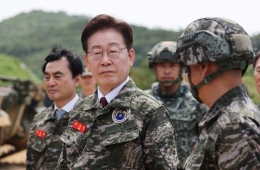
President Lee Jae-myung is speaking at the ministry briefing on the Ministries of Education, National Education Commission, Ministry of Culture, Sports and Tourism, and National Heritage Administration held at the Blue House Guesthouse on August 5, 2026. Photo by Yonhap News Agency
View original imageDuring the foreign affairs and security ministry briefing on August 5, President Lee referenced the Unification Ministry’s notion of "using official names for North and South Korea." He stated, "This is a controversial matter, and while you may be doing it with conviction as a move of goodwill for improving relations, didn’t I recently mention this and receive strong pushback?" He added, "Even if you pursue good values and ideals, if you leave room for political disputes because of phrasing, the result could be a situation worse than originally intended. You really need to give this a lot of thought."
The Unification Ministry identified the “Korean Peninsula Peaceful Coexistence Development Initiative,” which centers on mutual respect for each other's systems and sovereignty, as a key policy for the second half of the year. The plan would start with both Koreas using each other’s official names, reducing the use of confrontational and hateful language such as “main enemy,” and discussing new unification approaches that exclude the former government’s idea of absorption-based unification.
The Unification Ministry also presented a vision to shift inter-Korean relations from "two hostile foreign entities" to "two peaceful states aspiring toward unification." Rather than rushing unification, the intention is first to settle peaceful coexistence, and in the future, allow younger generations to choose the path to unification themselves.
Regarding the North Korean nuclear issue, the ministry suggested a step-by-step approach, proposing to first halt North Korea’s nuclear and missile activities rather than insisting on immediate denuclearization. Minister of Unification Chung Dong-young said, "We are not abandoning the goal of denuclearization, but in the short term, keeping North Korea from further increasing its nuclear capability is to everyone’s benefit," and announced efforts to develop a "peace-first strategy for the initial suspension of North Korea’s nuclear program."
To this end, the ministry plans to help facilitate a North Korea-U.S. summit and secure momentum for a four-party dialogue involving South and North Korea, the United States, and China. The ministry also reported plans to present the coexistence development initiative during the Liberation Day (August 15) address, and to expand discussions on a Korean Peninsula peace framework at the United Nations General Assembly in September and the Asia-Pacific Economic Cooperation (APEC) summit in November.
President Lee supported the basic direction of seeking dialogue and peaceful coexistence. In his opening remarks, he likened the current situation of no response from North Korea to "shouting into an echo-less canyon," but added, "Confrontation may serve internal political management, but in the end, it is harmful to the people and the national community." He urged, "Even if it is difficult, we must continue with policies of peace and coexistence. Please persevere and continue your efforts patiently."
However, he emphasized that it is necessary to soberly assess whether unilateral proactive measures would actually contribute to reducing tensions on the Korean Peninsula. Referring to the September 19 Inter-Korean Military Agreement, which he pledged to gradually restore upon taking office, President Lee pointed out, "Because there has been no improvement in the situation, people are now questioning whether we are unilaterally making concessions or abandoning our security."
He further commented, "Sometimes I even wonder if acting on our good intentions ultimately adds to the peace and stability of the Korean Peninsula," and he called on the Unification Ministry to give the matter serious thought, despite the difficulty involved. He thus implied that while the overall goals of North Korea policy remain unchanged, the pace and level of engagement should be adjusted in consideration of North Korea’s response, domestic public opinion, and security conditions.
The Unification Ministry also presented projects aimed at restoring the foundation for inter-Korean exchange. It plans to expand civilian contacts through international sports, cultural, academic, and religious events, and is preparing to supply medical equipment to hospitals at the military unit level in North Korea. The ministry announced that it received approval for a sanctions exemption from the UN Security Council in May for medical equipment worth about 10 billion won.
Hot Picks Today
 "South Koreans Are All Buying It to Take Home"... This "Drug" Costs 350,000 Won in Korea but Just 80,000 Won in Japan
- "Buy While It's Cheap"... Retail Investors Snap Up KRW 30 Billion in Bank Gold Bars as Prices Fall, Flocking In at a Frenzy
- "I Won't Be Able to See My Own Funeral When I Die"... U.S. Grandmother Holds "Living Funeral" for Her 80th Birthday
- "After Calculating Our Bonuses, It's at Least 3 Billion Won; Feels Like We've Escaped the Working Class"... Samsung Electronics DS Couple's Post
- "Bride Lee Dogyeong, Groom Lee Dogyeong"... Couple Share the Same Name and Date of Birth: "This Must Be Fate"
The ministry will also seek to expand the use of the Inter-Korean Cooperation Fund, which has gone largely unused for the past decade. Plans include amending the enforcement ordinance of the Inter-Korean Cooperation Fund Act to support peace economy special zones, private unification movements, and restoration of the academic research ecosystem on North Korean studies. The current fund allocation is approximately 1 trillion won. On the necessity of revising the enforcement ordinance, President Lee remarked, "There is some validity to this," but added, "I am not yet convinced the ministry’s position is entirely correct," instructing that other ministries should be fully consulted before reporting back.
© The Asia Business Daily. All rights reserved. Unauthorized AI training and use prohibited.