Will Production of the 'Monster Missile' Hyunmoo-5 Increase? [Yang Nakkyu's Defence Club]
Ministry of National Defense Briefing to the President,
Mass Production Announced

The government, which is accelerating the transfer of wartime operational control (OPCON), has reaffirmed its intention to designate this year's United States-Republic of Korea Security Consultative Meeting (SCM) in the fall as a “historic turning point” by deciding on the transfer timeline. The government also plans to partially conduct an assessment related to fulfilling the conditions for the OPCON transfer during this month's regularly scheduled U.S.-ROK combined military exercise, “Ulchi Freedom Shield” (UFS).
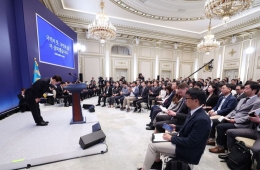
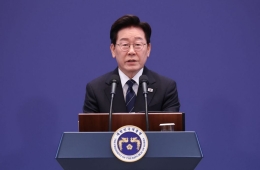
On the morning of August 5, during a policy briefing at the presidential office attended by the diplomatic and security ministries, the Ministry of National Defense reported that it would focus its defense capabilities in the second half of the year to finalize this year’s OPCON transition roadmap. The ministry also stated it aims to verify Full Operational Capability (FOC) for the Future Combined Forces Command and determine the OPCON transition date at this year’s SCM.
The prerequisites for OPCON transfer are as follows: ▲ military capabilities necessary to lead the alliance’s defense, ▲ the alliance's comprehensive ability to respond to North Korea’s nuclear and missile threats, and ▲ a security environment on the Korean Peninsula and in the surrounding region that supports a stable OPCON transition.
Among these, it is interpreted that the government intends to conclude external consultations on securing nuclear submarine fuel, a key component of responding to North Korea’s nuclear and missile threats, by next year. However, U.S.-ROK security consultations have not made significant progress recently. The government has presented plans to enhance and expand independent deterrence capabilities through bolstering core assets such as acquiring high-powered missiles and combat deployment of the Korea-made KF-21 fighter jet, as well as to accelerate the development of cost-efficient and advanced weaponry using high-output lasers. These assets will be integrated within the Korea-style Missile Defense System (KAMD).
In particular, the Hyunmoo-5 is classified as a core asset within the “Korea-style three-axis system” (strike, defense, and retaliation), specifically under the Korea Massive Punishment and Retaliation (KMPR) axis for overwhelming counterstrikes against North Korea’s nuclear and missile threats. The three-axis system combines the Kill Chain, which identifies and strikes enemy missile launch signs in advance, the KAMD, and KMPR. Until now, the military has developed the Hyunmoo-5 as a classified project, using the term "high-powered missile" rather than an official designation. Its development was officially confirmed when Minister of National Defense Kim Kyu-baek stated in a media interview last October, “Hyunmoo-5 is already in the process of entering service, and there are plans for mass production.”
Hot Picks Today
!["How Little Do Koreans Read? Who Will Acquire Munhakdongne Now on the Market [Weekend Money]"](https://cwcontent.asiae.co.kr/asiaresize/93/2026091716280432990_1789630084.jpg) "How Little Do Koreans Read? Who Will Acquire Munhakdongne Now on the Market [Weekend Money]"
"How Little Do Koreans Read? Who Will Acquire Munhakdongne Now on the Market [Weekend Money]"
- "Bank Offers 3.5%, but... Which ETF Hit a 21% Dividend Yield? [Weekend Money]"
- "Why Would You Boast About That?" Blocked From Departure Over Endangered Turtle Hunting Allegation After Social Media Video
- "Please Be Quiet"... China to Fine Up to 210,000 Won for Disruptive Passengers Using Speakerphones
- "Dream Shattered in an Instant": Sudden Clampdown by "This Country" Amid Ongoing Preparations
The military has begun deploying the Hyunmoo-5, a surface-to-surface ballistic missile referred to as the "monster missile," to operational units. Sequential deployment to field units started at the end of last year, and the military intends to complete operational deployment during the Lee Jaemyung administration. The Hyunmoo-5, developed as a "bunker buster" to strike underground nuclear and missile facilities where North Korea’s command is hidden, was publicly displayed at the Armed Forces Day ceremony for the second consecutive year last year, following its first real-life unveiling the year before.
© The Asia Business Daily. All rights reserved. Unauthorized AI training and use prohibited.