Despite World’s No. 2 R&D Investment, Korea Has Yet to Produce a Nobel Prize Winner in Science [Science Scope]
[Interview] Jinho Jung, President of the Korean Academy of Science and Technology
"Just as Important as Funding Is the Research Ecosystem...The Nobel Prize Is a Result, Not a Goal"
According to the results of the '2024 R&D Activity Survey' conducted by the Ministry of Science and ICT and the Korea Institute of S&T Evaluation and Planning (KISTEP), South Korea ranks second in the world in terms of R&D investment as a percentage of GDP in 2024, at 5.13%, following Israel. However, there has yet to be a Nobel Prize laureate in the sciences from Korea.
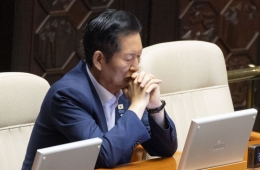
In an interview with The Asia Business Daily on July 30, Jinho Jung, President of the Korea Academy of Science and Technology (pictured), identified the gap not as a matter of R&D funding volume, but as an issue of the research ecosystem. He stated, "If you want a Nobel Prize, you first need to create an environment where Nobel-level research can emerge," adding, "Today's Nobel Prizes are results born from research environments that were accumulated 20 to 30 years ago."

Jinho Jung, President of the Korea Academy of Science and Technology, is giving an interview to The Asia Business Daily at the Academy's headquarters located in Seongnam, Gyeonggi Province on the 30th of last month. Provided by the Korea Academy of Science and Technology
View original imageHow Research Funding Is Used Matters More Than Its Amount
In terms of R&D investment scale alone, Korea already stands at a world-class level. However, scale of investment and Nobel Prize achievements do not necessarily correlate. President Jung's analysis is that more important than the total budget is which researchers are entrusted with the work, how that work is conducted, and for how long.
President Jung cited Japan as a representative example. While Korea has yet to produce a Nobel laureate in the sciences, Japan has had 25 recipients in the natural sciences (29 in total). He explained, "This does not mean that Japan's current research environment is better than ours," emphasizing, "The achievements Japan is seeing today are the accumulated results of its research ecosystem from 30 years ago."
During his inauguration process, he met with more than 350 scholars and heard most frequently that "it is difficult to focus on research because we are busy chasing funding." In a structure where researchers cannot pursue the topics they wish to study for a lifetime and instead must follow government-funded fields, it is difficult to expect world-class discoveries, he explained.
![Despite World’s No. 2 R&D Investment, Korea Has Yet to Produce a Nobel Prize Winner in Science [Science Scope]](http://www.asiae.co.kr/news/img_view.htm?img=2026080513153570532_1785903335.jpg)
President Jung stressed, "What matters more than how much research funding is provided is whether the system allows researchers to immerse themselves in one topic for a long period," adding, "Creating an environment where challenging attempts can be sustained ultimately leads to world-class achievements." He continued, "The 1997 Creative Research Initiative Program and the 1999 National Research Laboratory (NRL) project are representative success stories in which young researchers were assured of long-term funding and autonomy," pointing out, "It's fine to create new projects, but we should first reflect on why it was possible then and why it has become difficult now."
Research That Waits for 20 Years Yields Nobel Prizes
President Jung emphasized that the Nobel Prize should not be approached as a policy goal to be achieved in the short term. Rather than obsessing over short-term results, there needs to be a foundation that allows the fruits of long-term research to mature. He said, "The research environment we create now will determine the state of Korean science in 20 to 30 years," emphasizing, "The Nobel Prize is not a goal, but the result of research accumulated over a long period."
He pointed out the importance of a research environment where it is possible to persistently pursue meaningful questions, even in the early stages when applicability is unclear or the risk of failure is high. Instead of evaluating research by the number of papers or patents in the short term, he argued for guaranteeing long-term support and autonomy so that researchers can develop a single question over many years. President Jung said, "It does not mean we should guarantee research funding to a researcher indefinitely," stressing, "Instead of repeatedly demanding quick results, we need a system that allows researchers to pursue meaningful questions to the end."
Not Just a Few Universities... Nobel Seeds Must Be Planted in Regional Universities Too
President Jung diagnosed that to enhance Korea's research competitiveness, the current structure that concentrates capabilities in a few universities and research institutes must change. World-class achievements are more likely to emerge in an ecosystem where different research traditions and questions coexist, rather than in a system where a few institutions monopolize resources and talent.
He said, "The Nobel Prize is not something produced by a single university. It is the result of different questions and research traditions being accumulated over a long time at various research hubs," adding, "We must build the infrastructure so that world-class research can be conducted in regional areas as well."

Jinho Jung, President of the Korean Academy of Science and Technology, is giving an interview to The Asia Business Daily at the Korean Academy of Science and Technology Hall located in Seongnam, Gyeonggi Province on the 30th of last month. Provided by the Korean Academy of Science and Technology
View original imageIf the research infrastructure at regional universities weakens, the pathway for nurturing talent across the country also narrows. If excellent students and researchers flock only to the capital area, regional laboratories will struggle to secure the next generation, and the research base connected to regional industries will also be weakened.
This does not mean that research funding should be divided equally among universities. Rather, investment should go to researchers with capabilities and potential, regardless of region or affiliation, but it is essential to create an environment in which research teams and infrastructure can be stably maintained in regional areas as well. President Jung emphasized, "Rather than growing a few already leading universities even further, the way to enhance Korea's research competitiveness is to create research hubs with different strengths across the country."
Creating Channels for Excellent Research to Reach the World
President Jung also highlighted the need to establish channels through which outstanding research achievements can be validated and disseminated internationally. The Nobel Prize cannot be won by a single paper or an isolated achievement. It becomes possible only when follow-up research continues and other researchers affirm its significance, accumulating academic influence. Recognition at home alone is not sufficient. International researchers must cite these achievements and use them as starting points for new research, and academic value must be verified through international conferences and joint research. Only when research outcomes enter the shared language and concerns of the global academic community can they be recognized as pioneering new fields.
President Jung assessed that while the competence of Korean researchers is already at a world-class level, efforts to expand international scholarly networks and influence remain lacking.
He stated, "Rather than focusing solely on the Nobel Prize, it is important to steadily receive other internationally renowned academic awards," emphasizing, "The process of having a researcher's name and achievements repeatedly cited and verified in the global scientific community increases the likelihood of eventually winning a Nobel Prize."
The Academy is also consistently nominating Korean researchers for prestigious international academic awards. President Jung said, "We do not disclose the list of nominees or winners," citing "international practice aimed at avoiding excessive competition or conflicts of interest."

Jinho Jung, President of the National Academy of Science and Technology of Korea, is giving an interview to The Asia Business Daily on the 30th of last month at the National Academy of Science and Technology building located in Seongnam, Gyeonggi Province. Provided by the National Academy of Science and Technology of Korea
View original imageHe explained that researchers must take on key roles at international academic conferences and invite overseas researchers to Korea for joint research, while also being the first to present research topics that draw the attention of the global academic community.
He added that fostering internationally prestigious academic awards can also serve as one pillar of such an ecosystem. President Jung said, "Renowned international academic awards can serve as a platform for world-class researchers to visit Korea and form new networks with Korean scholars," continuing, "Rather than setting the Nobel Prize as a target, what matters first is consistently building up research that is recognized by the global academic community," and emphasized, "It is important to create a research ecosystem that naturally attracts international attention."
A Time to Endure Failure, Not Just Quantitative Metrics
President Jung stressed that even the evaluation criteria for science and technology policy must change. Until now, the volume of research funding and the number of papers or patents have been presented as key indicators of achievement, but going forward, new benchmarks must include whether new research fields have been opened, whether young researchers have been nurtured, and whether follow-up research is being sustained.
Even failed research holds meaning if it produces new knowledge and new researchers in the process. Conversely, even if the intended goal is achieved, if it simply repeats existing knowledge or leads to no further research, it is difficult to regard it as a world-class achievement. President Jung is concerned that in a system where only projects with a high probability of success are funded, no one will attempt questions with high risk of failure.
President Jung also urged young researchers to hold on to their own questions until the end. He stated, "In an era where AI can provide answers instantly, deciding what questions to ask is solely a human role," and advised, "Don't abandon your questions just because you failed; remember that you may simply need to change your approach." He emphasized, "When good research continues in an environment where researchers are not afraid of failure and can immerse themselves, Nobel Prizes will follow naturally as a result."
What Korean science lacks is not the absolute amount of research funding. It is the time to endure failure, the stability for researchers to pursue questions without having to change them, diversity that nurtures talent beyond regions and affiliations, and channels that link excellent research to the world.
■ Who is Jinho Jung, President of the Korea Academy of Science and Technology?
He graduated from the Department of Pharmacy at Seoul National University, earned a master’s degree in Life and Pharmaceutical Sciences from the same university, and received a PhD in Toxicology from Johns Hopkins University in the U.S. From 1988 to 2021, he served as a professor at the College of Pharmacy at Seoul National University and is currently Professor Emeritus.
A world-renowned authority in the field of toxicology, he pioneered research in chemical risk assessment and cardiovascular toxicity. In 2008, he was selected as the cover figure for the 20th anniversary special issue of the international journal ‘Chemical Research in Toxicology’, and in 2013, he delivered the Dyckman Award lecture at the opening ceremony of the International Congress of Toxicology (ICT), becoming only the second Asian toxicologist to do so. In 2021, he received the Medal of Science and Technology (Order of Science and Technology Innovation) from the Korean government.
He has served as Dean of the College of Pharmacy at Seoul National University, Director of the Institute for Environmental Safety, Executive Vice President of the Korea Academy of Science and Technology, expert advisor to the National Assembly’s special committee investigating the humidifier disinfectant issue, and head of the Ministry of Science and ICT’s National Life Science Advisory Board. He assumed office as the 11th President of the Korea Academy of Science and Technology in 2025.
Hot Picks Today
!["What Becomes of the Geniuses Who Devoted Their Lives?"... 722 Papers Released in Just 3 Hours Spark 'Shock and Awe' [Reading Science]](https://cwcontent.asiae.co.kr/asiaresize/93/2026100816554855490_1791446147.jpg) "What Becomes of the Geniuses Who Devoted Their Lives?"... 722 Papers Released in Just 3 Hours Spark 'Shock and Awe' [Reading Science]
"What Becomes of the Geniuses Who Devoted Their Lives?"... 722 Papers Released in Just 3 Hours Spark 'Shock and Awe' [Reading Science]
- "Colombia, Then South Korea?" ... TB Cases Surge, but Elderly Screening Budget Slashed 30%
- "I'd Rather Go Hungry"... The Shocking Reality of U.S. College Students Who Gave Up on "Boy Kibble" [The World Is Gen Z]
- "They say she got infected after breaking a test tube" "Can't trust the government's statement"... Fear spreads in Russia, driving Camus' 'The Plague' back up the charts
- "I Want Korean Glass Skin"... Then My Skin Got Wrecked: CNN's Skincare Warning
© The Asia Business Daily. All rights reserved. Unauthorized AI training and use prohibited.





![[Test Drive] All-New Tucson Returns as a Family SUV, Delivering on Space, Quietness, and Safety](https://cwcontent.asiae.co.kr/asiaresize/307/2026100808284054272_1791415720.jpg)
![[Why&Next] Even Mala-Flavored Cereal? ... The Fall of the "Healthy Breakfast"](https://cwcontent.asiae.co.kr/asiaresize/307/2022072716231366097_1658906593.jpg)