Small Business Owners File First Minimum Wage Cancellation Lawsuit in Nine Years: "We Can't Endure Any Longer"
Petition for Cancellation of Minimum Wage Notice Submitted
Motion for Constitutional Review Also Filed
Ministry Says "No Procedural Defects in Administration"
After the Ministry of Employment and Labor rejected small business owners’ requests to reconsider next year's minimum wage, the small business community has filed an administrative lawsuit demanding the cancellation of the minimum wage notice for the first time in nine years. They stated that, amid a prolonged economic downturn and operational difficulties, it would be unbearable if the burden of labor costs were to increase further.

At the Seoul Administrative Court in Seocho-gu, Seoul, Song Chiyoung, President of the Federation of Small and Medium Business, held a press conference on filing an administrative lawsuit against the minimum wage notice and is reading a statement. Photo by Seohee Lee
View original imageOn August 5, the Federation of Micro Enterprises submitted a petition to the Seoul Administrative Court seeking the cancellation of the minimum wage notice for 2027. They also simultaneously filed a motion for a constitutional review.
Song Chiyoung, chairman of the Federation of Micro Enterprises, held a press conference in front of the Seoul Administrative Court in Seocho-gu, Seoul, and said, "We lawfully objected to the uniform increase proposal by the Minimum Wage Commission, but the Ministry of Employment and Labor dismissed our appeal mechanically, ignoring the desperate situation on the ground." He strongly criticized the government's irresponsible administrative actions, stating, "In the first half of this year, the number of self-employed business closures registered an all-time high for a half-year period."
Chairman Song further pointed out, "The current decision structure, which enforces a uniform minimum wage increase without distinguishing between industries, fails to reflect realities on the ground." He added, "We need measures such as abolishing the paid weekly holiday allowance, implementing biannual minimum wage decisions, legally mandating industry-specific applications, and restoring the Job Stability Fund."
Hwang Sunghyun, the attorney from Roma Law Offices representing this lawsuit, cited three core issues: the Ministry's rejection of the request for reconsideration, the exclusion of industry-specific application, and the lack of adequate representation on the Minimum Wage Commission. Hwang stated, "Various economic indicators, including self-employed business loans, delinquency rates, and closure rates, all clearly show the limits of small businesses' ability to pay. The Ministry's mechanical dismissal of these objections constitutes an abuse and deviation of discretion." He added, "This undermines the original purpose of the Minimum Wage Act, which is 'the sound development of the national economy.'"
He also noted that the current Minimum Wage Act allows for industry-specific application, yet the government did not review this possibility and applied a uniform minimum wage rate to all industries, violating the principle of equality. He explained that the proportion of workers earning less than the minimum wage is significantly higher in the accommodation and food industries than in information and communications, and there are considerable productivity gaps, which should have been reflected in an industry-by-industry approach.
The decision-making structure of the Minimum Wage Commission was also criticized. Hwang noted that the Constitutional Court in 2019, in its supplementary opinion, stressed the need for broader participation by small business owners and the self-employed. Nevertheless, adequate progress has not been made to ensure sufficient representation for small business owners and SMEs.
This is the second time, following 2017, that the small business community has filed a lawsuit seeking the cancellation of the minimum wage notice. At that time, when the minimum wage for 2018 was raised by a record 16.4 percent, the Federation of Micro Enterprises filed its first such lawsuit since the system was introduced in 1988, but the court did not accept the case.
Meanwhile, on this day, the Ministry of Employment and Labor set and announced the minimum hourly wage for 2027 at 10,700 won. This is an increase of 380 won (3.7 percent) compared to the current year's minimum hourly wage of 10,320 won. Based on a 209-hour work month, this corresponds to 2,236,300 won per month, which is 79,420 won higher than this year. The minimum wage is applied uniformly to all workplaces, regardless of business type, and a separate minimum wage is not applied to subcontract workers.
The Ministry announced the proposed minimum wage for 2027 on July 16 and designated the period for raising objections until July 27. During this period, both the Korean Confederation of Trade Unions and the Federation of Micro Enterprises filed objections.
Hot Picks Today
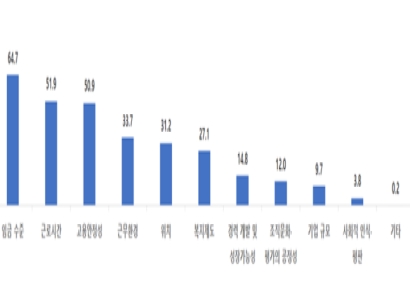 "Please Pay Me at Least 3 Million Won a Month": More Than Half of Young People Today Prioritize "Working Conditions" Over Company Size
- Selling Like Crazy Every Year... 30-Year-Old Hetbahn Takes on a New Challenge: Tastes Better Than "Mom's Home Cooking" [On-Site Report]
- "Americans Would Be Amazed If They Came": Wide-Eyed at a Sight They've Never Seen Before... Foreigners Also Fall for K-Baseball [K-Holic]
- "Hey, Lady, Teach Your Kids to Behave!" ... 300,000 Won in Cash and a Bodily Injury Claim Demanded Over Child's Door Ding
- Beachgoer Finds 'Plastic' That Turns Out to Be Perfume Ingredient Worth More Than Twice as Much as Gold
A Ministry official stated, "This minimum wage was finalized by vote according to the employers' proposal, and there were no procedural defects, as representatives from both labor and management, as well as employer representatives recommended by small business owners, participated directly in the vote."
© The Asia Business Daily. All rights reserved. Unauthorized AI training and use prohibited.