What the FSC Missed in Its Late-Night Clarification to Bloomberg's "South Korea Is Becoming Uninvestable" Column
Concerns Center on Policy Mistakes, Greater Volatility, and Retail Investor Losses
Financial Services Commission Highlights Fundamentals, Points Out Statistical Errors...
Falls Short on Responding to Policy Failures
The Financial Services Commission (FSC) issued a rare late-night response to a Bloomberg column warning that South Korea is becoming an "uninvestable" country. However, the authorities failed to properly address the core concerns raised by the column—policy failures and the erosion of market trust.

According to the FSC on August 5, a press statement titled "The Government's Position on the Domestic Stock Market" was distributed after 10 p.m. the previous night. The document presented an official rebuttal to the Bloomberg column "South Korea Is Becoming Uninvestable, Too," written by Bloomberg columnist Shuli Ren on the same day. It is highly unusual for authorities to issue a rebuttal to an analysis column by foreign media rather than a news report.
The FSC argued that the negative assessments of the Korean economy and capital market in the column did not reflect reality. They emphasized that indicators such as gross domestic product (GDP) and current account balance show that South Korea's economic fundamentals are stronger than ever, and that corporate earnings prospects are improving. The statement also pointed out what it called errors in some of the statistics cited in the column, such as forced liquidations.
The FSC stated, "There appear to be portions where the quoted statistics do not correspond with the facts, and the exact sources cannot be identified." The agency also dismissed the concerns, saying, "There is no reason to fear that South Korea will be evaluated as an uninvestable country based on unclear figures, especially as the nation is emerging as an irreplaceable supplier and investment destination in the global artificial intelligence (AI) market."

However, it is important to note that the column's main point was not about concerns over South Korea's economy itself, but rather about market distortions, investor losses, and the resulting breach of trust caused by policy decisions. Given that the FSC's two-page rebuttal was limited to addressing economic fundamentals, corporate earnings prospects, and statistical errors regarding forced liquidations, some point out that the response was lacking and missed the essential issues.
The FSC, having highlighted economic fundamentals at the outset, attempted to counter the column's mention of increased market volatility by stating, "There are signs that investor sentiment is recovering." The agency did not provide any explanation regarding the criticism that the National Pension Service's change in asset allocation principles failed to play a stabilizing role in the market. The column's repeated direct and indirect criticisms of policy failures—such as "what is more concerning is the scar that these policy mistakes have left on retail investors," "the government forced inexperienced investors to take excessive risks," and "allowing single-stock leveraged products is not the government's only blunder"—were also left largely unaddressed.
Even the sole rebuttal—the claim of statistical errors—requires more detailed explanation. The Bloomberg column stated that approximately 360,000 securities accounts were subject to forced liquidation, 62% of which belonged to investors under 35 years old. In contrast, the FSC contended this is not accurate, stating, "As of June, the average daily number of forced liquidations (including margined and settlement financing positions) was about 3,000 accounts." Since the figures cited in the column appear to be based on cumulative data and a different reference period, it is difficult to say that the FSC's rebuttal is entirely clear or sufficient just based on this number.
Of course, some both inside and outside the market argue that describing the Korean stock market as "uninvestable" is somewhat excessive. The late-night timing of the authorities' rebuttal is interpreted as stemming from concerns that such expressions could send the wrong signal to foreign investors. An industry insider commented, "It is certainly an exaggerated headline, but it does reveal a glimpse of the kinds of worries foreign investors have. Given that the KOSPI index has recently exhibited high volatility, fluctuating sharply up and down, which has shaken investor confidence in the market, it is true that the government needs to take the issue of restoring market trust more seriously."
Hot Picks Today
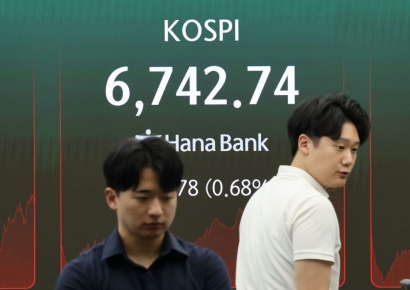 "Korea's Stock Market Dubbed 'World's Wildest'... U.S. Shocked as KOSPI Triples Then Plunges 40%"
- "What Did Billionaires Buy? These Two Stocks Take the Top Spots Side by Side"
- "Let Me Remove the Mole on Your Nose" — Danish Prime Minister Firmly Rejects Plastic Surgeon's Offer
- "You Clocked In but Didn't Turn on Your Computer"... Chinese Worker Dies in Restroom but Denied Work-Related Compensation
- "Jeju Should Not Be Taken Lightly... Do Not Walk Alone Even in Broad Daylight," Warns Jeju Resident of 7 Years, Hyegul Hong
According to the Bloomberg column, the KOSPI index has plunged around 40% in just 27 trading sessions. So far this year, there have been as many as 33 days when the index moved by more than 5% in a single day. Over the same period, Japan's Nikkei index had such swings on 4 days, and Hong Kong's Hang Seng index on none.
© The Asia Business Daily. All rights reserved. Unauthorized AI training and use prohibited.