President Lee: "Diplomacy and Security Must Not Become Subjects of Political Strife... Accountability Should Be Based on Outcomes, Not Mere Assertions"
President Lee Receives Briefings from Foreign Affairs, Unification, National Defense, and Patriots and Veterans Affairs Ministries
Warns Against Diplomatic and Security Policies Becoming Political Battlegrounds
"Peace Is the Economy... Inter-Korean Confrontation Harms the National Community"
Stresses Self-Reliant Defense and Normalization of Military Command Authority
References Unchambered Ammunition Incident: "Even Minor Lapses in Discipline Can Undermine Security"
On August 5, President Lee Jae-myung stated, "Most advanced countries do not make diplomatic and security policies the subject of political strife," adding, "Unfortunately, in our country, the most critical diplomatic and security issues have become topics of political contention." He further emphasized that the government, which bears responsibility for state affairs, should not confine itself to arguments founded solely on ideology and values but must ultimately be held accountable through outcomes that safeguard the people's lives and the national interest.

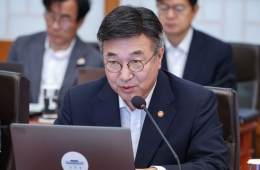
President Lee Jae-myung is speaking at the Ministry Work Report meeting for the Ministry of Foreign Affairs, Ministry of Unification, Ministry of National Defense, Ministry of Patriots and Veterans Affairs, and others held at the Blue House Guesthouse on August 5, 2026. Photo by Yonhap News Agency
View original imageDuring his opening remarks at the work report session for the Ministry of Foreign Affairs, Ministry of Unification, Ministry of National Defense, Ministry of Patriots and Veterans Affairs, and other diplomatic and security agencies held at the Blue House State Guest House, President Lee said, "We are living through a period of upheaval in the international order," and stressed, "The most important factor for Korea's leap forward, sustained growth, and a better life for our people is peace and stability on the Korean Peninsula." He reiterated, "There can never be too much emphasis on peace and stability. Peace means a livelihood, and peace is, in itself, the economy."
In connection with this, President Lee warned about the reality in which diplomatic and security policies are entangled in ideological confrontations of domestic politics. He remarked, "If each person's ideology and values are imposed on others, it inevitably leads to conflict and confrontation," continuing, "The way to realize my own ideology and values is not to make noisy arguments and pressure opponents, but to persuade as much as possible, reduce resistance, and bring the other side to accept them."
He further called for the government, which bears responsibility for the entire community, to be accountable through results rather than mere assertions. President Lee explained, "When one is in opposition (like the opposition parties), the burden of responsibility is not heavy, so argument can be a primary tool; however, those charged with the destiny and authority of the entire community must prioritize action over rhetoric." He emphasized, "It is more important to take action than to raise one's voice, and to bear responsibility through outcomes rather than mere claims."
During the day's work report, President Lee directed the Ministry of Foreign Affairs to expand the foundation for economic and trade cooperation through summit diplomacy early in the presidential term. Referring to his recent trip to South America, he stated, "When the President of Korea visits a country early in their term, the counterpart feels that we consider them important," adding, "Summit meetings at the start of the term provide a greater opportunity to strengthen ties between corporations and nations." Prime Minister Han Sung-sook also commented, "When the President visits China, we hear that trade with China improves; after a trip to Brazil, companies tell us that the K-beauty sector has had a positive reaction," adding, "I have come to realize in government that the President and the administration pave the way first."
President Lee also called on overseas missions to become footholds for promoting Korean culture and companies abroad. He said that Korea is gaining international attention for its culture, cutting-edge technology, defense industry, and democratic capacity, stating, "Embassies, consulates, and consulate generals overseas must serve as the vanguard for cultural and corporate expansion." Regarding policies for overseas Koreans, he urged, "We must make good use of the capabilities of overseas Koreans and citizens abroad, and overseas missions need to assume greater responsibility."
Addressing the Ministry of Unification, he instructed that the policy of peace and coexistence must continue, even without a response from North Korea. President Lee said, "It may feel like shouting into the void," yet added, "It's easiest when you stick to your road and I stick to mine; sometimes confrontation is useful politically, but ultimately, it is harmful to the public and the national community." However, given the high political sensitivity of inter-Korean issues, he stressed the need to choose expressions and wording more carefully. President Lee said, "We must continue our efforts, but be especially prudent, as even a single word or expression can become a topic of political controversy," and appealed, "Please continue policies of peace and coexistence with patience."
To the Ministry of National Defense, President Lee emphasized the reinforcement of a firm posture and self-reliant defense capacity. He said, "National defense is the ultimate physical force that protects the national community from external invasion and attack," and added, "Self-reliant defense, maintaining security solely on our own strength without external assistance, is Korea's greatest challenge." With respect to the exercise of military command authority, President Lee remarked, "We must exercise military command—a partial expression of our sovereignty—ourselves," adding, "It is unthinkable for our Armed Forces not to follow the command of the Minister of National Defense who receives orders from the President, the supreme commander of the military. Normalizing this situation is also an important task."

Cho Hyun, Minister of Foreign Affairs, is reporting at the ministry briefing presided over by President Lee Jae-myung at the Blue House State Guest House on August 5, 2026. Photo by Yonhap News Agency
View original imageRegarding the recent controversy over unchambered ammunition during military guard duty, President Lee warned that even a small lapse in military discipline can weaken the overall security posture. He cited an anecdote that the finest mulberry arrows were gradually replaced by bamboo and reed, ultimately leaving the armory empty, stating, "If you retreat step by step, you may eventually find there are no arrows left in the quiver." He continued, "While in daily life, it may not be unreasonable to assume that 'nothing will happen,' this mindset cannot apply to national defense. Even though the military is overall in good shape, the public expects that not even the smallest gap should be allowed."
Hot Picks Today
 "1.4 Million Won for a Family of Four: This City Grants 350,000 Won Per Person Ahead of Chuseok"
- "Why Hire Employees? Earning 14 Billion Alone... Number of Single-Person Companies Doubled in Two Years"
- "Everyone Was Traveling Abroad"... Why Did Travel Agencies' Operating Profits Plunge by 40%?
- POSCO Labor and Management Extend Collective Bargaining Mediation Period... Final Talks Set for the 18th
- "Fears of Severe Cases Rising"... COVID-19 Positive Rate Soars to 20%, but Treatments Remain Out of Reach in China
President Lee also called on the Ministry of Patriots and Veterans Affairs to ensure substantial honors and compensation for those who sacrificed for the country and community. He said, "There was a time when the saying 'three generations are ruined by participating in the independence movement, and three generations thrive by collaborating with the Japanese' reflected actual reality," stressing, "Independence patriots, war casualties, and those who sacrificed for the lives, safety, and democracy of our people must be treated and compensated appropriately."
© The Asia Business Daily. All rights reserved. Unauthorized AI training and use prohibited.