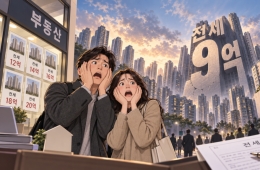
Landlords Returning to Their Homes Leave Tenants Stranded as Jeonse Supply Disappears: "Only Those Who Didn't Buy Are Left Behind" [Real Estate AtoZ]
Property Tax Rises for Non-Resident Single Homeowners
More Landlords Announce Return for Owner Occupancy
Families Tied to School Districts Struggle to Relocate
Unable to Afford Jeonse, Many Forced into Multi-Unit Housing
#Last month, Mr. A moved to Canada with his child and rented out his apartment in Jamsil, Seoul. He had planned to continue leasing out the Jamsil apartment after returning to Korea two years later, while living in Gaepo-dong, Gangnam-gu. However, after seeing the latest tax reform plan, he abandoned that idea. Once the current lease with the tenant ends, he has now decided to move back into the Jamsil apartment. This is because if he lives in Gaepo-dong while renting out the Jamsil apartment, he will be classified as a non-resident single homeowner and his taxes will rise significantly. If Mr. A returns and moves into the Jamsil apartment, the existing tenant will have to find another place to live.

A notice reading "Non-resident 1-household property listing reception" was posted at a real estate agency in Songpa-gu, Seoul. In the tax reform plan announced by the government on the 3rd, the basic deduction amount for comprehensive real estate tax on housing for non-resident single homeowners was lowered from 1.2 billion KRW to 900 million KRW, and the tax rate was increased from the current 1% to 1.3% next year for the taxable standard range of 600 million to 1.2 billion KRW, increasing the burden. Yonhap News
View original imageAfter the 2026 tax reform plan was released, which will reduce the property tax burden for owner-occupied single homeowners except for those with ultra-luxury properties worth over 4 billion won, more landlords in Seoul's Gangnam, Seocho, and Songpa districts who own apartments priced between 2 and 3 billion won have begun to declare their intention to move in for their own use. As a result, rental listings in these areas are visibly declining. Concerns are rising that this may trigger a real crisis in the rental market, especially in school districts.
According to real estate big data platform Asil on August 5, rental supply in the three core districts—Gangnam, Seocho, and Songpa—has been rapidly dwindling recently. As of August 4, there were 2,780 rental listings in Songpa-gu, down 24% from three months ago—the highest decrease among the 25 districts of Seoul. Compared to a month ago, jeonse listings declined from 1,473 to 1,422, a 3.5% drop. However, monthly rentals increased by 16.4%, from 1,167 to 1,358.
Gangnam-gu and Seocho-gu also turned to a downward supply trend over the past month. Jeonse listings in Gangnam-gu fell by 2.6%, from 4,738 a month ago to 4,614. Monthly rentals dropped by 1.5%, from 4,205 to 4,143. Seocho-gu jeonse listings fell by 3.1%, from 8,000 to 7,749; monthly rentals decreased by 1.1%, from 5,980 to 5,914.
This reduction in rental supply stems from non-resident landlords increasingly announcing their intention to move back and reside in their units. It is the tenants who are immediately impacted. Particularly, tenants linked to specific school districts have even fewer options. If the landlord moves in, tenants are forced to search for new rental homes, but relocating to a different district is not easy due to their children's school boundaries.
A realtor in Jamsil-dong commented, "Elementary students are less affected by transferring schools, but it's much harder for middle and high school students to move. Even if rents rise, many parents will try to hold on until their child graduates." If families cannot afford the new rental prices, they may have to downgrade their living standards within the same school district. "If they can't hold out, they'll have to move into a two- or three-room multiplex or multi-household unit in Jamsil-bondong, just to maintain the same commute to school," the realtor said. "In the end, those who trusted the government and didn't buy property turned out to be the fools."
Daechi-dong, a district with many families renting to secure access to sought-after schools, is also on alert. A real estate agent in Daechi-dong said, "A slight reduction in the basic deduction for the comprehensive real estate tax would not normally disturb wealthy landlords." He continued, "But with the tax for non-resident homeowners more than doubling, owners will now choose to move in themselves, as the extra cash outflow is hard to justify." The government lowered the basic deduction for the comprehensive real estate tax for non-resident single homeowners from 1.2 billion won to 900 million won, while also raising both the tax rate and the cap on tax liability.
The agent added, "Tenants will be forced to find homes where the landlord does not plan to move in, which could spark a crisis nearby. It won't be easy for families accustomed to apartments to move into villas, and with the current lack of rental supply, finding a new place is very difficult." However, he noted, "Landlords can only move in after tenants’ contracts expire, so tenants whose leases are not yet up won't be forced out right away."
![Landlords Returning to Their Homes Leave Tenants Stranded as Jeonse Supply Disappears: "Only Those Who Didn't Buy Are Left Behind" [Real Estate AtoZ]](http://www.asiae.co.kr/news/img_view.htm?img=2026080511075070387_1785895671.jpg)
The owner of a real estate agency near Helio City in Garak-dong, Songpa-gu, predicted that the reform will halt property upgrades and lead to widespread "property freeze," where owners do not trade units.
A certified realtor in Garak-dong stated, "Previously, there was a trend where people would sell a 3 billion won home in Songpa and add more funds to upgrade to an ultra-luxury 4 to 5 billion won home in Gangnam or Seocho. With the higher tax on ultra-high-end homes, this pattern will diminish. As fewer people consider upgrading from Songpa to Gangnam, listings in Songpa will also become stuck," he said. He also mentioned, "For owners who cannot feasibly return to live in their properties—such as those living in other regions—now may be the time to sell. Still, most landlords will likely try to return and live in their own units, so the supply of rental properties will inevitably shrink even further."
In major apartment complexes in Mapo and Seocho—areas where the ratio of resident to non-resident owners is roughly even—the rush of landlords moving back in is expected to intensify the shortage of jeonse rentals. A realtor in Ahyeon-dong, Mapo-gu, said, "If they do not live in their properties themselves, landlords face a heavier tax burden. So, landlords who used to lease out their homes are increasingly moving back in. At Maporaemian Prugio, the biggest residential complex in this area, about half the owners are residents and half are non-residents, but jeonse rental supply is expected to decrease even more." A realtor in Jamwon-dong, Seocho-gu, added, "At Jamwondong A Apartment, the resident and non-resident split is about even, and quite a few landlords appear to be planning to move in themselves, requiring tenants to leave."
With continued lending restrictions, even available mid-tier listings are being seen as an opportunity by so-called "cash-rich" buyers. A realtor in Mapo-gu said, "For homes valued at around 2 billion won with a size of about 66 square meters, loans are limited, so there isn’t much demand from average buyers. In this situation, whenever a bargain deal emerges, cash-rich investors are snapping them up immediately."
Even elderly single homeowners with ultra-luxury properties and tenants are anxious. In Apgujeong-dong, Gangnam-gu, complaints abound about a potential tax bomb. The owner of a real estate agency near Apgujeong Hyundai Apartment commented, "Here, there are numerous owners in their 80s or older whose entire life savings are tied up in one apartment. If their lifetime home is subject to a capital gains deduction cap of just 1 to 2 billion won, their retirement security may collapse." He added, "Since rumors of tightened benefits started circulating even before the official announcement, a few quick-witted owners have already put their homes up for sale. With increased tax burdens, more such listings are likely to surface going forward."
Hot Picks Today
 "Auntie, When Will Dried Shredded Squid Return as a Side Dish?"...Once Vanished from Restaurants, Now Making a Comeback
- "Saved Up for Overseas Trips, but When Can We Use Them?"... Korean Air Mileage Surpasses 3 Trillion Won
- "They Thought They Hit the Jackpot: Thieves Steal Nvidia-Branded Trailer, Flee After Discovering Only Sand Inside"
- Resident in Cardiac Arrest After Fire in Eunpyeong Multi-Family Residence on Chuseok
- Already 1,000 Examined, Stirring Up Protest: "Why Go to the Army When We Said No?" Students Rally in the Streets
![Landlords Returning to Their Homes Leave Tenants Stranded as Jeonse Supply Disappears: "Only Those Who Didn't Buy Are Left Behind" [Real Estate AtoZ]](http://www.asiae.co.kr/news/img_view.htm?img=2026080510552670351_1785894925.gif)
© The Asia Business Daily. All rights reserved. Unauthorized AI training and use prohibited.