"Lifetime Democratic Supporters Turn Away Amid Stock Crash... Foreign Media: 'Political Burden for President Lee'"
Losses Mount for Investors Amid Tech Stock Plunge
FT Follows Bloomberg in In-Depth Analysis
FT: "Market Downturn Becomes a Political Burden"
Recently, foreign media highlighted how the anger of individual investors who suffered major losses in the domestic stock market is directed at President Lee Jae-myung, with market instability turning into political pressure.
On August 4, local time, the UK's Financial Times (FT) reported, "Political repercussions are emerging as individual investors, who suffered significant losses from the decline in technology stocks last week amid extreme volatility in the Korean stock market, turn their anger toward the president."

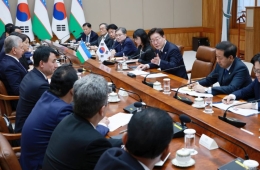
President Lee Jae-myung is speaking at the ministry work report session for the Ministry of Trade, Industry and Energy, the Ministry of Climate Change, and the Nuclear Safety and Security Commission held at the Blue House's Guest House on the 4th. Photo by Yonhap News Agency
View original imageFollowing last week's sharp global sell-off in technology stocks, the KOSPI at one point dropped nearly 40% from its June peak. Some investors using leveraged products also faced margin calls.
An official at a bank in Seoul explained that many investors in their 30s entered the stock market to raise funds for future home purchases, so this downturn hit them particularly hard. The official stated, "Many people entered the market using substantial leverage and suffered significant losses," adding that the government expedited approval for individual stock leveraged ETFs as a measure to further support the KOSPI.
The official continued, "While the ultimate responsibility for investment decisions lies with individuals, the government cannot be completely free from accountability, as many people placed particular trust in it and were encouraged to invest in stocks."
Yoon, a woman in her 40s who started investing in stocks for the first time, said she and her husband have invested their pensions in the stock market and are now facing losses of about 9%. Although she always supported the Democratic Party, Yoon criticized the government for taking no action while the market was falling. She added, "Now I'm beginning to think I might not vote in the next election."
Ripple Effects of Korean Stock Market Volatility... FT: “Political Burden for President Lee”
FT analyzed, "The Korean stock market has become one of the world’s most volatile as investments have surged into semiconductor stocks amid expectations for AI industry growth," adding, "The massive investment losses are turning into a political risk for President Lee Jae-myung."
Amid the sharp market downturn and controversy over leveraged exchange-traded funds (ETFs), President Lee's approval ratings declined for three consecutive weeks, hitting the lowest level since taking office. According to a Realmeter poll released on August 3, President Lee’s approval rating stands at 45.9%.
Jung Eui-jeong, head of the Korea Equity Investor Association, said, "Our group chat rooms are full of messages criticizing President Lee," adding, "Many members are saying they will not vote for the ruling party in the next election."

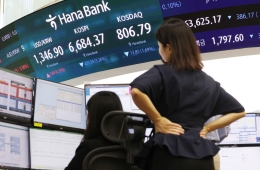
On the 4th, after opening higher and then turning to a downward trend, employees are monitoring the stock market and exchange rates in the dealing room at the Hana Bank headquarters in Jung-gu, Seoul. On that day, the KOSPI opened at 6,351.38, up 93.93 points (1.50%) compared to the previous trading day, and the KOSDAQ opened at 748.19, up 10.84 points (1.47%). Photo by Yongjun Cho, August 4, 2026.
View original imageSome analysts say the anger of individual investors could become a political liability for the ruling party in the general elections scheduled for April 2028. Shin Yul, a professor of political science and international relations at Myongji University, said, "Because President Lee encouraged the public to invest in stocks, he bears some responsibility for the current problems."
FT noted, "Among previous Korean presidents, none had tied their political fortunes to the stock market as closely as President Lee." During his campaign, Lee pledged to boost the KOSPI to 5,000 by the end of his term in 2030. At that time, the KOSPI had been fluctuating around the 2,000 mark for more than a decade.
President Lee has emphasized that, since most household assets are concentrated in real estate, it is necessary to shift to 'productive finance' such as stocks. He also pursued policies to attract more capital to the stock market by strengthening protections for minority shareholders.
Kim Hyung-gyun, head of the investment division at Chart Partners Asset Management, said, "When President Lee first took office, he earned favorable reviews by introducing investor-friendly amendments to the Commercial Act," adding, "With around 15 million people—about one-third of the population—investing in stocks, supporting the stock market was one of President Lee's biggest achievements."
Thanks to record earnings by Samsung Electronics and SK hynix, the KOSPI far exceeded its original target; President Lee maintained an optimistic outlook on the stock market even then.
When the KOSPI neared 8,000 this June, President Lee stated at a press conference, "The market has risen faster than expected, but I still think it is undervalued." Afterward, the KOSPI dropped to around the 6,000 level.
"Backlash for the Government Over Leveraged ETFs"
Amid the semiconductor boom, the government also expanded access to high-risk investment products. At the end of May, financial authorities allowed, for the first time in Korea, leveraged ETFs that track the price movements of individual stocks. These products attracted over $10 billion (about 14 trillion won) in just a few weeks after launch. Investors mainly used them to bet on the rising share prices of Samsung Electronics and SK hynix.
However, as the market turned downward and individual investors’ losses increased, Lee Chan-jin, Governor of the Financial Supervisory Service, publicly expressed regret over the introduction of leveraged ETFs for individual stocks. Financial authorities also tightened investment requirements, such as raising the minimum deposit for leveraged ETFs to 30 million won.
John Lee, editor-in-chief of Korea Risk Group, analyzed that allowing securities firms to launch leveraged products was a reflection of the Lee Jae-myung administration’s will to expand investor choice. However, he noted, "This decision ultimately resulted in a tremendous backlash against the government."
Previously, Bloomberg also highlighted the repeated crashes and surges in the domestic stock market, diagnosing a sharp decline in the investment sentiment of Korean retail investors. Bloomberg added that belated government measures regarding single-stock leveraged ETFs have shaken investor confidence.
Hot Picks Today
 You Can Receive Monthly Payments Like a Pension Without Selling Your Home... The Local Mutual Growth Housing Pension That Provides 1.69 Million Won Each Month
- "Unimaginable in Korea"...Koreans Surprised by Secondhand Smoke in Japan and China Restaurants
- "Special Skill: Admitting Mistakes"... The Unexpected Edge That Helped Job Seekers Tired of AI Resumes Succeed
- "Canceled After Five Days and Lost 770,000 Won"... Hit by Steep Fees After Pressing the Cancel Button
- "I Thought She Was an Ordinary SKT Employee... The Unexpected Identity of Nongshim's Third-Generation Bride"
Bloomberg noted, "This incident strikes at the heart of President Lee’s political brand," adding that Lee’s "KOSPI 5000" policy and his commitment to capital market reform have been put to the test.
© The Asia Business Daily. All rights reserved. Unauthorized AI training and use prohibited.

![How Did Tacos Come to Have Two Shells [Delicious Stories]](https://cwcontent.asiae.co.kr/asiaresize/307/2026091410392626963_1789349966.jpg)