Ministry of Trade, Industry and Energy to Fast-Track 1,600 Trillion-Won 'Mega Projects'...First Mega Special Zone to Be Designated This Year [Work Report]
Yongin Semiconductor Complex Completion to Be Advanced by Up to 12 Years
Honam Cluster to Begin Construction and Production Within Current Administration
Regional Growth Engines to Be Announced at the End of August
Full-Scale Push for U.S. Strategic Investment and CPTPP Membership
Industrial Resource Security Fund to Be Established and Critical Mineral Stockpiles Expanded

The government will accelerate the launch of its "Three Mega Projects," worth a total of 1,600 trillion won, focused on semiconductors, artificial intelligence (AI), and robotics, moving ahead of the initial timeline. To expand the industrial growth axis, currently centered in the greater Seoul area, to other regions, regional growth engines will be selected by the end of this month, and the "Mega Special Zone Act" will be enacted within this year to designate the first mega special zone. Externally, the government will select the first U.S.-Korea strategic investment project, focusing on shipbuilding and energy, and is considering membership in the Comprehensive and Progressive Agreement for Trans-Pacific Partnership (CPTPP).
On August 4, Minister of Trade, Industry and Energy Kim Jeong-gwan announced the work plan for the second half of 2026 under the vision of “Super Growth+New Spaces: An Irreplaceable Industrial Powerhouse” at an official briefing held at the Blue House State Guest House. The Ministry of Trade, Industry and Energy has established four main axes for growth: mega projects, Manufacturing AI Transformation (M.AX), industrial and resource security, and fostering the industrial ecosystem. Additionally, the strategy includes two spatial axes: regionally led growth and expanding economic territories overseas. Through these initiatives, the ministry aims to “scale up” industries, “broaden” the growth stage, and “solidify” foundations to prevent crises, described as the so-called “Three High Strategy.”
Minister Kim stated, “The landscape of the global economy is changing profoundly. How we respond will determine whether we can preserve and expand our legacy as an industrial powerhouse for future generations, or whether it ends with ours.” He added, “With geopolitical risks such as wars in the Middle East becoming constant, trade barriers rising, and competitors closing in, failure to keep up with the AI revolution could become an immediate existential risk.”
1,600 Trillion-Won Investment Plan Accelerated...Yongin and Honam Semiconductor Projects to Fast-Track
Accordingly, the ministry will rapidly execute the three mega projects, allocating 896 trillion won to the Honam region, 392 trillion won to the Chungcheong region, and 312 trillion won to the Yeongnam region, for a combined investment of 1,600 trillion won. Minister Kim stated that the ministry will act as the “investment project manager,” coordinating with related ministries, public agencies, and local governments.
For the Yongin Semiconductor Cluster, the completion of the general industrial complex will be advanced by 12 years, from 2045 to 2033, and the national industrial complex by eight years, from 2047 to 2039. The Yongin national complex aims to operate its first fabrication plant by 2029, with land compensation procedures to be completed within this year, and power and water procurement procedures to proceed in parallel.

The Honam Semiconductor Cluster aims to begin construction and production within the current government's term, finalizing the selection of the project operator and designation of the cluster location candidates by the end of this year. The processes for approvals, compensation, and site acquisition will be carried out in parallel, with related demand incorporated into the Basic Plan for Power Supply and the National Water Supply Master Plan. Supporting infrastructure for workforce and transportation, such as the Southern Semiconductor Alliance University and the Gwangju-Yeongam Autobahn, will also be pursued.
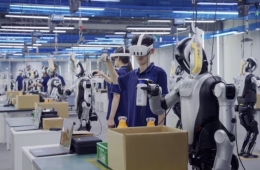
M.AX will also be accelerated. By the end of this year, the ministry plans to convert a cumulative total of 220 manufacturing processes into AI-powered factories and deploy humanoid robots at 10 manufacturing sites, including those in steel and semiconductors, to demonstrate risk reduction and replacement of repetitive simple tasks. At 30 manufacturing sites, the expertise and knowledge of skilled workers will be digitized to develop AI models containing manufacturing know-how. By 2030, seven M.AX clusters will be established in key industrial complexes by region.
Minister Kim stated, “Over the past year, the M.AX Alliance has demonstrated the possibility of achieving a 30% increase in productivity and a 15% reduction in defect rates. We will develop a manufacturing data library built on the implicit knowledge of skilled workers, and create a full-stack AI factory autonomously operated by AI and robots.” To foster collaboration between manufacturing and AI companies, shared AI infrastructure for industrial complexes and regional M.AX academies will also be established.
Regional Growth Engines to Be Announced End of August...First Mega Special Zone to Be Designated Within Year
Regional industrial policy will be shifted from dispersed support to a strategy focused on selected regional growth engines. The Ministry of Trade, Industry and Energy has narrowed down candidates for three to four growth engines in each region, in consultation with local governments and anchor companies, with final selection and announcement planned at a central-local cooperation meeting chaired by the president at the end of this month.
Industries designated as regional growth engines will receive a package of seven support measures, including special grants; preferential investment from the National Growth Fund and the Regional Growth Fund; local tax incentives; regionally autonomous R&D; fast-track approval processes; and improvements to settlement conditions such as cultural, childcare, and housing environments.
The ministry also plans to enact the “Special Act on Designation and Operation of Mega Special Zones” within this year and designate the first mega special zone. About 300 menu-style regulatory exemptions and demand-responsive regulatory relief will apply to the mega special zone. An executive appointed by the president, the so-called “czar,” will be empowered to coordinate approvals and regulatory exemptions, expediting investment processes. Large-scale joint demonstrations will be allowed, and the review period for the regulatory sandbox will be shortened from 90 to 60 days.
Considering CPTPP Membership...Expanding Overseas Economic Territory
The ministry will also initiate a full-scale effort to expand Korea's overseas economic territory. With the United States, it will broaden cooperation in strategic sectors such as shipbuilding and nuclear power, and designate the first U.S.-Korea strategic investment project within the year based on strategic value, commercial viability, and mutual benefit. Projects in areas of shared interest, such as shipbuilding and energy, will be announced sequentially. The Korea-U.S. Shipbuilding Cooperation Center, which opened in the U.S. last month, will assist domestic companies in entering the local market.
With the EU, the ministry will work to reduce trade uncertainties, while in the Middle East it will seek out opportunities for high-value-added plant contracts in the aftermath of war. Negotiations for supplementary agreements on services and investment in the Korea-China Free Trade Agreement will be pursued with China, while a dedicated industrial complex for Korean companies is planned for India. There will also be stronger cooperation on critical minerals with Latin America.
The ministry has also formalized its intention to consider joining the CPTPP. Minister Kim said, “To secure new markets in ASEAN and Mexico and accelerate exports of K-content and consumer goods, we will consider CPTPP membership and seek the full input of stakeholders, including the agricultural and fisheries sector as well as the National Assembly.”

Establishing the Industrial Resource Security Fund...Dramatic Expansion of Critical Mineral Stockpiles
The recent Middle East war has prompted a full overhaul of the industrial and resource security system. The ministry will reduce dependence on Middle Eastern oil and gas by diversifying importing countries and shipping routes. Naphtha suppliers will be supported to co-fire with ethane, encouraging diversity in sourcing and supply. Stockpiles of essential petrochemical products, such as medical polyethylene (PE), will also be built up for both public welfare and industrial production.
For critical minerals, a dedicated stockpiling base will be established in Saemangeum, and the number of stockpiled items will be expanded from 35 to 43. The stockpiling period for heavy rare earth elements will be increased from 180 to 365 days and for tungsten from 100 to 270 days. Recycling of domestic resources, such as used permanent magnets, will be expanded, and government-to-government cooperation will be strengthened with resource-rich countries in South America and Southeast Asia.
An “Industrial Resource Security Fund” will also be established to provide long-term support for securing and stockpiling crude oil and critical minerals. Management will be strengthened for universities and other potential loopholes in technology outflow, and harsher economic penalties will be imposed for crimes involving the illegal export of national core technologies.
Around 5 trillion won will be invested in the “Industrial Ecosystem Co-Growth Project,” where large companies and suppliers jointly develop and test new technologies until 2030. The government will contribute 1.8 trillion won, while anchor companies provide 2.8 trillion won, supporting technology transfer and purchase guarantees for future growth industries such as robotics, AI-driven shipyards, and OLED process innovation. Separately, a 10 trillion-won public-private industrial growth fund will be established in stages.
Establishing a Direct Taskforce Under the Minister...AI to Analyze 2.5 Million Pages of Trade Documents
The ministry aims not only to announce plans but also to strengthen execution by establishing a direct ministerial “Policy Performance Innovation Taskforce,” also known as “Jeongseongdan.” Modeled after the Blair administration’s Delivery Unit, it will monitor the implementation of key initiatives using performance trajectory and a traffic light evaluation system, and immediately resolve delayed or contentious issues.
The ministry will also build a specialized AI platform for the industrial and trade sectors, called “Tong AI.” This system will compare and analyze some 2.5 million pages of trade agreement documentation at once and support R&D planning, reducing the administrative workload.
Hot Picks Today
!["Thought It Was Over?"... Samyang Foods' Stock Slumps, One Big Play for Next Year [Weekend Money]](https://cwcontent.asiae.co.kr/asiaresize/93/2023062814413679320_1687930896.jpg) "Thought It Was Over?"... Samyang Foods' Stock Slumps, One Big Play for Next Year [Weekend Money]
"Thought It Was Over?"... Samyang Foods' Stock Slumps, One Big Play for Next Year [Weekend Money]
- Condoms Out of Stock... "Please Stop Having Kids": Country to Deliver Contraceptive Pills Door to Door
- British Man Who Stabbed Acquaintance at Seoul University Arrested in UK Nine Days Later
- "Did Hitler Mussolini Become Mayor?" ... A Bizarre Turn in Peru's Election
- "Should I Raid Mom's Bathroom First?"... Millennials & Gen Z Go Wild for This 10,000-Won Bath Essential
Minister Kim quoted the 23rd chapter of the Doctrine of the Mean, saying, “We must not neglect even small tasks but strive to do our best.” He vowed, “We will put our utmost sincerity and effort into carrying out today's work plans and bring about real change for our industry and the Republic of Korea.” He emphasized, “The Ministry of Trade, Industry and Energy will take the lead in building an irreplaceable industrial powerhouse.”
© The Asia Business Daily. All rights reserved. Unauthorized AI training and use prohibited.