President Lee: "As Police Gain More Authority, Accountability Must Match... At Least Dismissal or Removal for Investigative Misconduct"
"Public Distrust of Police Investigations Remains... Strict Neutrality and Ethical Conduct Needed"
One Hundred Civilian Investigators, New Internal Affairs Unit to be Established... Expanded Protections for Investigation-Related Parties
On August 4, President Lee Jae-myung addressed the significant expansion of police investigative authority following the amendment of the Criminal Procedure Act, emphasizing that "the amount of authority and the amount of responsibility must be equal." He called for robust self-discipline and stronger accountability within the police. President Lee even mentioned the possibility of minimum penalties such as dismissal or expulsion or a lifelong ban from investigative work for police officers who commit clear misconduct during investigations.

President Lee Jae-myung is speaking at the Cabinet meeting held at the Blue House on the 4th. August 4, 2026. Photo by Yonhap News
View original imageAt the cabinet meeting held at the Blue House that day, after being briefed on "measures to strengthen the fairness of police investigations," President Lee stated, "The police have now gained enormous authority, including the power to initiate and conclude investigations, as well as the power to conduct compulsory investigations." He continued, "However, whether the police are able—or even prepared—to assume corresponding responsibility is another matter entirely."
Earlier, in his opening remarks at the cabinet meeting, President Lee noted, "There are growing concerns about the monopoly and expansion of the police's investigative powers." He stressed, "The police must also show a willingness to end internal corruption, to offer truly meaningful protection to victims, and to strengthen democratic oversight, even if it requires painful self-reflection."
President Lee, referencing his past experience as a lawyer, pointed out that public distrust towards police investigations still lingers. He remarked, "Not only the prosecution but also the police investigations could not be trusted. There were cases where the facts of a case were completely altered, and since courts tend to respect the official decisions made by police or prosecutors, trials themselves could end up being distorted."
He went on to say, "The authority to conclude an investigation is a power that can decide the life and fate of an individual or a company." He noted, "There have been cases where the perpetrator and victim have been switched, resulting in wrongful imprisonment or total financial ruin." He further criticized, "From the victim's perspective, when an investigation is botched to the point of contemplating suicide, it is hard to understand how the police officer responsible may only be suspended for a few months and then return to investigative work."
Given the increased police authority, he argued that officers who commit clear investigative misconduct should at least be dismissed or expelled. President Lee added, "Alternatively, they must be permanently disqualified from ever engaging in investigative work again." His remarks conveyed the view that a higher level of accountability for misconduct is needed than in the past, so that investigators’ sense of responsibility and public trust can both be strengthened.

President Lee also warned the police that they will now face much stronger external scrutiny and oversight. He noted, "Going forward, the level of monitoring and checks on the police will increase to an unprecedented degree. Both other power institutions and the entire public will be watching to see if the police act improperly—not because this is bad, but because the authority and responsibility of the police have grown so much." He emphasized, "When I say prepare, I am in no way telling you to cover up wrongdoing. What I mean is that investigations should be conducted strictly and impartially with a high sense of responsibility and ethics, to ensure that victims of crime do not suffer additional injustice and that no one is wrongly accused."
President Lee also referenced historical instances in Korea's constitutional history of police, military, and prosecutorial power being abused in turn. He said, "At first there was dictatorship using the police, then came the military's use of force, and later there was what amounted to prosecutorial dictatorship using prosecutorial power." He cautioned, "Now that the police possess great authority, we cannot help but worry whether it will remain completely safe in the future."
Hot Picks Today
 "Thanks to Consumers Turning Away, Twosome Place Enjoys a Boost as Customers Flock Away from Starbucks"
- "Samsung Electronics and SK hynix Could Halve in a Day"... Wall Street Bets on Crash Risk
- Principal Sent Fake Wedding Invitation 4 Months Before Retirement... How Much Congratulatory Money Did He Collect?
- "Money Matters More Than Studying": 2.7 Million Won Camps Fully Booked as Chinese Parents Raise 'Little Buffetts'
- "Air Conditioning on Full Blast and Even Free"...An Unexpected 'Hot Spot' for Seniors Amid Heat Wave

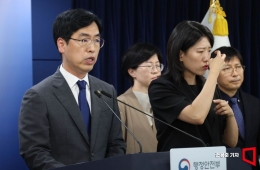
Yoon Ho-jung, Minister of the Interior and Safety, is reporting on measures to strengthen the fairness of police investigations at the Cabinet meeting presided over by President Lee Jae-myung at the Blue House on August 4, 2026.
View original imageMeanwhile, President Lee also raised the issue of the practice of withholding the results of disciplinary measures against police officers and other public officials from the public under the pretext of "personal information" and "privacy." He said, "When a public official is disciplined for an incident related to the execution of public duties, how can that be considered a matter of privacy?" He instructed the Ministry of Government Legislation and the Ministry of Personnel Management to review the scope of making disciplinary actions public and to consider reforms to related systems. President Lee reiterated, "For a public official, it may be just one of dozens or even hundreds of cases in a career, but for those involved, it may be a matter of life and death." He stressed once again that the police must have a strong sense of responsibility to ensure that no victims face wrongful harm.
© The Asia Business Daily. All rights reserved. Unauthorized AI training and use prohibited.