[Q&A] "SCIA to Balance Autonomy and Oversight... No Disadvantage in Ranks or Working Conditions"
SCIA Preparatory Team Briefs on Establishment Progress
Investigators Account for 89.3% of Total Staff with 2,567 Members
Staffing Procedures Underway... Headquarters and Six Regional Branches to Be Established
The Preparatory Team for the Establishment of the Serious Crime Investigation Agency (SCIA) under the Ministry of the Interior and Safety announced on August 4 that draft legislations for the "Organization of the Serious Crime Investigation Agency and Its Affiliated Institutions" and the "Decree on Appointing Investigators of the Serious Crime Investigation Agency" will be put up for public notice from August 5 to 10.

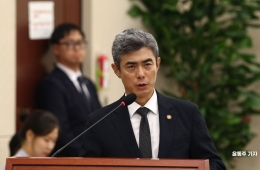
Kim Minjae, Deputy Minister of the Ministry of the Interior and Safety, is giving a briefing on the opening of the Serious Crime Investigation Agency at the Government Seoul Building in Jongno-gu, Seoul on August 4, 2026. Photo by Cho Yongjun
View original imageThe preparatory team explained that for prosecutors being appointed from the Prosecutors’ Office to the SCIA, their ranks and working conditions will be set so that they are not at a disadvantage compared to their previous positions. The team also conveyed its intention to harmoniously maintain democratic oversight and autonomy to establish the agency as a trusted institution. For the SCIA headquarters, a private building that meets requirements for space, accessibility, and security has been selected.
The following is a Q&A with the SCIA Preparatory Team.
-How many prosecutors, investigators, and general public officials will there be, respectively?
▲ In accordance with the SCIA Act, prosecutors previously affiliated with the Prosecutors’ Office will be appointed as "investigators" upon their transfer to the SCIA. The total staff consists of 2,567 investigators, accounting for 89.3% of the organization, while general public officials and others make up 307 members, or 10.7%.
-What are the functions of the SCIA headquarters and its regional branches?
▲ The SCIA is a specialized investigative agency created under the principle of separating investigation and prosecution. The headquarters is responsible for policies on investigations, directing and supervising investigations, and human rights protection policies. The regional branches directly investigate serious crimes within their respective jurisdictions. Regional SCIA branches will be established in six locations: Seoul, Suwon, Daejeon, Daegu, Busan, and Gwangju. In consideration of the concentration of major crime investigations and the vast jurisdiction compared to other regional branches, 1,089 personnel have been assigned to the Seoul branch, with three deputy chiefs appointed under the branch chief.
-There are concerns that setting the investigator rank equivalent to that of prosecutors at grade 4 or higher is unfair compared to other public officials.
▲ Prosecutors transferring to the SCIA will be appointed to corresponding ranks based on previous positions and legal experience: chief public prosecutors to grade 1, deputy or division chief prosecutors to grade 2, those with more than 10 years of legal experience to grade 3, and those with less than 10 years of experience to grade 4 investigator. These ranks are a temporary measure that only apply to prosecutors appointed from the Prosecutors’ Office to the SCIA, and will be in effect from October 2 until April 30 of next year in accordance with the implementing regulations. The aim is to ensure the transition of key investigative personnel and to set grades and conditions that are not less favorable than before.
-Are there plans to recruit external experts, such as police officers or lawyers?
▲ The establishment of the SCIA is an organizational restructuring as part of prosecution reform, resulting in the personnel and functions of the current Prosecutors’ Office being separated into the SCIA and the Public Prosecution Agency. Consequently, in accordance with the supplementary provisions of the SCIA Act, priority will be given to staffing with those in the Prosecutors’ Office who wish to be appointed to the SCIA. After the scale of personnel transfer from the Prosecutors’ Office is finalized, fields and scales for additional recruitment of external professionals will be assessed and experienced-based hiring will be carried out. The necessary qualification requirements, such as relevant work experience and certificates, have already been specified for such recruitment.

The building of the Seoul Supreme Prosecutors' Office. Photo by Yonhap News Agency
View original image-There are concerns that the Minister of the Interior and Safety holds excessive authority over personnel appointments of SCIA investigators.
▲ Given the SCIA will exercise strong investigative powers, there is a recognized need for democratic oversight. However, appointment recommendation authority for grades 1 to 5, authority for grade 5 transfers, and appointment authority for grade 6 and below investigators are delegated to the chief of the SCIA to ensure autonomy. Additionally, unlike the Prosecutors’ Office, the SCIA has independent budgetary authority, which further ensures institutional autonomy. The agency plans to harmoniously maintain autonomy and democratic oversight to become a trusted institution.
-What is the background and schedule for holding information sessions about appointments?
▲Before beginning recruitment for appointments as stipulated in Article 4 of the supplementary provisions of the SCIA Act, information sessions will be held to provide necessary information about the SCIA's organization, roles, and appointment procedures to prosecutors and staff of the Prosecutors’ Office. The sessions will be conducted from August 5 to 12 for prosecutors and staff under the Ministry of Justice and the Prosecutors’ Office. Morning and afternoon groups will be organized by region, with explanations on the SCIA's organization, HR, budget, and headquarters, as well as Q&A sessions.
-Why was a private building selected for the SCIA headquarters?
▲Joint use of existing prosecutors' office buildings was excluded as it was inconsistent with the intent to separate investigation and prosecution. Continuously reviewing idle government properties that could be used immediately did not yield any buildings meeting the required area. After the preparatory team's launch, field inspections and internal discussions led to the selection of a private building meeting requirements for accessibility and security.
-Why was the location for the Daejeon branch selected in Sejong City?
▲ Both government-owned and private buildings in the Daejeon area were considered, but none met the requirements. The search area was therefore expanded to neighboring Sejong City. Based on field inspections and technical reviews, a building in Sejong City was found suitable and was selected. In the future, the possibility of constructing and relocating to the old Daejeon Tax Office site (pending government property repurposing) in Daejeon is also under consideration.
Hot Picks Today
 "Eat and Play All Day for Just 20,000 Won"... Rise of 'Chinese Gatherings' Spreading by Word of Mouth
- "I Washed Dishes Too"... The '22,000-Won Jensen Huang' Who Went Viral Makes a Sincere Request to NVIDIA
- Korean Student Among Alleged Perpetrators in Cornell University Gang Rape Case... US Actress Florence Pugh Calls Incident "Disgusting"
- "One in Three Unsuitable for Marriage": 72-Year-Old Professor's Diagnosis Sparks Fierce Debate Among Chinese Netizens
-Is the SCIA preparing to build its own Criminal Justice Information System (KICS)?
▲ The construction of an independent KICS tailored to the SCIA's specific needs will be pursued after the official launch of the agency.
© The Asia Business Daily. All rights reserved. Unauthorized AI training and use prohibited.

!["Failed Even With Net Assets of 400 Million Won?"... Six Criteria That Define 'The Real Middle Class' [Data Pick]](https://cwcontent.asiae.co.kr/asiaresize/307/2026092809144741876_1790554486.jpg)