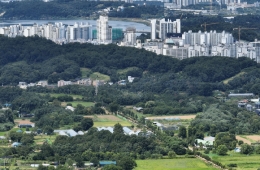
"Unprecedented Heat Possible"... First-Ever Heat Wave Emergency Alert Issued
Heatwave Expands Westward as Typhoon Dolphin Advances
Foehn Effect Intensifies Hot Winds Crossing the Mountain Ranges
Seoul Expected to Break Highest Temperature Record Set Eight Years Ago
The heat wave that has swept across the Seoul metropolitan area is expected to persist for at least ten more days. With the first-ever heat wave emergency alert issued for Seoul and Gyeonggi Province, there are forecasts that temperatures could break previous all-time highs set eight years ago.

On the 3rd, during the ongoing heat wave, the view of downtown Seoul and the Han River was captured with a thermal imaging camera from the observation deck of the 63 Building in Yeongdeungpo District, Seoul. Areas with higher temperatures are shown in red, while cooler areas are displayed in blue. Photo by Yonhap News
View original imageAccording to the Korea Meteorological Administration, starting at 11 a.m. on August 4, a heat wave emergency alert will take effect in Seoul’s southwestern and southeastern districts, and in parts of the capital region, including Osan, Hanam, and western Yeoju in Gyeonggi Province. The alert will also be issued for parts of South Jeolla Province, such as eastern Gwangju, Jangseong, Boseong, Yeosu, Gwangyang, Suncheon, northern Gokseong, and western Gokseong. This is the first time a heat wave emergency alert has been declared in the capital region since the system was implemented in June of this year.
The heat wave emergency alert is issued when the apparent temperature is expected to reach at least 38 degrees Celsius for over a day, or when the maximum temperature is projected to exceed 39 degrees Celsius, in areas where the apparent temperature has already been at least 35 degrees Celsius for two consecutive days.

The entire metropolitan area is already under a heat wave warning, and this extreme heat is projected to continue for at least ten more days, through August 13. On this day, high temperatures in major cities are expected to reach 38 degrees Celsius in Seoul, 37 degrees in Incheon, and 37 degrees in Suwon. In Seoul, the temperature already climbed to a yearly high of 36.7 degrees Celsius the previous day, approaching the all-time record high of 39.6 degrees set in August 2018. That figure was the highest recorded since the beginning of modern weather observations 111 years ago.
The expansion of the heat wave, which has been heating up the Yeongnam region, westward is attributed to the influence of Typhoon Dolphin. As Dolphin approaches the seas southeast of Japan and rotates counterclockwise, it generates easterly winds. When these winds reach the Korean Peninsula, they cross mountain ranges and become even hotter. This process creates a hot, dry wind through the 'Foehn phenomenon,' in which moist air drops rain as it crosses high mountains and transforms into hot, dry gusts descending into the lowlands, fueling the heat wave spreading westward.
Hot Picks Today
 "No Wonder It Soared Today... Morgan Stanley Eyes 3 Million Won Target—Which Stock Is It?"
- "Who Wants to Hire 40 Skilled Kimbap-Making Women?"... A 'Suspicious Ad' Appears Online
- "Why Waste Scorching Subway Heat? New York Launches 1.1 Billion Won 'Innovative Experiment'"
- "If You're So Sure, Try It Yourself": 44-Year-Old Father Admitted to Prestigious University After Daughter's Challenge
- "This Is Not Right, Chairman"...Flood of Criticism over SK hynix's Pursuit of 'Five-Layer Duplicate Listing'
Meanwhile, according to the Korea Disease Control and Prevention Agency’s emergency room surveillance system for heat-related illnesses, 2,025 cases of heat-related illnesses were reported, and 16 deaths were recorded between May 15 and August 2 this summer.
© The Asia Business Daily. All rights reserved. Unauthorized AI training and use prohibited.