[Good Morning Market] US Stocks Surge as AI Profitability Concerns Ease...Korea Also Expected to Rally
Trump Cancels Iran Airstrike, Easing Macro Uncertainties
"Normalization Process for the Domestic Stock Market"
As U.S. stock markets surged due to the easing of concerns over artificial intelligence (AI) profitability, fueled by strong second-quarter earnings from hyperscaler companies, it is expected that the Korean stock market will also show a bullish trend.
On August 3 (local time), the Dow Jones Industrial Average closed at 53,178.41, up 1.32% from the previous session at the New York Stock Exchange (NYSE). The S&P 500 Index rose by 1.48% to 7,600.5, and the Nasdaq Composite ended up 2.13% at 25,913.9.
The fact that the main sectors leading the U.S. market—including Big Tech (major information technology companies) and semiconductors—confirmed robust second-quarter results has led to a decline in negative commentary regarding AI. Experts say that the upward revision of annual capital expenditure (CAPEX) guidance for this year by the four leading hyperscalers—Amazon, Alphabet, Meta, and Microsoft—from USD 710 billion to USD 755 billion, as seen in this earnings season, has been a driving force behind the stock market rebound. Han Ji-young, a researcher at Kiwoom Securities, stated, "Although there were no specific figures presented for next year’s CAPEX, the Bloomberg consensus shows that CAPEX for 2027 is nearing USD 1 trillion, which is also a positive sign."

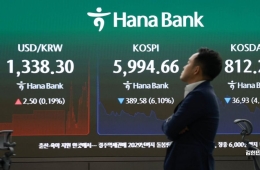
On the 3rd, employees were monitoring the stock market and exchange rates in the dealing room at the Hana Bank headquarters in Jung-gu, Seoul. That day, the KOSPI started at 6,358.27, down 3.6% from the previous trading day, continuing its downward trend, while the KOSDAQ started at 709.00, down 1.3%, before turning upward. August 3, 2026. Photo by Jo Yong-jun
View original imageRecently, military tensions between the United States and Iran—which had been a source of volatility for major global stock markets—have eased again under the so-called 'TACO' (Trump Always Chickens Out) effect. As a result, oil prices have plunged, and risk appetite in macroeconomic terms has improved as well.
KOSPI is expected to show a strong trend, supported by continued perceptions of overselling following the steep decline in July and the sharp drop in the previous day, the falls in oil prices and interest rates, and the rebound in U.S. semiconductor stocks. Han also emphasized the need to pay attention to Palantir's strong second-quarter results and raised guidance, driven by surging commercial and government revenue after market close, as well as the profitability indicator ‘Rule of 40’ for SaaS (Software as a Service) firms which hit 155%, with after-hours shares surging by over 13%. Han added, "This is positive for the domestic stock market, as it demonstrates AI monetization through software in the application category, a core area of the AI value chain."
Hot Picks Today
 "Expensive, Smelly and Scary"... What's Happened to the "Honeymooners' Paradise" Tourists Have Abandoned?
- Women Who Say "A Husband's Annual Salary of 100 Million Won Is a Given"... Matchmaking CEO: "They Talk About It Like It's Nothing"
- "I Want to Eat Like Koreans..." Foreigners Who Once Opened Ramen Packs Now Keep Gochujang in Their Pantries
- Saemaul Geumgo Mutual Aid Insurance Member Data: More Than 400 Records Leaked... "Includes Encrypted Resident Registration Numbers and Balances"
- "They Said Today Was the Cheapest..." "Let's Get Wedding Jewelry!" Why Did the Luxury Brand Crowds Flocked To Cut Prices by 1.08 Million Won?
Furthermore, he noted as a positive factor that the market consensus for KOSPI operating profit has been revised upward to KRW 974.9 trillion this year, thanks to robust performance from main industries including semiconductors at the end of July. Additionally, the proportion of leveraged trading value of single stocks in KOSPI dropped sharply from 33.4% on July 30 to 5.4% on August 1, which is also expected to be a favorable development.
© The Asia Business Daily. All rights reserved. Unauthorized AI training and use prohibited.