"The Korean Stock Market Isn't Over Yet... Focus on the Trend, Not Just a Single-Day Fluctuation" [Click e-Stock]
Hana Securities: "Select Companies With Real AI Sales and Cash Flows
Despite High Volatility in August, Focus on the Direction of Profits"
!["The Korean Stock Market Isn't Over Yet... Focus on the Trend, Not Just a Single-Day Fluctuation" [Click e-Stock]](http://www.asiae.co.kr/news/img_view.htm?img=2026080408024968216_1785798168.png)
Hana Securities commented on the recent sharp fluctuations in the KOSPI, stating on the 4th, "We need to look at the direction of the era, not just a day's rebound." While the KOSPI rebounded by 17.91% on July 31st in a single day, this did not completely recover the monthly loss. However, July's export data and corporate earnings demonstrated once again that demand for semiconductors and artificial intelligence (AI) remains robust.
The KOSPI closed at 6,595.45 on July 31st, up 17.91%. Both the absolute and percentage increases marked the largest on record. However, for the whole of July, the index fell by 22.19%, recording the third-largest monthly decline since the 1997 foreign exchange crisis and the 2008 global financial crisis.

On the 3rd, an employee is monitoring the stock market and exchange rates in the dealing room at the headquarters of Hana Bank in Jung-gu, Seoul.
View original imageKim Du-eon, a researcher at Hana Securities, said, "A single day's rebound has not erased all of the month's shock, but it is also difficult to see it as simply a technical bounce driven by an oversold level." On that day, shares in Samsung Electronics rose 26.81%, while SK hynix, SK Square, and Samsung Electro-Mechanics hit their upper trading limits. He explained that capital was concentrated not across the entire market but in semiconductor and AI-related stocks, indicating the market has chosen new leading sectors.
The principal players in the market shifted as well. Net foreign buying combined from the Korea Exchange and NextTrade reached KRW 8.7709 trillion, the highest ever recorded, while individuals recorded net selling of KRW 10.3834 trillion. Kim pointed out, "It is important that the main agents behind the sell-off and the rebound have changed," and added, "Ultimately, what determines the direction of stock prices is not the magnitude of the rebound, but orders, exports, and profits."
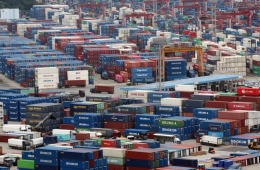
Exports in July amounted to USD 98.89 billion, up 62.8% from the previous year. This is the second-highest figure ever on a monthly basis, with the trade balance recording a surplus of USD 30.32 billion. Semiconductor exports also grew 178.8% year-on-year, reaching USD 41.01 billion. However, this was an 8.5% decrease compared to the all-time high in June, indicating a slightly slower month-on-month growth rate. Of the top 20 major export items, 19 saw increases, and exports excluding semiconductors grew by 26%, suggesting the scope of recovery is actually broadening.
Corporate earnings pointed in the same direction. Samsung Electronics posted KRW 171.5 trillion in sales and an operating profit of KRW 89.5 trillion in the second quarter, while SK hynix also hit record highs with KRW 79.3187 trillion in sales and KRW 60.5426 trillion in operating profit. High bandwidth memory (HBM), server DRAM, and enterprise solid-state drives (SSDs) fueled these improvements.
!["The Korean Stock Market Isn't Over Yet... Focus on the Trend, Not Just a Single-Day Fluctuation" [Click e-Stock]](http://www.asiae.co.kr/news/img_view.htm?img=2026080311021567335_1785722535.jpg)
However, volatility is expected to inevitably increase in August. Several factors are likely to be tested at once: whether semiconductor prices continue to rise, whether major IT companies maintain their AI investments, and uncertainties related to high interest rates and U.S. policy. Major IT companies such as Amazon and Google are also reporting divergent free cash flows (the amount of cash generated after accounting for investment expenses). Google turned negative on free cash flow this quarter due to large-scale facility investments, but maintained a surplus on a rolling 12-month basis. The U.S. Federal Reserve kept the benchmark interest rate unchanged in July, but Hana Securities remains open to the possibility of a rate hike in September.
Hot Picks Today
 "Apparently, you can easily make 3.3 million won a month in Korea"... The "easy-money gig" making waves among international students
- "Is My Home Safe?" Water Gushing into Concrete for Apartment Construction... LH President: "We Will Inspect and Take Action" [2026 Parliamentary Audit]
- Korean Companies' Share of EV Battery Cathode Materials Falls to 9%; LFP Tops 65%
- "Hand in Your Resignation and Get a Year's Salary"... This Country Pushes Early Retirement for Civil Servants
- "Oh Eunyoung's Consultation Fee: Millions of Won? Not Expensive"... Yonsei Professor's Sharp Rebuke over "300,000-Won Lecture Fee"
Seasonal factors are also not favorable. Since 1980, August has recorded the lowest average KOSPI return among all twelve months, at -1.4%. Kim advised, "Rather than chasing sharp rallies or interpreting steep declines as the end of a trend, investors should focus on companies where exports and profits are confirmed and AI investments are actually translating into sales and cash flow." He added, "Short-term returns are determined by timing, but long-term returns rely on the direction of the industry, corporate profits, and the ability to withstand over time."
© The Asia Business Daily. All rights reserved. Unauthorized AI training and use prohibited.