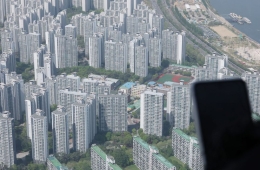
Apartment Worth 4 Billion Won: Comprehensive Real Estate Tax '3.25 Million Won for Residents, 11.14 Million Won for Non-Residents'...Will Listings Increase? [2026 Tax Reform]
CRHT on 7 Billion-Won Homes to Surge 4.7 Times
For Resident Single Homeowners, Rise Limited to 3.5 Times
CRHT Gap Between Non-Resident and Resident Owners at 1.35 Times
Eased Tax Burden Expected to Bring More Listings to Market
With the government revising the tax code to differentiate the tax burden based on whether an owner actually resides in their property, non-resident owners of a single home and ultra-high-priced property owners are expected to face a significant increase in their tax liability. According to simulations by the Ministry of Economy and Finance, a 60-year-old non-resident owner of an ultra-high-priced home valued at 7 billion won would see their comprehensive real estate holding tax (known as the "comprehensive real estate tax") rise to 44.8 million won—about 4.7 times higher than under the current system. As the burden becomes concentrated on non-resident single-home owners and those owning ultra-high-value properties, the government forecasts an additional tax revenue of 2.2 trillion won by 2029. However, the market anticipates that the strengthening of the tax regime will result in only a limited increase in properties being put up for sale.
The centerpiece of the 2026 real estate tax reform plan announced by the Ministry of Economy and Finance on August 3 is to center comprehensive real estate tax benefits around "actual residence." The ministry explained the purpose of the revision, stating, "While easing the tax burden on single-home owners residing in their property, the aim is to normalize the burden for non-resident owners."
![Apartment Worth 4 Billion Won: Comprehensive Real Estate Tax '3.25 Million Won for Residents, 11.14 Million Won for Non-Residents'...Will Listings Increase? [2026 Tax Reform]](http://www.asiae.co.kr/news/img_view.htm?img=2026080317243868014_1785745478.png)
The basic deduction for the comprehensive real estate tax for non-resident single-home owners will be reduced to 900 million won—the same as for owners of multiple homes. Previously, all single-home owners, regardless of residency, were eligible for a basic deduction of up to 1.2 billion won, but now, to increase the tax burden for non-resident single-home owners, their basic deduction will be lowered to 900 million won. For owners of two or more homes, the basic deduction will be further reduced to 400 million won, and only a proportion of the value of their primary residence, up to a 500 million won limit, can be additionally deducted based on its share in the total property value. In contrast, the basic deduction for resident single-home owners will be raised to 1.4 billion won. Additionally, for owners of three or more homes, the fair market value ratio used to calculate the tax will be set at 80%.
The comprehensive real estate tax burden for non-resident single-home owners is expected to become more tangible. In a scenario presented by the Ministry of Economy and Finance, if a 60-year-old has owned a single home for ten years but does not reside in a 4 billion won (market price) apartment with an officially assessed value of 2.8 billion won, the comprehensive real estate tax would increase from 2.63 million won currently to 11.14 million won in 2028—an increase of 4.2 times. In contrast, if the owner resides there themselves, the tax would be 3.252 million won. For expensive apartments in areas like Jamsil or Banpo with a market price of 4 billion won, if the owner does not reside in them and instead leases them out, the removal of previous tax deductions means the comprehensive real estate tax will soar to more than four times the current level.
For a 60-year-old owner with a single high-priced home assessed at 5 billion won and a market value of 7 billion won, the comprehensive real estate tax burden would rise from 9.377 million won to 44.801 million won in 2028 if the owner is a non-resident. In comparison, for a resident owner of the same age, the tax burden would be 32.957 million won, which is about 23 million won higher than current levels.
![Apartment Worth 4 Billion Won: Comprehensive Real Estate Tax '3.25 Million Won for Residents, 11.14 Million Won for Non-Residents'...Will Listings Increase? [2026 Tax Reform]](http://www.asiae.co.kr/news/img_view.htm?img=2026080317373368031_1785746253.png)
The government’s adjustment of deduction rates in the comprehensive real estate tax to favor residency appears to be an effort to cut off speculative demand from non-resident single-home owners and prompt them to list their properties for sale. By imposing a differentiated tax burden based on residency status, the intention is to encourage owners to fulfill the required residency period even just to benefit from tax reduction. Furthermore, from 2028, the special long-term holding deduction—currently allowing up to an 80% reduction in capital gains tax if residency and ownership conditions are met—will be entirely revised to be residency-oriented, so the residential property market is expected to shift more toward actual occupancy as people seek to reduce their capital gains and comprehensive real estate tax burden.
The question is whether this will actually result in more properties being listed for sale as the government intends. Experts believe there will be a certain increase in demand to sell ultra-high-priced single homes before 2028, when the special long-term holding deductions for both the comprehensive real estate tax and capital gains tax are fully restructured to emphasize residency. Premier Pathfinder specialist at Shinhan Bank, Woo Byung-tak, explained, "Among non-resident single-home owners feeling the pressure of property holding taxes, there will be a growing trend to sell before 2028 to also reduce capital gains tax. As a result, we can expect to see more ultra-high-priced homes coming onto the market."
Hot Picks Today
 "Thanks to Consumers Turning Away, Twosome Place Enjoys a Boost as Customers Flock Away from Starbucks"
- "Lifetime Democratic Supporters Turn Away Amid Stock Crash... Foreign Media: 'Political Burden for President Lee'"
- "Money Matters More Than Studying": 2.7 Million Won Camps Fully Booked as Chinese Parents Raise 'Little Buffetts'
- "Should You Buy Hynix Tomorrow?"... What Is the 'Rumor About Why Chey Tae-won Said to Buy the Stock'?
- "Air Conditioning on Full Blast and Even Free"...An Unexpected 'Hot Spot' for Seniors Amid Heat Wave
However, within the market, consensus is leaning toward the effect on the supply of properties for sale being limited. It is unlikely that resident single-home owners will sell their homes simply to lower their tax burden. Furthermore, current homeowners are more likely to pass on higher costs by raising deposit or monthly rent prices. As a result, there are growing concerns that this could simply add to instability in the rental market. An anonymous licensed realtor commented, "With real estate prices rising by tens of millions of won in just a few weeks, it's unlikely that owners of ultra-high-priced homes will simply decide to sell."
© The Asia Business Daily. All rights reserved. Unauthorized AI training and use prohibited.