Employees Earning Over 5 Million Won or With 5+ Years Service Receive More Work Calls During Vacation
Workplace Gapjil 119 Survey of 1,000 Workers
"16% Worked at Office During Vacation"
According to a recent survey, one out of two office workers has experienced receiving work-related communications, carrying out work tasks, or even going to the office during their vacation period.

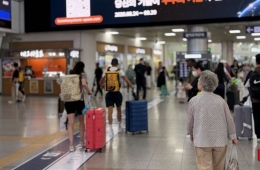
On the 2nd, the departure hall of Terminal 1 at Incheon International Airport was bustling with passengers ahead of the holiday season. Incheon International Airport Corporation predicted a total of 234,273 passengers for arrivals and departures combined on this day. Yonhap News
View original imageOn August 2, the civic group Workplace Gapjil 119 announced the results of a survey it commissioned from Global Research, a leading polling firm. The survey, conducted from June 1 to June 9, 2026, targeted 1,000 office workers across the nation aged 19 and above. Among respondents, 48.8% reported having received work communications while on vacation.
Of the 488 respondents who received work communications, more than half—53.5%—said they had to handle work tasks during their vacation. Specifically, 37.7% said they responded immediately to such communications by working from their vacation spot, home, or a cafe, while 15.8% reported that they returned to the office or to the worksite to perform their tasks.
By age group, 24.6% of respondents in their 20s who had received work communications said they returned to the office or worksite, the highest percentage among all age groups. This was followed by: ▲30s at 15.6%, ▲50s at 15.4%, and ▲40s at 11.6%. Meanwhile, 30.5% said they relayed the work details to colleagues and asked them to handle it. By contrast, only 15.6% of those contacted during vacation said they notified their workplace that they were on vacation and postponed the task.
By respondent characteristics, the proportion of those receiving work communications during vacation was higher among those with higher wages (61.2% for those earning 5 million won or more), those in higher positions (69.8% for middle managers), and those with longer tenures (57.1% for over 5 years).
Examples of office workers contacted during vacation include one employee, who reported to Workplace Gapjil 119, "During my vacation, my team leader pressured me via messenger to keep submitting work documents," adding, "In the end, I worked and responded to messages while on leave." Another employee complained, "With the company forcing staff cuts, they not only forced me to work after hours but also required me to respond to work communications and attend meetings during vacation." In response, Workplace Gapjil 119 pointed out, "Repeated work communications after working hours or during vacation infringe on employees' right to rest," and added, "Depending on the severity, this may constitute workplace harassment."
Revisions to the Labor Standards Act prohibiting employers from giving work instructions through phone calls, text messages, or communication apps such as KakaoTalk outside of working hours were proposed in July and September 2024, but the bills still remain pending in the National Assembly.
Hot Picks Today
 "Surviving on One Meal a Day to Invest 3.5 Million Won Monthly... 'FIRE' Craze Sparks 'NISA Poverty' in Japan"
- "Correction Over for Samsung and SK hynix" "670,000 for Samsung, 4.7 Million for SK hynix": Why Global IBs Remain Optimistic
- "Used for the Wedding" 300,000-Won Ring and Dress...Changing Wedding Trends
- Causing Trouble Without a Simple "Sorry"... The Reason Behind the 'Gen Z Stare' Revealed
- Nongshim Third-Generation Executive Sangyul Shin to Wed SKT Employee on the 13th
Heeseong Jeong, a labor attorney from Workplace Gapjil 119, stressed, "Contacting employees for work during time off or after working hours infringes on the right to rest and constitutes an abuse that forces unpaid labor," and emphasized, "There needs to be an institutional guarantee of the 'right to disconnect.'"
© The Asia Business Daily. All rights reserved. Unauthorized AI training and use prohibited.