Blue House Respects National Assembly's Decision Following Passage of Criminal Procedure Act Abolishing Prosecutors' Supplementary Investigation Rights
"Preventing Monopoly and Abuse of Power,
Raising the Level of Protection for Victims and Citizens' Rights"
"Ensuring Seamless Implementation of the Revised Act"
On July 31, the Blue House stated, "We respect the legislative process of the National Assembly and its final decision," in response to the passage of the amended Criminal Procedure Act at the plenary session, which includes abolishing supplementary investigation rights for prosecutors.

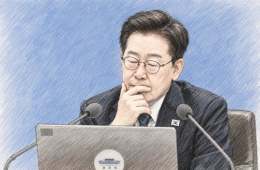
On December 29, 2025, President Lee Jae-myung went to the Blue House, officially marking the return of the Blue House era after 3 years and 7 months. The phoenix flag is flying at the Blue House in Seoul. Photo by Jo Yongjun
View original imageSeong Kihong, Senior Presidential Secretary for Public Relations and Communications, said, "This amendment to the Criminal Procedure Act is intended to prevent the monopoly and abuse of power by separating investigation and prosecution, while also raising the level of protection for victims' and citizens' human rights."
Seong further emphasized, "The criminal justice system will take a step closer to the public," adding, "We will do our utmost to ensure that the revised bill is implemented seamlessly in practice and that citizens are able to feel these changes in their daily lives."
On this day, the National Assembly convened a plenary session in the afternoon and passed the amended Criminal Procedure Act with 175 votes in favor, 2 against, and 1 abstention out of 178 lawmakers present. The Democratic Party of Korea and other members of the coalition forced an end to the filibuster initiated by the People Power Party the previous day after 24 hours, then put the bill to a vote. Amid fierce confrontation between the ruling and opposition parties, the People Power Party attempted to block the bill through a filibuster (a legitimate parliamentary procedure involving unlimited debate), but the Democratic Party and its allies ended the debate by a vote after 24 hours and passed the bill.
The amendment deletes Article 196 of the Criminal Procedure Act, which had granted general investigative powers to prosecutors. This means that prosecutors are now prohibited from conducting direct investigations or supplementary investigations on transferred cases. Prosecutors can request supplementary investigations from the police, but cannot carry them out directly. Police no longer have the authority to conclude investigations unilaterally; instead, cases investigated by the police must, in principle, be transferred to prosecutors.
Measures to protect victims have also been strengthened. The amendment expands victims' rights to submit materials and express their opinions, establishes grounds for notifying case proceedings, and allows victims to view and copy investigation records. Complainants have also been added to the list of those who can file objections to police decisions not to refer cases for prosecution. Additionally, the amendment makes it a valid reason for detention if there is concern that a defendant may harm the victim.
Hot Picks Today
 "I'm Scared, Please Don't Go to Japan Right Now"... Tourists on High Alert as Deaths Occur and Trains Halt
- "Receiving 3.8 Billion Won and Claiming 'High Pay Prevents Bribes'... The Country with the World's Top-Paid Prime Minister Plans 64% Salary Hike"
- "Works at a Major Corporation and Wins the Lottery Too"...Is the 1.2 Billion Won Prize Claim by 30s Employee Real?
- "Hardly Eating, Only Napping After the Ordeal"...Cats Felt 'Fear' During Kumamoto Earthquake
- "Over 300 People Gathering to Read in Nightclubs? Why the World Is Embracing Social Reading, Even If It's Just for Show"
This amendment will go into effect on October 2, in tandem with the planned establishment of the Public Prosecutors' Service and the Serious Crime Investigation Agency. Accordingly, the government is expected to accelerate follow-up preparations, including revising enforcement decrees and investigation regulations, transferring cases, and dividing work between investigative agencies.
© The Asia Business Daily. All rights reserved. Unauthorized AI training and use prohibited.