"Sweltering Heat Continues in Jeju: No Rain in Sight as Tropical Nights and Heatwaves Persist"
Heatwave and Tropical Nights Continue Across Jeju for 24 Consecutive Days
Typhoon Dolphin to Approach Tokyo on the 5th... Its Path May Affect Weather
With heatwave advisories and tropical night warnings issued across Jeju, except for the mountainous regions, the sweltering heat is expected to persist through the first weekend of August and into the following week, with daytime maximum apparent temperatures reaching close to 35 degrees Celsius and nighttime temperatures hovering around 27 degrees. As such, residents are urged to exercise heightened caution to prevent heat-related illnesses and take special care of their health.

According to the Jeju Regional Meteorological Administration and weather reports on July 31, the Jeju region will remain mostly clear under the influence of the North Pacific High for the time being, and no rainfall is expected through the next weekend, indicating that the scorching heat will continue for an extended period.
Currently, a heatwave warning is in effect for the southern part of Seogwipo, while heatwave advisories are active for the mid-mountain, eastern, and western areas of Jeju and Seogwipo, as well as Chuja Island.
In addition, tropical night warnings have been issued for the northern, western, and eastern parts of Jeju City and the southern and western parts of Seogwipo. As a result, daytime high temperatures will remain between 32 and 33 degrees, and the maximum apparent temperature is expected to soar above 33 degrees (and above 35 degrees in areas with a heatwave warning), resulting in very oppressive conditions.
The daytime heat is not dissipating at night, leading to continued tropical night conditions. During the previous night, the minimum temperature reached 27.6 degrees in Jeju City and 26.1 degrees in Gosan, confirming the occurrence of tropical nights.
This year, the total number of days with tropical nights at major locations in the province has been highest in Jeju City with 24 days, followed by Seogwipo with 23 days, Gosan with 20 days, and Seongsan with 16 days.
The Korea Meteorological Administration has forecast that strong sunlight will cause the ultraviolet index during the day to remain at “high” to “very high” levels for the time being, and has urged people to refrain from outdoor activities and to ensure adequate hydration.
Meanwhile, Typhoon Dolphin, the 13th typhoon of the year, was moving west-northwest at a speed of 16 km/h over waters approximately 2,020 kilometers northeast of Guam on the morning of July 31.
Dolphin has developed into a “Category 5” super typhoon, with maximum central sustained winds of 56 m/s, and is expected to approach waters about 1,250 kilometers south of Tokyo, Japan, by the morning of August 5.
This prolonged heatwave in Jeju has been caused by the strength of the North Pacific High, which is firmly parked over the Korean Peninsula and has not weakened easily.
Hot Picks Today
 "Even More Money Isn't Enough: Gen Z Refuses Management Roles Over Added Responsibility"
- "Licking a Straw Changed His Life: The Consequence for a 19-Year-Old's Vending Machine Prank"
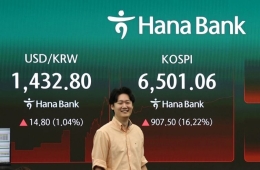
- Semiconductors Spark Foreign Investors’ Comeback: KOSPI Soars Over 16%, Highest Gain on Record
- "Betrayal in a Cup of Iced Coffee"... Even 7,500 Won Coffee Not Spared from 'Contaminated Ice'
- Crawling and Rolling on All Fours in Broad Daylight... The Reason Behind a Woman in Her 20s’ Shocking Behavior Near Suwon Station
While the movement of Typhoon Dolphin and its interaction with the atmospheric pressure systems over the Korean Peninsula could act as a variable in future weather patterns, for now, the heat of around 33 degrees and tropical night conditions are expected to persist. Accordingly, measures to prevent damage to agricultural and livestock products and preparations to handle heat-related illnesses must be thoroughly maintained for safety management.
© The Asia Business Daily. All rights reserved. Unauthorized AI training and use prohibited.