Semiconductors Spark Foreign Investors’ Comeback: KOSPI Soars Over 16%, Highest Gain on Record
Immediate Return to 6,000-Point KOSPI Fueled by U.S. Semiconductor Momentum
Tim Cook, Apple CEO: "Memory Prices Will Continue to Rise"

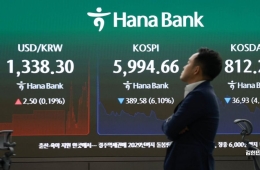
On the 31st, the KOSPI index surged more than 16% in the early session, quickly recovering to the 6,500 level as the trading day began. The index was displayed on the board in the dealing room at the Hana Bank headquarters in Jung-gu, Seoul. 2026.07.31 Photo by Dongjoo Yoon
View original imageThanks to a semiconductor rally originating from the United States, the KOSPI index soared by over 16%, posting the highest single-day gain in its history. Robust earnings announcements from artificial intelligence (AI) companies such as Samsung Electronics and Microsoft, along with positive outlooks for semiconductor demand, suggest that related stocks are expected to find a bottom and attempt a trend reversal. With new regulations on single-stock leveraged exchange-traded funds (ETFs)—which had previously been criticized for amplifying market downturns—coming into full effect, volatility is also expected to decrease.
Rapid Return to the 6,000 Level on the Back of U.S. Semiconductor Rally
As of 10:00 a.m. on July 31, the KOSPI was trading at 6,490.53, up 16.04% from the previous trading day. This marks the highest daily gain in the index's history—to date, the previous record for the largest single-day increase was 11.95% on October 30, 2008, during the global financial crisis. This is also the first time that the index has surged by more than 800 points in a single day. The KOSDAQ jumped 9.06% to 702.99.
The sharp rise in U.S. semiconductor stocks overnight had a positive impact on the domestic market. On the New York Stock Exchange, the Dow Jones Industrial Average rose by 1.19%, the S&P 500 by 1.66%, and the Nasdaq Index by 2.78%. Key semiconductor stocks such as Micron (up 18.36%), SanDisk (25.99%), AMD (13.00%), and Intel (11.30%) posted double-digit gains, leading the Philadelphia Semiconductor Index to jump 8.19%. Microsoft (MS), which posted earnings that far exceeded expectations, rose by 15.51%.

Amazon, which reported strong earnings after the market closed, also climbed more than 6% in after-hours trading. Seo Sangyoung, an analyst at Mirae Asset Securities, commented, "After five consecutive sessions of steep declines, U.S. semiconductor stocks rebounded sharply, driven by earnings reports from Samsung Electronics, MS, and others, as well as options flows, pulling the index higher."
Semiconductor stocks are leading the domestic market as well. As of 10:02 a.m., Samsung Electronics was trading at 257,500 won, up 24.40% from the previous day, and SK hynix was at 1,699,000 won, a 28.44% increase. SK Square and Samsung Electro-Mechanics both hit their daily upper limit of 30%. Hyundai Motor (up 9.40%), Samsung Life Insurance (16.86%), and Samsung C&T Corporation (20.75%) also saw sharp increases. The rally was led by foreign investors, who had recorded net purchases of over 5 trillion won on the KOSPI as of 10:06 a.m., while individual investors had net sold about 5 trillion won during the same period.
Apple CEO Tim Cook’s forecast during the company’s Q3 earnings call—that supply constraints for semiconductors and memory components would continue—was also viewed as a positive factor for semiconductor stocks. Set to retire in September, Cook appeared on his final conference call, projecting weak Q4 earnings due to supply constraints for memory and other components.

Apple announced plans to offset some of the increase in memory prices using savings from inventory and non-memory components. However, Cook stated that there was no sign of an end to the semiconductor shortage for the time being. He said, "After September, memory market prices are expected to continue rising. This could have an increasingly significant impact on our business." Previously, citing 'chipflation' (inflation driven by semiconductors), Apple raised MacBook prices by about 15–20% and iPad prices by about 15–25%. An increase in iPhone prices is also expected later this year.
Cook also reiterated that Apple’s semiconductor supply chain must expand beyond its current three key suppliers. According to the Financial Times (FT), Apple lobbied the U.S. government to allow the purchase of DRAM chips made by China’s Changxin Memory Technologies (CXMT), which was added to the U.S. Defense Department’s blacklist in the first half of this year. The IT-focused publication The Information recently reported that Apple had begun developing its own AI server chips by acquiring a semiconductor startup.
"Memory Chip Demand Remains Robust, Market Seen Bottoming Out and Rebounding"
According to the securities industry, solid growth in memory chip demand is expected to continue beyond next year, with related stocks anticipated to consolidate and rebound. Global investment bank UBS released a report projecting that the acceleration in memory demand will intensify next year.
Nicolas Gaudouin, an analyst at UBS, forecasted that DRAM bit (capacity-based) demand growth would accelerate from 22% this year to 36% in 2027, and NAND flash from 20% to 23%, respectively. He also predicted that memory shortages could persist until 2028, as agentic AI is driving demand that exceeds even the capabilities of high-bandwidth memory (HBM). Accordingly, UBS maintained a 'Buy' rating on SK hynix American Depositary Receipts (ADR), with a target price of $204—representing a potential 33.5% upside from the current price of $149.

Following Samsung Electronics’ robust earnings report the previous day, some analysts raised their target prices on the stock. Korea Investment & Securities raised its Samsung Electronics target price from 590,000 won to 650,000 won, citing the company's multi-year supply contracts that have increased stability and visibility in its memory business. This new target is 2.7 times higher than the current price, which is in the 240,000 won range. Min Sook Chae, an analyst at Korea Investment & Securities, said, "Multi-year contracts will not only improve the stability and visibility of the memory business, but also reduce the risk of recurring supply gluts that have plagued previous cycles by enabling investment based on customer demand."
Expectations are also mounting that volatility will ease with the full implementation of regulations on single-stock leveraged ETFs starting today. According to the Financial Services Commission, the minimum margin requirement for single-stock leveraged products will rise from the current 10 million won to 30 million won. In addition, the commission will set individual investment limits to manage total volume. Asset management firms and brokerages managing single-stock leveraged products will also reduce volatility by splitting the rebalancing trades—typically concentrated near the market close—throughout the trading session.
Hot Picks Today
 "Expensive, Smelly and Scary"... What's Happened to the "Honeymooners' Paradise" Tourists Have Abandoned?
- Women Who Say "A Husband's Annual Salary of 100 Million Won Is a Given"... Matchmaking CEO: "They Talk About It Like It's Nothing"
- "I Want to Eat Like Koreans..." Foreigners Who Once Opened Ramen Packs Now Keep Gochujang in Their Pantries
- "I'd Buy a Home Rather Than Spend 16 Million Won on Guests' Meals"... People in Their 20s and 30s Ditch Wedding Halls and Funeral Viewing Rooms
- "They Said Today Was the Cheapest..." "Let's Get Wedding Jewelry!" Why Did the Luxury Brand Crowds Flocked To Cut Prices by 1.08 Million Won?
© The Asia Business Daily. All rights reserved. Unauthorized AI training and use prohibited.