[Exclusive] Illegal Crypto Exchanges Finally to Be Blocked... BMCDC to Deliberate as with Scam Sites
Prioritizing Review and Blocking for Sites With Confirmed Damages
FIU: "Internal Review and Reporting Underway"
Disagreements Over Excluding Binance From Review
The Broadcasting Media Communication Deliberation Committee (BMCDC) has proposed that, when cooperating with the Financial Intelligence Unit (FIU) on blocking illegal overseas virtual asset exchanges, sites where tangible user harm has been specifically verified should be prioritized and selected as targets for deliberation. This move marks the substantive beginning of procedures to block illegal cryptocurrency exchanges that have caused significant losses, particularly among the youth demographic.

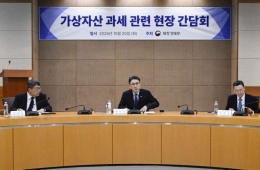
On March 12th, Ko Gwangheon, Chairman of the Broadcasting Media Communication Deliberation Committee, is holding a regular meeting at the Broadcasting Hall in Mokdong, Seoul. Photo by Yonhap News.
View original imageAccording to data submitted to Democratic Party of Korea lawmaker Lee Juhee's office by the BMCDC on July 31, the committee and the FIU held a working-level meeting on July 16 to discuss standards for deliberating the blocking of unregistered overseas virtual asset service providers. The BMCDC suggested prioritizing sites where damages such as criminal fund laundering, illegal currency exchange, tax evasion, or personal data leakage have already been confirmed. This approach mirrors the method used for blocking scam sites, which relies on documents such as 'crime recognition reports' or 'internal investigation reports' prepared by police who have become aware of victimization. The BMCDC clarified that the same method can be applied to overseas virtual asset operator sites. The FIU responded, “We will conduct an internal review and report on the proposal made by the committee.”
FIU and the BMCDC had previously held differing views until this proposal was presented.
![[Exclusive] Illegal Crypto Exchanges Finally to Be Blocked... BMCDC to Deliberate as with Scam Sites](http://www.asiae.co.kr/news/img_view.htm?img=2026073111141365652_1785464052.png)
The FIU asserted that, under the “Act on Reporting and Using Specified Financial Transaction Information,” issues with overseas virtual asset operator sites cannot be regarded simply as cases of unreported business conduct. The agency argued that this is a serious public financial crime, potentially involving investment fraud targeting young people, drug money laundering, illegal currency exchange, tax evasion, and personal data leakage. The FIU pointed out that investigations cannot proceed, as it is difficult to identify the locations of site operators, and police investigations have already come to a halt. The FIU emphasized that if the committee continues to suspend deliberations on the grounds that “investigations are ongoing,” this will only prolong a regulatory vacuum, underscoring the need for active blocking measures.
The BMCDC presented a different explanation. Under its internal regulations, deliberation must be suspended for matters under ongoing investigation, and the committee has not received any formal response from the FIU on updates regarding additional investigative developments, making it difficult to reverse the existing suspension. The committee also raised concerns that blocking entire websites solely for being unregistered may spark controversy over excessive regulation.
The BMCDC separately met with the National Police Agency's Integrated Response Team for Telecommunications Financial Fraud on July 21. This meeting aimed to request data on whether any of the sites for which the FIU had requested deliberation were currently under police investigation for fraudulent crimes. The committee stated, “We are checking whether there are any sites among those submitted by the FIU that are currently under investigation by the police for crimes such as fraud.”
![[Exclusive] Illegal Crypto Exchanges Finally to Be Blocked... BMCDC to Deliberate as with Scam Sites](http://www.asiae.co.kr/news/img_view.htm?img=2026073018291764898_1785403757.png)
There was also disagreement regarding Binance. The FIU explained that Binance terminated its Korean-language service and halted domestic marketing after government press releases, thus excluding it from the deliberation scope. The BMCDC countered that removing major exchanges from regulatory scrutiny based solely on the presence or absence of Korean-language services could be inequitable.
The BMCDC particularly pointed out that even if blocking is based on Korean-language service or marketing, once the operator suspends those activities, the grounds for blocking disappear—meaning access would have to be restored. In other words, with this structure, operators can evade regulation at will. As a result, Binance, the world’s largest exchange by trading volume, is currently not subject to deliberation under this approach.
The issue of blocking illegal cryptocurrency exchanges has been highlighted through this newspaper's special series “Coin Lawless Zone.” The FIU had previously requested cooperation in blocking access to unregistered foreign virtual asset operators (on August 7, 2025, August 22, 2025, and January 12, 2026), but the BMCDC did not begin verification until June 19 this year. Subsequently, the committee signaled the possibility of again suspending deliberation on actions to block illegal overseas exchanges. The committee stated, “Please understand that when issues accepted for review are already undergoing administrative or judicial procedures by courts or other relevant institutions, the BMCDC conducts its deliberations with due consideration for the final rulings of such bodies.”
Related Articles
![[Exclusive] Block on Illegal Coin Exchanges in Jeopardy as Nine-Member BMC Review Committee Also Hints at "Review Suspension"](https://cwcontent.asiae.co.kr/asiaresize/37/2026071614231348860_1784179393.png) [Exclusive] Block on Illegal Coin Exchanges in Jeopardy as Nine-Member BMC Review Committee Also Hints at "Review Suspension"
[Exclusive] Block on Illegal Coin Exchanges in Jeopardy as Nine-Member BMC Review Committee Also Hints at "Review Suspension"
- [Reporter’s Notebook] Illegal Crypto Exchanges Remain Unblocked... Agencies' Explanations Miss the Point
- [Reporter’s Notebook] "Bedroom Administration" Turns Coin Market Into Lawless Zone
- [Exclusive] 13.9 Billion Embezzled Yet Still Neglected... KCSC Fails to Review 'Blocking Requests' [Coin Lawless Zone] ④
On July 21, the FIU and the BMCDC issued an informational statement saying, “We will closely cooperate with investigative agencies to devise effective measures based on objective evidence, and we will strengthen cooperation to ensure timely blocking of access to illegal overseas virtual asset operator sites.”
© The Asia Business Daily. All rights reserved. Unauthorized AI training and use prohibited.