Fed Keeps Rates Steady Amid Uncertainty... Key Focus Shifts to Whether Bank of Korea Will Hike Again Next Month
U.S. Policy Rate Held Steady at 3.50–3.75%
Three Members Advocate "Need for Action Against Inflation"
Market: "September Hike Likely, but Uncertainty Remains"
August Rate Hike in Korea Increasingly Likely—"Eyes on July Core Inflation"
Annual Growth Rate of 3% Virtually Secured, GDI Upswing Expected to Continue
This Increases Demand-Side Inflationary Pressure
With the U.S. Federal Reserve (Fed) deciding to keep interest rates steady as expected, market attention has shifted to the Bank of Korea’s base rate decision next month. As the likelihood that the U.S. will raise rates at least once more this year has increased, investors are closely watching whether the Bank of Korea will implement another hike in August, following July’s increase. Since economic performance in the first half has been confirmed to be strong—one of the factors highlighted by Governor Shin Hyun Song—the inflation figure for July, which will be released early next month, is expected to be a major variable.

Steady as Expected, but Future Direction Becomes Increasingly Uncertain
The Fed kept its policy rate at 3.50–3.75% annually during the Federal Open Market Committee (FOMC) meeting held on the 28th and 29th (local time). However, three members advocated for a 0.25 percentage point increase, highlighting growing pressure within the Fed for action against inflation.
This meeting has been assessed as weakening the credibility of the Fed’s monetary policy. By keeping the statement and decisions basically unchanged from the last meeting, Fed Chair Kevin Warsh gave the impression that his resolve to end inflation remains more rhetorical than practical. Furthermore, by mentioning the possibility of considering inflation indices other than Personal Consumption Expenditures (PCE), the Fed left room to cherry-pick favorable data.
Market participants see a high probability of a rate hike by the Fed in September, but uncertainty remains. The current rate gap between Korea and the U.S. is one percentage point. On the 30th, Bank of Korea Deputy Governor Park Jongwoo also remarked in a market review meeting, "While Chair Warsh reaffirmed his commitment to price stability during the FOMC press conference, he did not provide any concrete signals regarding the future direction of policy," adding, "Uncertainty has increased for monetary policy as well as geopolitical tensions in the Middle East."

August Rate Hike in Korea Increasingly Likely—"Eyes on July Core Inflation"
With caution from U.S. developments, Korea faces its next rate decision on the 27th of next month. Following the July hike (to 2.75% annually) and the accompanying press briefing, the possibility of a consecutive increase in August has become more prominent. Previously, most forecasts anticipated another increase in October, but expectations for back-to-back hikes in July and August are now nearly as prevalent.
Immediate attention is on July’s inflation data. While the consumer price index rise is expected to slow from the previous month, greater focus will be placed on core inflation, which excludes energy prices. In a parliamentary work report delivered the previous day, Governor Shin pointed out, "Due to a short-term shock, June’s inflation rate climbed to 3.2%," adding, "We are paying closer attention to core inflation, which rose to 2.5% in May." Market watchers believe that while the pace of price increases in July may ease slightly compared to the previous month, the level will remain elevated. Choi Jiuk, a researcher at Korea Investment & Securities, commented, "July is seasonally a period when agricultural prices go up," but added, "Given the drop in petroleum prices and a temporary reduction in summer electricity rates, consumer price inflation is likely to come in at -0.3% month-on-month and 2.7% year-on-year based on current data." Core inflation is projected at 2.4% year-on-year, with the cost of living index forecast at 3.1%.
The robust growth in the first half was already confirmed. Real gross domestic product (GDP) growth for the second quarter, quarter-over-quarter, was 0.6%, significantly exceeding the Bank of Korea’s May forecast of 0.2%. Even if growth is flat in the second half, annual growth above 3% is now essentially secured. The real gross domestic income (GDI), another indicator focused on by Governor Shin, increased by 3.6% from the previous quarter and 15.6% from a year earlier in the second quarter. This reflects a sharp rise in purchasing power as the terms of trade have improved, largely on the back of higher semiconductor prices.
Jin-Sung Kim, researcher at Heungkuk Securities, noted, "The Bank of Korea previously assessed that the recent favorable terms of trade will persist for some time and that resulting increases in GDI are more sustainable than in the past, boosting incomes and improving consumption—and thus amplifying the ripple effect on domestic demand." He added, "If this high GDI growth continues, it will further strengthen the foundation for domestic demand growth." This is a factor that could accelerate the Bank of Korea’s monetary tightening. Hojeong Kim, economist at Yuanta Securities, commented, "In the second half, private consumption will be led by income inflows driven by improved terms of trade," and added, "While we maintain one more rate hike in the fourth quarter as our base forecast, the possibility of an August increase has also risen meaningfully."

On the 30th, the electronic board in the dealing room of Hana Bank Headquarters in Jung-gu, Seoul, displayed the current status of the domestic stock market.
View original imageDespite Falling Exchange Rate, Volatility Concerns Remain... Housing Price Rises Also Warrant Caution
The exchange rate has eased to around the 1,440-won level, compared with earlier in the month. This was influenced by the inflow of funds into the foreign exchange market from SK hynix’s listing of American Depositary Receipts (ADR) in the United States. Dollar selling by exporters also contributed to the currency’s decline. However, concerns about increased market volatility persist. The rising trend in housing prices and mounting household debt also remain worrisome. In a report submitted to the National Assembly the previous day, the Bank of Korea noted, "The upward trend in housing prices, especially in the Seoul metropolitan area, is widening again, and as investments leveraging debt increase, the risk of accumulating financial imbalances is growing."
Hot Picks Today
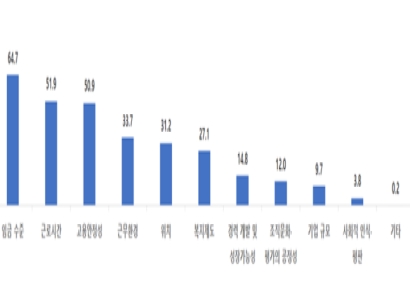 "Please Pay Me at Least 3 Million Won a Month": More Than Half of Young People Today Prioritize "Working Conditions" Over Company Size
- Selling Like Crazy Every Year... 30-Year-Old Hetbahn Takes on a New Challenge: Tastes Better Than "Mom's Home Cooking" [On-Site Report]
- "It's so popular you can't get it": 'Legendary liquor' returns after 11 years, causing a stir... 'Newtro' craze takes over convenience stores [How We Shop Today]
- "Hey, Lady, Teach Your Kids to Behave!" ... 300,000 Won in Cash and a Bodily Injury Claim Demanded Over Child's Door Ding
- "Don't Trust This Woman": Documentary on 'Investment Scammer' Earns KRW 22 Billion in One Week
Meanwhile, on the same day, First Vice Minister Lee Hyung Il of the Ministry of Economy and Finance stated at the joint macroeconomic and financial meeting on the FOMC outcome, "While the Fed kept its rates unchanged, the U.S. economy continues to grow robustly, and corporate facility investment—centered around artificial intelligence (AI)—remains strong." He added, "Considering persistent high inflation in the United States and Europe, as well as ongoing instability in the Middle East, uncertainty about future policy rate paths continues." He went on, "We will closely monitor the monetary policies of major economies, international oil prices, and global capital flows, and assess their impact on the domestic economy and financial markets."
© The Asia Business Daily. All rights reserved. Unauthorized AI training and use prohibited.




![[Market ING] KOSPI Seeks Rebound in Superweek Packed with Corporate Earnings and FOMC](https://cwcontent.asiae.co.kr/asiaresize/307/2026102514484873155_1792907327.jpg)