Park Hong-geun: "Special Subsidies for Companies Moving to Local Regions... Meticulous Preparation Underway"
Subsidies to Be Included in "Region-Led Growth Engine" Initiative
Future Response Fund to Focus Investment on Youth, Regional Development, and Growth Engines
Commitment to Structural Reform of Local Education Finance Grant Confirmed
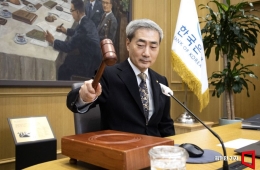
Park Honggeun, Minister of Strategy and Finance, said on the 30th, "We are considering special subsidies to be provided to companies when they relocate or establish new operations," adding, "We will provide far more subsidies to regions outside the Seoul metropolitan area than to the capital itself."

Park Honggeun, Minister of Strategy and Finance, speaking at a Blue House briefing. Photo by Yonhap News.
View original imageAppearing on the YouTube channel "Jang Yoonseon's Press Convenience Store" on the same day, Minister Park stated, "The government will soon announce a region-led growth engine plan and is meticulously preparing a subsidy system." According to the government's "5 Poles, 3 Special Zones" initiative, strategic industries for each region will be finalized within the third quarter, and the government is pursuing a comprehensive "3 Axes, 7 Major Package" of support, encompassing investment incentives and regulatory easing, as well as enacting a special law for mega-special zones by the end of this year. In addition, the government has clarified its policy direction to provide subsidies to companies that move to regional areas.
Plans to establish a "Future Response Fund" utilizing additional tax revenue generated from the semiconductor super-boom have also been made more concrete. Minister Park emphasized, "With tax revenue forecasted to reach record-high levels, we cannot use it all for short-term, one-off expenditures," adding, "We must be prudent and invest effectively, especially during times like these." He identified four main areas for the Future Response Fund to be used: youth, future growth engines, local regions, and talent and education. He also explained, "We have designed the fund to include a stabilization function to supplement fiscal capacity when tax revenue plunges. To ensure accountability, the bill will be directly proposed by the government rather than as an assemblyman-initiated bill, and we plan to enact the law within the year."
Regarding the recent controversies among education authorities and provincial and metropolitan education superintendents over local education finance grants, Park responded forcefully, directly refuting the criticism. He stated, "I have never once said I would reduce the total amount of education finance grants or per-student grants," and criticized, "Using expressions like 'reduction' and 'cutback' sends the wrong signal to parents." He added, "This year, the education finance grant stands at 76.4 trillion won, double the amount from when I was a first-term member of the National Assembly (39 trillion won), and the per-student grant has reached 13 million won, the highest among OECD countries. Both the total grant amount and the per-student grant will continue to increase in accordance with existing upward trends."
However, he made it clear there are plans to reconsider the "automatic linkage of 20.79% of domestic taxes" system. "We will firmly guarantee funding for primary and secondary education, and the surplus will be allocated to higher education, lifelong learning, and early childhood education, where spending is below the OECD average," he said. "Are we trying to pocket those savings personally? Please understand that our intention is to invest properly in education."
Hot Picks Today
 "The Transfer Failed, but 'Ding Dong' Money Came In"... 32.5 Billion Won Financial Incident at Toss Bank
- "They Wouldn't Give It a Second Look When Offered to Ancestors"... MZ Goes Wild for 80-Year-Old Ceremonial Liquor as a Household Must-Have
- Pinky swear: "I'll become a female soldier"... An elementary school student's moving letter of support from 11 years ago
- "Even If He's Handsome, That's a Bit Much"... The "Behavior" That Turns Off 7 in 10 Women
- The 'Hangover Legend' That Had You Waking Up the Day After Tomorrow Returns After 11 Years... Lee Sunmin's Captain Q Sells Out
Finally, Minister Park said, "This government is not a government that exists only for President Lee Jaemyung," stressing, "We must not miss this once-in-a-lifetime opportunity for Korea, and we will do our utmost for the future."
© The Asia Business Daily. All rights reserved. Unauthorized AI training and use prohibited.