Government to Limit Single-Stock Leveraged ETF Investments to 20% Per Individual
A cap of 20% of individual total investment amounts mentioned
Authorities to establish legal basis for market stabilization measures
"Adjustment weakens investment... Korean fundamentals remain solid"
The government is implementing total volume management measures, such as setting individual investment limits for single-stock leveraged exchange-traded funds (ETFs), which have been identified as a factor increasing stock market volatility.

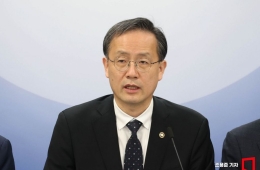
Deputy Prime Minister and Minister of Strategy and Finance Koo Yoon-chul is presiding over an urgent market situation review meeting at the Government Seoul Complex in Jongno-gu, Seoul, on the 29th. Photo by Yonhap News
View original imageOn July 29, Deputy Prime Minister and Minister of Strategy and Finance Koo Yoon-chul held an 'Urgent Market Situation Review Meeting' (F4 meeting) with relevant institutions at the Government Seoul Complex and announced this set of measures. The meeting was attended by Koo, Bank of Korea Governor Rhee Hyun-song, Financial Services Commission Chairman Lee Eogwon, Financial Supervisory Service Governor Lee Chanjin, and Blue House Chief Presidential Secretary for Economic Growth Ha Junkyung.
The participants shared a consensus that the concentration of investment funds into single-stock leveraged products has been increasing stock market volatility, and agreed to strengthen regulations. First, they will manage the size of investment in single-stock leveraged ETFs by establishing individual investment limits. One example presented was restricting the proportion of single-stock leveraged ETF investments to within 20% of an individual's total investment amount.
In addition, by referencing Hong Kong's flexible leverage management practices, the authorities plan to establish a legal basis for implementing market stabilization measures in urgent market situations. To limit excessive trading behaviors, transaction-related costs will also be increased. They plan to refer to the method of applying excess order fee charges currently used in the futures market. Furthermore, simulated trading will be introduced, in addition to the existing pre-investment education programs. These measures will be implemented immediately.
Previously, the authorities had decided to raise the minimum deposit requirement for investing in single-stock leveraged products from 10 million won to 30 million won. This measure is scheduled to take effect from July 31.
During the meeting, participants diagnosed that the recent decline in the domestic stock market was due both to weakened investor sentiment during a correction following rapid stock price increases, and to supply-demand instability. Considering strong exports of key items such as semiconductors, upward revisions of corporate earnings forecasts, and an increasing current account surplus, they assessed that the fundamentals of the Korean economy remain solid.
Hot Picks Today
 "Is This Serious? Should I Go Back to Korea?"... New U.S. Internship Guidelines Put International Students on Edge
- "Driverless" Chinese Robotaxis to Run Freely on Seoul Roads: Up to 200 Vehicles as Early as 2028
- NPS Draws the Line on ‘Additional Payment’ Controversy: “Foreigners Who Paid Contributions Cannot Be Charged Higher Hospital Fees”
- "South Korea Excels" Even Mongolians, Renowned for Good Eyesight, Flock In... Chinese Spend 57.7 Billion, Japanese 28.5 Billion on K-Medical
- Lee Jaemyung Congratulates Yong Hyein on Birth of Child... 1990-Born Nominated as Gender Equality Minister [Profile]
They also agreed on the need to guard against the spread of excessive anxiety surrounding the stock market. At the same time, given that stock market volatility in Korea is higher than in other countries, they decided to conduct a detailed analysis of its causes and to maintain the highest level of vigilance for the time being, with a 24-hour market monitoring system.
© The Asia Business Daily. All rights reserved. Unauthorized AI training and use prohibited.