"Single-Stock Leverage ETFs Are a Weapon": Investor Group Delivers Condolence Wreaths to National Assembly
Kim Yongbeom: "We Should Not Blame Leveraged ETFs for Everything"
Financial Supervisory Chief: "Lowering Leverage Ratio Would Help Reduce Volatility"
As controversy grows over losses suffered by individual investors due to the sharp declines in single-stock leveraged ETFs based on Samsung Electronics and SK hynix, a group of retail investors has sent condolence wreaths to the National Assembly, urging for these products to be abolished.

On the 29th, condolence wreaths urging the delisting of single-stock leveraged ETFs were installed near the main gate of the National Assembly in Yeouido, Seoul. Photo by Yonhap News.
View original imageOn July 29, the “Meeting for the Normalization of the Stock Market,” a group representing retail investors, delivered over 30 condolence wreaths en masse to the front of the National Assembly building in Yeouido, Seoul.
The wreaths displayed messages such as “Is investor protection just lip service?” and “Delist them.” The wreaths lined the sidewalk in front of the National Assembly, drawing citizens’ attention—many paused to read the signs or take photos.
This group is demanding the suspension of single-stock leveraged ETFs, arguing that these products have amplified the volatility of Samsung Electronics and SK hynix shares and exacerbated losses for individual investors.
Single-stock leveraged ETFs are high-risk products that track twice the daily return of their underlying assets. If stock prices decline, losses are doubled; if prices fluctuate repeatedly, the “negative compounding effect” can erode the principal invested.
Kim Yongbeom, policy chief at the Presidential Office and a key advocate for introducing these products, stated that it is not appropriate to attribute all responsibility solely to single-stock leveraged ETFs. He cited several independent factors behind the recent sharp decline in the stock market: uncertainty surrounding whether artificial intelligence (AI) investments will lead to real profits; the competitive pursuit by Chinese semiconductor companies; the high level of trading by individual investors; the growing proportion of derivatives trading; and the fact that Samsung Electronics and SK hynix account for a significant portion of the domestic market, which amplifies the impact of external shocks.

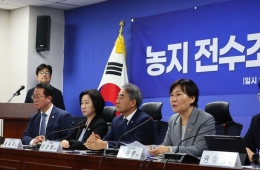
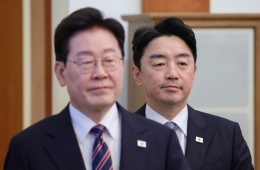
Lee Eokwon, Chairman of the Financial Services Commission, is answering questions from lawmakers at the full meeting of the Political Affairs Committee held at the National Assembly on the 29th. Yonhap News.
View original imageThe Financial Services Commission plans to raise the investment threshold for these products starting July 31, requiring individual investors who wish to buy new or additional positions in single-stock leveraged ETFs to maintain a minimum cash collateral of 30 million won.
Lee Okwon, Chairman of the Financial Services Commission, stated at the National Assembly’s Political Affairs Committee work report that lowering the existing leverage ratio from two times could help mitigate volatility. He also said the commission is considering options such as restricting new purchases to professional investors only, or setting individual investment limits.
Within the ruling party, some raised criticisms about the product design being inappropriate, but there was caution about proceeding with immediate delisting. Kim Namgeun, secretary of the special committee from the Democratic Party of Korea, said, “Rushing to discuss immediate delisting could undermine trust in the stock market,” adding, “It is likely the approach will focus on dampening the product’s appeal and reducing volatility instead.”
Lee Kangil, a member of the same party, said, “The smaller investors who put in 5 million to 10 million won tend to exhibit higher risk appetite,” and added, “If we raise the required collateral, it will put the brakes on speculative funds and foster a more rational market.” Meanwhile, lawmaker Min Byungdeok suggested that if market instability persists, “We could consider raising the required collateral to 50 million won.”
Hot Picks Today
 "I Went for the Cheap Coffee, but Now I Feel Uneasy"... Major Coffee Franchises Cited for Violations One After Another
- Did the Chinese Take All the Unemployment Benefits Too?... Foreign Workers Received a Record 113.4 Billion Won
- "3821% Returns" "Better Than Stocks": 30s and 40s Flock to the Market, Secondhand Trading Surges
- "How Did It Get Here?"... Ramen Noodle Packet Discovered 2,000 Meters Deep in the Abyss
- "Surprisingly Real, Perfect Like AI" -- Global Media Praise Korean Fencer's Beauty
Meanwhile, for the first time in history, circuit breakers were triggered for two consecutive days in both the KOSPI and KOSDAQ markets on this day.
© The Asia Business Daily. All rights reserved. Unauthorized AI training and use prohibited.