I Thought Only GPUs Were Expensive... The Surging Costs Accompanying AI Data Centers [Click e-Industry]
OpenAI to Shoulder Power Grid Costs for AI Data Centers
Oracle May Face $7 Billion in Financial Collateral Demands
AI Race Turns into a Battle of Financial Strength to Support Power Infrastructure

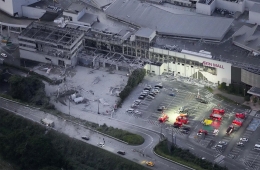
On the 18th, a woman protested against the construction of an artificial intelligence (AI) data center in Berkeley, California, USA. Photo by Reuters and Yonhap News.
View original imageThe competition for investments in artificial intelligence (AI) data centers has entered a new phase. Until now, the market's attention has primarily focused on the costs of graphic processing units (GPUs), servers, and data center construction. However, expenses related to building out power grids and providing financial collateral are now emerging as critical investment factors.
On July 30, Hana Securities analyzed in a report that the construction of AI data centers has become a battle of financial strength. It explained that it is no longer just about securing land, buildings, or chips—power plants, transmission lines, power substations, and even the capacity to provide credit guarantees have become major cost components.
On July 22 (local time), OpenAI announced “Project Camellia,” a plan to build an AI data center in Georgia that will require up to 3.2 gigawatts (GW) of power. To execute this, it signed a 25-year long-term electricity supply contract with Georgia Power and unveiled plans for power grid expansion as well.
The aspect that drew the most market attention was not the investment size but the structure of the cost burden. OpenAI emphasized that the power infrastructure costs necessary for the project would be covered by the business itself, ensuring that existing residents' electricity bills would remain unaffected. In addition, OpenAI presented plans to adopt a closed-loop cooling system, invest in the local community, and adjust power usage during peak demand times. These measures appear to address criticisms that AI data centers absorb local grid capacity and increase the burden on residents. Lee Youngjoo, a researcher at Hana Securities, explained, "AI data centers are now projects that must consider both power infrastructure and local community acceptance."
The example of Oracle goes a step further—even the management of investment risk for long-term power infrastructure has become a cost issue. Oracle is pursuing an AI data center campus in Port Washington, Wisconsin, worth about $15 billion (approximately 21.7216 trillion won). The key challenge is that the power company must build the power plant, transmission lines, and substations in advance. If the data center project is scaled back or fails, the power company could be left with massive investment losses.
To address this, regulatory authorities in Wisconsin have introduced a system requiring financial collateral from data center operators who do not meet a certain credit rating threshold. Oracle’s long-term credit ratings stand at 'BBB-' from Standard & Poor's and 'Baa2' from Moody's, both falling short of the collateral waiver threshold of 'A-'. As a result, Oracle could be required to provide up to about $7 billion in financial collateral. Researcher Lee pointed out, "This collateral is not a guarantee for the construction of the data center itself, but a credit enhancement mechanism to manage investment risk for power infrastructure built on the premise of Oracle’s long-term power demand."
The key issue is a time gap between technology and infrastructure. Power plants, transmission grids, and substations are long-term infrastructure assets used for 30 to 40 years or more. In contrast, GPUs and servers in AI data centers are upgraded every three to five years due to rapid technological change. There is no problem as long as demand for AI continues to increase, but if the pace of investment slows or if projects are scaled back, the long-term power infrastructure remains.
To mitigate this risk, power companies and regulators are introducing financial collateral requirements, minimum usage obligations, and separate rate plans for large customers. This structure ensures that AI data center operators share a portion of the investment risk associated with power infrastructure.
Hot Picks Today
 "Who Would Buy an 'Ugly' Car?" Despite Harsh Reviews, All $920,000 Ferraris Already Sold Out
- "Down 17% — 'This Is Too Much'... Frustrated Shareholders Enter Politics Themselves"
- "Betrayal in a Cup of Iced Coffee"... Even 7,500 Won Coffee Not Spared from 'Contaminated Ice'
- "My Money Is Melting Away... Government Blamed for Turning Stock Market Into a Playground for Foreign Investors Amid Market Crash"
- "Licking a Straw Changed His Life: The Consequence for a 19-Year-Old's Vending Machine Prank"
Ultimately, the scope of investment in AI data centers is expanding. Researcher Lee noted, "Whereas GPUs, servers, sites, and construction costs were once the core, now expenses for building out the power grid, financial collateral, and minimum usage obligations are all part of the capital costs. As the demand for AI data center construction projects continues, such cost and risk-sharing structures are likely to expand further."
© The Asia Business Daily. All rights reserved. Unauthorized AI training and use prohibited.