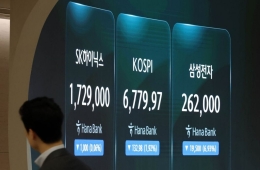
[Good Morning Market] Ongoing AI Concerns in U.S. Markets... When Will the Korean Market Hit Bottom?
Sector Rotation in U.S. Markets: Semiconductors Down, Consumer and Software Stocks Up
Key Focus: Will the KOSPI Rebound After Sharp Decline?
"KOSPI Valuation Nears All-Time Lows"
![[Good Morning Market] Ongoing AI Concerns in U.S. Markets... When Will the Korean Market Hit Bottom?](http://www.asiae.co.kr/news/img_view.htm?img=2024013100381948931_1706629099.jpg)
The major indices of the U.S. stock market ended mixed. While cyclical stocks rebounded on expectations that geopolitical risks in the Middle East would ease, semiconductor stocks remained sluggish due to persistent concerns about continued investment in artificial intelligence (AI). Attention is now on whether the KOSPI, which has plunged for several consecutive days and seen its forward price-to-earnings ratio (PER) drop to around 5 times, will stage a rebound.
On July 28 (local time), the S&P 500 index rose 0.21% to close at 7,428.78. The tech-heavy Nasdaq Composite Index fell 0.22% to 24,876.91. The Dow Jones Industrial Average ended up by 1.03% at 52,747.32 compared to the previous session.
The market is being interpreted as a rotation out of semiconductor stocks. Among Dow index components, Coca-Cola and paint manufacturer Sherwin-Williams both reported strong quarterly earnings, rising 5% and 8.3%, respectively. Software stocks, which had previously underperformed—such as Salesforce (4.6%), Accenture (6.9%), FactSet (6.8%), Adobe (4.8%), and ServiceNow (4.8%)—also showed strong gains.
In contrast, semiconductor stocks continued to decline. Micron Technology fell 8.9%, Marvell Technology slipped 7.8%, Intel dropped 5.9%, and Qualcomm lost 4.2%. SK hynix American Depositary Receipts (ADR) also continued their decline, dropping by 8.98%. The Philadelphia Semiconductor Index fell 4.5%, marking a fourth consecutive session of losses.
International oil prices appeared to stabilize somewhat. After falling for three consecutive days, West Texas Intermediate (WTI) crude futures closed at $79.26 per barrel, staying below the $80-per-barrel mark. Brent crude futures also dropped 4.8% compared to the previous session, closing at $84.09 per barrel.
Market watchers are paying close attention to whether the KOSPI, which plunged over 10% the previous day, will rebound. Factors cited as potential positives include inflows of bargain hunting, expectations of negotiations between the U.S. and Iran, and eased caution regarding this month’s Federal Open Market Committee (FOMC) meeting of the U.S. Federal Reserve. Analysts believe that the overnight steep fall in U.S. semiconductor stocks already had a limited impact, as the KOSPI’s sharp drop the previous day may have already factored in this risk.
However, there are also views that caution is still warranted, since the MSCI Korea Index Exchange-Traded Fund (ETF), which is closely linked to the domestic market, fell 6.05%. In the short term, whether or not the KOSPI can maintain support at its 200-day moving average, around 5,600 points, is expected to be a key factor.
Hot Picks Today
 "30,000 Won in Korea, 70,000 Won in Japan"—Koreans Fill Suitcases as Illegal Direct Purchases Soar
- "SK hynix Is Our Target"... Japanese Firm Bets 7 Trillion Won as Germany Competes for Investment [AIDC Era of Coexistence] ⑪
- Body Presumed to Be Jang Miran, Linked to 'False Missing Person Case Closure,' Found in Jeju
- Why Did the Park Wi KTX Fall Incident Escalate? Reasons Behind Involvement of Train Operator and Parents of Children with Disabilities
- "Monster That Eats Gold" Turns Out to Be Real: Uproar in China as 5-Year-Old Swallows $7,500 Gold Bar, Sparking Questions About Family's Wealth
Han Ji-young, a researcher at Kiwoom Securities, explained, “The KOSPI’s 12-month forward PER is at a historic low of 5.1 times, and even factoring in a 27% downward revision of earnings estimates to financial crisis levels, the forward PER would only be 7.0 times. Since valuations are entering bottom territory, the catalysts for a rebound may include whether leading stocks like Samsung Electronics and SK hynix can restore earnings credibility, and whether the influence of leverage in individual stocks continues to diminish.”
© The Asia Business Daily. All rights reserved. Unauthorized AI training and use prohibited.