"K-shaped Polarization Worsens"... Next Year's Standard Median Income to Rise by Record 6.7% (Comprehensive)
The "standard median income," which serves as the eligibility benchmark for various welfare programs, will see its largest-ever increase of 6.7%, reaching 6,929,885 won for a four-person household. The amount of basic livelihood benefit that recipients will receive monthly is set at 2,217,563 won. The government has overhauled its calculation method for the first time in six years, aiming to more realistically reflect both income growth and the minimum living expenses required.

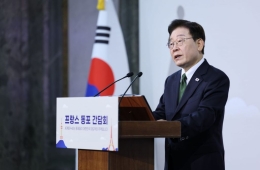
Jung Eunkyung, Minister of Health and Welfare, is speaking at the 80th Central Welfare Committee meeting held at the Government Seoul Office in Jongno-gu, Seoul, on the 28th. Photo by Yonhap News Agency
View original imageThe Ministry of Health and Welfare announced on the 28th that the Central Welfare Committee had decided to raise the standard median income for a four-person household from this year’s 6,494,738 won to 6,929,885 won for next year—an increase of 6.7%. For single-person households, the standard median income will rise from 2,564,238 won to 2,736,042 won, an increase of 171,804 won.
The standard median income represents the median value of household incomes in Korea and is used as the criterion for 80 types of welfare benefits, including the livelihood benefit under the National Basic Livelihood Security System. It is announced by the Minister of Health and Welfare following approval by the Central Welfare Committee. As in previous years, households with an income below 32% of the standard median income (2,217,563 won per month) qualify for the basic livelihood benefit.
The standard median income was increased by 5.02% in 2022, 5.47% in 2023, 6.09% in 2024, 6.42% in 2025, and 6.51% this year. The government has decided on increases in the 6% range for three consecutive years, citing a deterioration in the living conditions of low-income households. The average monthly deficit for households in the bottom 20% expanded from 438,000 won in the fourth quarter of last year to 519,000 won in the first quarter of this year. The proportion of households running a deficit also rose from 58.7% to 62.5% over the same period.
As of 2024, the disposable income of the top 20% of households was 5.78 times that of the bottom 20%. In the first quarter of this year, the disposable income growth rate was 5.1% for the top 20%, compared to just 1.9% for the bottom 20%.
An official from the Ministry of Health and Welfare stated, "There is a growing need to actively address recent deepening poverty and K-shaped polarization. With this decision, the maximum basic livelihood benefit will rise by about 55,000 won for single-person households and about 140,000 won for four-person households, which is expected to help improve the living standards of low-income groups."
The standard median income determined today was set according to the new calculation method that will be applied from next year. Until the standard median income for 2026, which was decided last year, the amount was calculated using two factors: the “base growth rate,” which is the average annual growth rate of the median income over the past three years according to the Household Finance and Welfare Survey, and a separately determined “additional growth rate.” The additional growth rate had been temporarily applied only for six years, with the last application at last year's Central Welfare Committee meeting.
At today’s committee meeting, it was decided to retain the current base growth rate for calculating the standard median income, but also to allow adjustments reflecting other key socio-economic indicators, such as the latest consumer price index and real economic growth rate (GDP), to address issues of volatility and time lag in the Household Finance and Welfare Survey’s median income. In addition to statistical adjustments, further modifications to the growth rate may be made to mitigate relative poverty, ensure the adequacy of basic livelihood benefits, and consider the state's fiscal conditions. The committee plans to use this new calculation method for the next three years.
Hot Picks Today
 "I'm Scared, Please Don't Go to Japan Right Now"... Tourists on High Alert as Deaths Occur and Trains Halt
- "Receiving 3.8 Billion Won and Claiming 'High Pay Prevents Bribes'... The Country with the World's Top-Paid Prime Minister Plans 64% Salary Hike"
- "Works at a Major Corporation and Wins the Lottery Too"...Is the 1.2 Billion Won Prize Claim by 30s Employee Real?
- "Hardly Eating, Only Napping After the Ordeal"...Cats Felt 'Fear' During Kumamoto Earthquake
- "Over 300 People Gathering to Read in Nightclubs? Why the World Is Embracing Social Reading, Even If It's Just for Show"
A Ministry of Health and Welfare official explained, "The consumer price index and GDP were chosen as indicators because they can reflect up-to-date economic conditions in determining next year’s standard median income. By specifying and using these major socio-economic indicators for adjustment, both consistency and predictability have increased."
© The Asia Business Daily. All rights reserved. Unauthorized AI training and use prohibited.