AI Capabilities to Be Added to 18,000 Public CCTVs: Transitioning to NPU-Based Systems
Ministry of Science and ICT Selects Gyeongsangnam-do, Ulsan, and Korea Expressway Corporation
Rebellions, DeepX, and Mobilint NPUs to Be Introduced

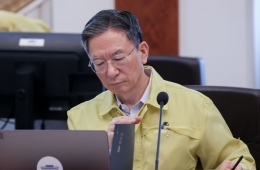
Baek Gung-hoon, Deputy Prime Minister and Minister of Science and ICT, is speaking at the joint public-private meeting of the National Growth Fund 'K-NVIDIA Project' held at the Press Center in Jung-gu, Seoul on March 17, 2026. Photo by Jo Yongjun
View original imageThe initiative to upgrade over 18,000 public CCTVs with artificial intelligence (AI) capabilities is now underway.
The Ministry of Science and ICT, along with the National Information Society Agency (NIA), announced on July 28, 2026, that they will pursue the "AI CCTV Transformation Project based on Domestic NPU," which aims to convert public CCTVs to AI using neural processing units (NPUs) developed in Korea.
An NPU is a semiconductor chip designed to efficiently process AI computations by mimicking the human brain's neural network. This project marks the first large-scale introduction of NPUs into public CCTV monitoring sites. The Ministry of Science and ICT plans to deploy NPUs to a total of approximately 18,100 CCTVs this year, with a total investment of 11.68 billion won.
Through a public call for participation, the ministry selected Gyeongsangnam-do, Ulsan Metropolitan City, and Korea Expressway Corporation as the initial recipients. Each institution will introduce NPUs developed by Rebellions, DeepX, and Mobilint into their CCTV control centers to support tasks such as accident prevention and response.
Specifically, Gyeongsangnam-do will use the system to quickly detect and respond to natural disasters like wildfires and floods; Ulsan plans to utilize it for preventing industrial zone safety incidents and enhancing public security; Korea Expressway Corporation aims to use it for automated detection of traffic accidents and congestion on highways, and to offer a safer road environment.
By installing NPUs in the servers of CCTV control centers, AI models will be able to analyze video feeds from each camera in real time, enabling prompt detection and notification to operators so that immediate responses can be taken at each center.
For example, in the past, even if the monitoring system detected potential wildfires or floods, personnel still needed to visually check the footage and make their own determination. With the introduction of NPUs and AI software specialized in video analysis, the system will be able to automatically generate detailed sentences such as "The road in the OO area is heavily flooded due to the flood, and immediate vehicle access control is required," enabling operators to respond swiftly to real-time developments.
Going forward, the Ministry of Science and ICT intends to continue this effort by selecting demand institutions such as local governments and public agencies every year, and supporting the adoption and AI transformation of public CCTVs with NPUs.
Hot Picks Today
 "30,000 Won in Korea, 70,000 Won in Japan"—Koreans Fill Suitcases as Illegal Direct Purchases Soar
- "Will Burst Within 3 Years, Gather Gold and Bitcoin"…World's Largest Hedge Fund Founder Warns
- In Korea, It's a Beloved Side Dish... But Miami Spends $4.1 Million to Remove 9,000 Tons from Its Beaches
- "Only 400m from Accommodation": Body Believed to Be Jang Miran Found After 104 Days, Sparking Investigation Negligence Controversy
- Homeless Man with Necrotic Leg Refusing Help Opens Up to Police After Two Months of Consistent Visits
Hong Seongwan, Director-General of Information and Communication Policy at the Ministry of Science and ICT, stated, "Through this project, we hope that the large-scale deployment of NPUs to public CCTVs will make it possible to respond more quickly and broadly at disaster and accident sites."
© The Asia Business Daily. All rights reserved. Unauthorized AI training and use prohibited.