From the Secrets of Memory to Underwater CO₂: Government to Boost Eight Key 'Boundary-Challenging R&D' Projects
Ministry of Science and ICT Holds 'Boundary-Challenging ASTRA DAY'
Collaboration with Samsung and Commercialization Agencies to Accelerate Outcome Dissemination
Strengthening Commercialization of Future Technologies
Including Quantum Communication, Extreme Climate Prediction, and PFAS Alternative Materials
Research that uncovers the principles behind storing and altering memory; technology that converts underwater carbon dioxide (CO₂) into a resource; and techniques for generating single photons for quantum communication at room temperature—these are among the eight 'Boundary-Challenging Research & Development (R&D)' projects aimed at future industries, whose outcomes the government is now working to disseminate more widely.
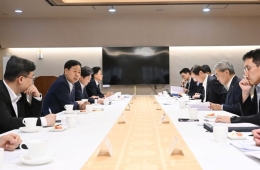
The Ministry of Science and ICT and the National Research Foundation of Korea announced that on the 28th in Seoul, they held the 'ASTRA DAY for Boundary Challenges,' bringing together the Samsung Electronics Future Technology Fostering Center, the Korea Technology Commercialization Promotion Agency, and the researchers from the Boundary-Challenging R&D program to discuss strategies for further support and commercialization of pioneering research.

The Boundary-Challenging R&D initiative is a flagship program of the Ministry of Science and ICT, where specialized program managers design and closely supervise high-risk, high-reward research projects that have low probability of success but potentially great impact.
The ongoing research spans eight projects across the fields of bio, materials, and climate & energy. Topics include elucidating the mechanisms of memory storage, transformation, and recovery; developing mental health platforms; creating single photons for room-temperature quantum communication; materials for replacing perfluoroalkyl substances (PFAS) in lubrication coatings; and harnessing next-generation magnetic materials such as 'altermagnets.' Additional initiatives cover carbon cycling technologies using underwater CO₂, AI-based predictions of extreme weather events, and producing carbohydrates from CO₂ and electricity.
Challenging Research, Linked to Technology Transfer and Startups
At the event, public-private collaboration measures were also discussed to connect R&D outcomes to technology transfer and startups. The Samsung Electronics Future Technology Fostering Center introduced support cases for innovative research and suggested collaborations with outstanding projects, while the Korea Technology Commercialization Promotion Agency shared technology validation, follow-up R&D, technology transfer, and startup support programs.
The Ministry of Science and ICT plans to use this event to strengthen cooperation among the Samsung Electronics Future Technology Fostering Center, the Korea Technology Commercialization Promotion Agency, and the Boundary-Challenging Strategy Center at the National Research Foundation of Korea, with the goal of expanding support so that excellent research results can lead to further studies and successful commercialization.
Hot Picks Today
 "This Is the First Time in 38 Years"... Real-Time Situation Unfolds at U.S. Airports
- "Monthly Salary Exceeds 10 Million Won"... The Top Job in Japan Even Doctors Envy
- "The Real Risk Lies in the Next Week"...Flights Continue to Depart for Kumamoto Despite Seismic Intensity 7 Aftershock Warning
- "Crying Over Apartments, Smiling Over Semiconductors... Diverging Fortunes for Top Construction Firms" (Comprehensive)
- "Bring a Friend and Get 1.18 Million Won"... Dubai Starts Offering Cash Incentives Amid Tourism Slump
Gu Hyukchae, First Vice Minister at the Ministry of Science and ICT, said, "As Boundary-Challenging R&D projects have entered the intermediate stage, we will strengthen connections with follow-up support initiatives from both the private and public sectors, so that researchers can develop technologies with the dissemination of their outcomes in mind. We will actively support challenging research so it can lead to the creation of new industrial and social value."
© The Asia Business Daily. All rights reserved. Unauthorized AI training and use prohibited.