"Signals Needed for Quality Redevelopment and Reconstruction Supply"... Real Estate 2nd Debate Expected to See Rising Government Criticism
Chaired by Prime Minister Han Seongsook
Over 100 participants including FSS officials, experts, and the public
Key Issues: Property Holding and Capital Gains Tax Reform
Critical Voices Expected on Government Policies
Attention on Potential Additional Supply Measures
The second National Public Debate on real estate policy, covering topics such as tax reforms, will be held in the afternoon on July 27th, 2026. The debate aims to further discuss key issues that were not concluded in the first forum, such as revisions to property holding and capital gains taxes, and regulations on loans for genuine homebuyers. Opinions shared on tax policy are expected to be reflected in the upcoming tax reform proposals to be announced soon.

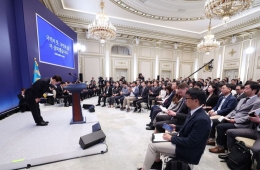
On the 23rd, participants are requesting to speak at the National Public Debate on Real Estate Policy, presided over by President Lee Jae-myung, held at the KBS Annex in Yeouido, Seoul. Photo by Yonhap News Agency
View original imageAccording to the government and related agencies, the debate will be chaired by Prime Minister Han Seong-sook and attended by officials from the Financial Supervisory Service, Korea Land & Housing Corporation, Korea Real Estate Board, Korea Housing & Urban Guarantee Corporation (HUG), as well as experts including Kwon Dae-jung, Professor at Hansung University; Kim In-man, head of the Real Estate Economic Research Institute; Song Seunghyun, CEO of Urban & Economy; and 45 members of the general public, including university students. In total, around 100 people are expected to participate.
Notably, experts invited to this forum, including Professor Kwon, CEO Kim, and CEO Song, are known for their candid criticism of the current administration's real estate policies. This has fueled speculation that the government is mindful of criticism that these debates could be mere formalities.
At last week’s debate presided over by President Lee Jae-myung, repeated calls were made for relaxing regulations, particularly in the supply sector. There were proposals to ease lending regulations for developers and to exclude non-apartment properties from the housing unit count in order to boost the supply of non-apartment housing. Key suggestions also included expanding relocation loans and increasing floor area ratios to revitalize private redevelopment projects, and more proactive development of semi-industrial zones. However, compared to supply-side arguments, calls for strengthening tax policies were more prominent. Topics included how to define the threshold for ultra-high-priced homes, as well as arguments to restrict tax exemptions. President Lee commented, “It is generally agreed that we should strengthen the property tax, but what matters is the specific scope, the degree of increase, and any gradations that may apply.”
The debate chaired by Prime Minister Han is expected to focus on the detailed design of tax reforms, including criteria for categorizing ultra-high-priced homes, region- and residency-based tax reductions, the extent of deductions for property tax, the level and grace period of capital gains tax relief, and more. The government is considering further subdividing property tax rates. The plan would establish a three-tier tax burden system based on the basic deduction threshold and the ultra-high price standard: a group exempt from the comprehensive real estate tax as is currently the case, an intermediate group carrying a moderate burden, and an ultra-high-priced group facing increased taxation. The standard for ultra-high-priced homes is being discussed in the range of 3 to 5 billion won in market value. The intermediate group would likely see either a maintained or gradually increasing burden.
Experts attending the debate are expected to voice critical opinions on these proposals. In addition, it will be worth watching to see whether alternative supply measures, which have received less attention, are proposed. In a phone interview with The Asia Business Daily, Professor Kwon Dae-jung said, "The market can only be stabilized by increasing supply. For young people and newlyweds, buying a non-apartment home makes them ineligible for the apartment lottery, while those owning a home would become multi-property owners and thus are unlikely to buy. I don’t see how the government plans to actually increase non-apartment housing." He added, "I will argue that small non-apartment units should be excluded from the official housing count."
CEO Song Seunghyun said, "The issue is not just how much supply there is, but what type of housing is supplied and where. There needs to be a signal that redevelopment and reconstruction can result in higher-quality supply, which in turn would stabilize housing prices," and added that he intends to propose reasonable adjustments to the land transaction approval system to ensure smooth transaction circulation as well as supply planning.
The online forum set up by the government for the debate continues to receive public opinions as of today. One commenter emphasized, "We need rationalization of regulations to encourage private redevelopment and reconstruction. Recovery of development profits should be unified under general tax categories such as property holding and capital gains tax."
Hot Picks Today
!["How Little Do Koreans Read? Who Will Acquire Munhakdongne Now on the Market [Weekend Money]"](https://cwcontent.asiae.co.kr/asiaresize/93/2026091716280432990_1789630084.jpg) "How Little Do Koreans Read? Who Will Acquire Munhakdongne Now on the Market [Weekend Money]"
"How Little Do Koreans Read? Who Will Acquire Munhakdongne Now on the Market [Weekend Money]"
- "Bank Offers 3.5%, but... Which ETF Hit a 21% Dividend Yield? [Weekend Money]"
- "Why Would You Boast About That?" Blocked From Departure Over Endangered Turtle Hunting Allegation After Social Media Video
- "Please Be Quiet"... China to Fine Up to 210,000 Won for Disruptive Passengers Using Speakerphones
- "Dream Shattered in an Instant": Sudden Clampdown by "This Country" Amid Ongoing Preparations
Opinions from various sectors are also expected to pour in on loan regulations. The finance sector received the most proposals in the online consultation. Calls have continued to relax loan restrictions for genuine buyers such as young people and newlyweds to lessen their burden in purchasing homes. Additionally, easing relocation loans to facilitate reconstruction is expected to be discussed. On the forum today, one user said, "If the standard price for a house in northern Seoul is 300 million won, the relocation loan is 180 million won. But if you subtract the loan and the key money deposit, actual relocation becomes impossible, so further relaxation is necessary."
© The Asia Business Daily. All rights reserved. Unauthorized AI training and use prohibited.