Including Hangul on Gwanghwamun Signboard Divides Opinion... 8 Out of 10 Support "Maintaining Original Form"
First “Everyone’s Debate” with Over 200 Citizens
104 Support Dual Signboards, 101 Oppose
155 Agree with Alternatives Such as Exhibitions and Digital Content
Approximately 200 members of the public held an open discussion on whether to display both the existing Chinese character signboard and a Hangul signboard at Gwanghwamun, but opinions were sharply divided. However, about 8 out of 10 participants agreed with the view that the current signboard, which has been restored based on historical research, should be maintained, and that the value of Hangul can be promoted through other methods such as exhibitions or digital content.

Culture, Sports and Tourism Minister Hwee-young Choi is giving a greeting at the "Should the Gwanghwamun Signboard Include Hangul? A Discussion for Everyone" held on the 26th at Baekyang Nuri Hall, Yonsei University, Seodaemun-gu, Seoul. Photo by Yonhap News
View original imageThe Ministry of Culture, Sports and Tourism and the Ministry of the Interior and Safety held the first "Everyone's Forum" on the topic of displaying a Hangul signboard at Gwanghwamun on the 26th at Baekyang Nuri Hall, Yonsei University, in Seodaemun-gu, Seoul. About 200 citizens, who were pre-selected considering gender, age, and regional population distribution, as well as experts in history, cultural heritage, Hangul, and urban landscape, participated in expert presentations, panel discussions, and small group discussions.
In the survey conducted after the discussion, 104 respondents agreed and 101 opposed the statement, "Keeping the Chinese character signboard and adding Hangul together allows both the cultural heritage value and the symbolism of Hangul to be preserved." The difference between support and opposition was only three people.
In contrast, 170 respondents agreed (107 "strongly agree," 63 "agree") with the statement, "It is desirable for cultural heritage to be kept as it was restored based on historical evidence." This accounts for about 83% of the 205 total respondents. Additionally, 155 agreed and 49 opposed the view that "it is sufficient to promote the value of Hangul through exhibitions, events, or digital content, even if a Hangul signboard is not installed."
There was little change in participants' opinions before and after the forum. In the item on preserving the original form, the number of "agree" responses decreased from 64 to 63, while "disagree" increased from 23 to 24; nonetheless, strong opinions remained unchanged. For the item on the addition of the Hangul signboard, support (104 people) and opposition (101 people) remained virtually identical to the pre-discussion distribution.

Minister of Culture, Sports and Tourism Hwee-young Choi (left) and Minister of the Interior and Safety Hojung Yoon are entering the "Should Gwanghwamun Signboard Include Hangeul? Everyone’s Discussion" held on the 26th at Baekyang Nuri Hall, Yonsei University, Seodaemun-gu, Seoul. Photo by Yonhap News Agency
View original imageSupporters argued that Gwanghwamun is not only the main gate of Joseon's main palace but also now serves as a national symbol of South Korea, and that its contemporary identity, represented by Hangul, should also be reflected. Hyunmo Park, head of the Sejong Institute of National Governance, proposed including the Hangul signboard, stating, "We are not trying to erase existing cultural heritage, but to create future value."
Jaehwan Jung, co-representative of the Hangul Culture Solidarity, cited the glass pyramid at the Louvre Museum in France as an example of coexistence between tradition and the modern age and said, "Adding a Hangul signboard will clarify Korea's identity."
Opponents countered that the issue of Hangul’s value and the installation of the signboard should be addressed separately. Hyunkyung Kim, professor of National Heritage Management at the Korea National University of Cultural Heritage, argued, "The intent to add new meaning cannot be sufficient grounds for altering the shape of cultural heritage," and suggested using exhibitions, explanations, or education as alternatives to a signboard.
Woongkyu Bae, professor of Urban Systems Engineering at Chung-Ang University, also pointed out that adding a Hangul signboard could unnecessarily create conflict between the authenticity of the cultural heritage and the symbolism of Hangul. Regarding the Louvre example, Professor Kim countered, "The construction of the glass pyramid did not alter the appearance of the Louvre Palace," stating that this is fundamentally different from the installation of a Hangul signboard at Gwanghwamun.

On the 26th, at Baekyang Nuri Hall, Yonsei University, Seodaemun-gu, Seoul, the results of the on-site survey were announced during the forum titled "Should Gwanghwamun Signboard Include Hangul? A Discussion for Everyone." Photo by Yonhap News
View original imageDuring the citizen discussions, divided into 21 groups, alternative suggestions emerged, such as utilizing drone shows, LED and media façades, permanent exhibitions, and digital information content, in addition to installing a Hangul signboard. There was also a proposal to revive the function and meaning of the historical Jiphyeonjeon (Hall of Worthies) in a modern context to further highlight the symbolism of Hangul.
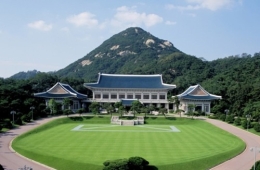
The current Gwanghwamun signboard features Chinese characters written by Training Commander Im Taeyoung in 1865, during the reconstruction of Gyeongbokgung Palace. In 1968, a Hangul signboard with the handwriting of former President Park Chung Hee was installed during the reconstruction of the gate in concrete, but in 2010, with the restoration of the wooden Gwanghwamun, it was replaced with a Chinese character signboard featuring black characters on a white background. In 2023, based on historical research, a new signboard with gold lettering on a black background was installed.
This survey was not a final vote to determine whether or not to install the signboard, but rather a process to gather public opinion for policy development. The Ministry of Culture, Sports and Tourism plans to comprehensively review the opinions and survey results from the forum and reflect them in future policy decisions.
Choi Hwee-young, Minister of Culture, Sports and Tourism, said, "This discussion is an opportunity to see how today’s citizens view the historic significance of Gwanghwamun and the symbolism of Hangul and Chinese characters."
Hot Picks Today
 "Surviving on One Meal a Day to Invest 3.5 Million Won Monthly... 'FIRE' Craze Sparks 'NISA Poverty' in Japan"
- "As Soon as Yong Hyein Was Nominated... After a 195% Surge, This Stock Suddenly Plunged"
- "1,000% of Base Salary Allowed, But Not 10% of Operating Profit?"... Growing Controversy Over Performance Bonus Criteria [Why&Next]
- "Almost Got Caught for a Finger Gesture"... North Korean MZ Generation Enthralled by the 'Korean-Style Finger Heart'
- "Why Buy a House When You Can Buy Stocks?"... 1.2 Million More Young and Rich Renters in the US Over 10 Years
Yoon Ho-jung, Minister of the Interior and Safety, stated, "This forum is a space for public debate where citizens and experts can discuss and deliberate together to create better policies," adding, "Since Gwanghwamun is a space that symbolizes the history and identity of South Korea, a variety of perspectives is to be expected."
© The Asia Business Daily. All rights reserved. Unauthorized AI training and use prohibited.